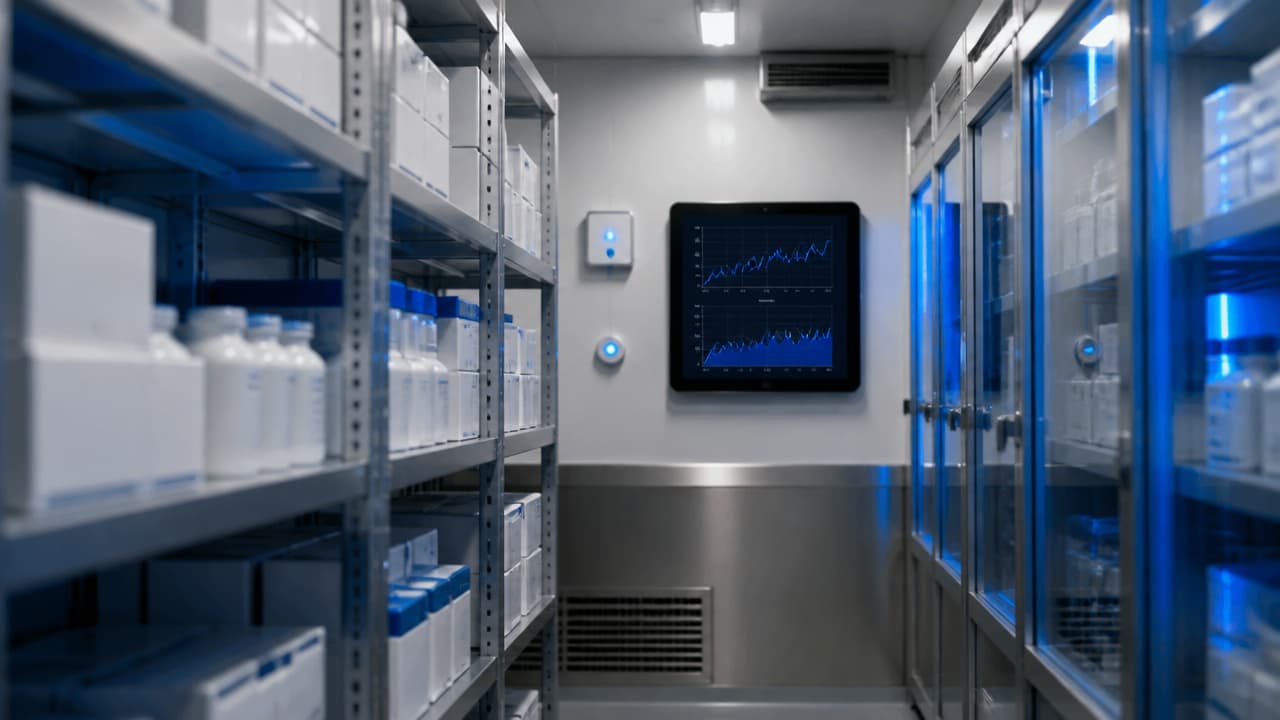
Pharmaceutical storage begins to degrade long before a product is discarded. In practice, the problem appears first in the environment: unstable temperature, persistent humidity, seal failures, and indirect signals that go unnoticed in manual routines. For quality, logistics, and pharmaceutical operations teams, recognizing these indicators early is what separates a simple correction from a critical loss.
The seven signs below help identify when the environment has stopped protecting the inventory as it should. More than listing symptoms, the goal is to show what each one reveals about real risk, how to prioritize response, and where solutions with continuous monitoring and AI, like DROME's, gain value.
Highlights that deserve immediate attention
- Repeated oscillation matters more than an isolated spike, because it indicates loss of process control.
- Humidity and condensation usually appear before visible product loss.
- Altered packaging is a sign of inadequate environment, even when the contents still appear intact.
- Seal failure, power loss, or air circulation failure creates cumulative risk, not just a one-time event.
- Frequent alerts without treated cause show operational fragility and require root cause investigation.
1. Frequent temperature oscillations show loss of environmental stability
When temperature rises and falls several times a day, the inventory is already exposed to a risk condition. The problem is not just exceeding the specified range, but repeating micro-deviations that accumulate thermal stress over time.
This signal usually appears in chambers with excessive door opening, poorly positioned sensors, undersized refrigeration, or delayed maintenance. In temperature-sensitive medications, the consequence can be silent: the lot remains visually normal but loses safety margin.
That's why the most useful indicator is not just the maximum value. It's the complete curve: frequency, duration, and timing of deviations. DROME solutions combine continuous telemetry with pattern analysis to highlight anomalies before behavior becomes an incident.
2. Humidity outside the range accelerates degradation of packaging and supplies
Persistent humidity is one of the most underestimated signals in pharmaceutical storage. Even without reaching extreme levels, it can degrade boxes, labels, package inserts, seals, and sensitive product components.
In routine operations, this appears as wavy paper, peeling labels, softened boxes, and a stuffy feeling in closed areas. In solid forms, powders, and hygroscopic materials suffer more. In refrigerated areas, the combination of cold and humidity also favors surface condensation.

The critical point is that humidity rarely acts alone. It almost always points to ventilation imbalance, poor sealing, door open beyond ideal time, or chronic condensation. If the sensor records a rising trend at specific times, there's already an operational pattern to correct.
3. Visible condensation indicates that environmental control has already failed
If there are droplets on surfaces, doors, pipes, or shelves, the environment has passed the alert stage and entered concrete failure. Condensation is a clear symptom of poorly managed thermal difference and humidity without effective control.
Beyond wetting packaging, this phenomenon favors corrosion, mold in peripheral areas, and damage to electrical components. In many storage facilities, condensation first appears at door edges, in chamber corners, and near air outlets.
It's a mistake to treat this signal as mere operational discomfort. Repeated condensation usually reveals that infrastructure is operating out of balance. Without correction, the problem becomes recurring and increases the chance of cascading losses.
4. Packaging alterations reveal environmental stress before product deviation
Deformed packaging, peeling label, opaque blister, or box with humidity marks are practical alerts that the environment is not preserving the inventory as it should. Often, the packaging signals the problem before any quality test on the contents.
This signal is valuable because it can be observed at receipt, separation, and internal audit. When alterations appear across different lots or warehouse points, it's worth investigating temperature distribution, air circulation, and proximity to cold walls or external areas.
Mature teams treat packaging as a passive environmental sensor. The gain is simple: anticipate investigation before deviation reaches the product, internal customer, or patient.
5. Odors, particles, and excessive dust show the area has lost control
Clean enough environment to leave no doubt is the expected standard in pharmaceutical operations. When unusual odors, recurring dust, visible particles, or stale air sensation appear, the inventory may be in an area with inadequate filtration, sealing, or cleaning routine.
This type of degradation is important because it expands cross-risk. It's not just about appearance. Accumulated dust interferes with sensors, obstructs ventilation, favors incorrect readings, and complicates visual inspection. Odors can also indicate infiltration, damp material, or problems in the operation's surroundings.
If the team perceives this signal recurrently, the response should not be just cleaning. It's necessary to confirm origin, frequency, and impact on the inventory's microenvironment.
6. Recurrent seal, power, or refrigeration failures increase cumulative risk
Door that won't close properly, worn gasket, equipment that defrosts outside standard, and brief power drops are signs of environmental degradation, even when the alarm doesn't always trigger. The risk is in accumulation.
In critical operations, small events add up and create invisible exposure. Poor sealing can raise humidity. An electrical oscillation can affect the compressor. Irregular defrost can generate condensation. Each deviation feeds the next.
That's why maintenance and quality need to view the system as a cause-and-effect chain. When analysis stays limited to isolated equipment, the operation loses the chance to prevent recurrence.
7. Increase in alert volume shows the process has become reactive
Many alarms don't mean more control. Generally, they mean the environment has become unstable and the team has started responding after the problem. If the same alerts reappear at similar times, assets, or zones, there's a clear pattern of operational degradation.
This is when monitoring stops being enough. It's necessary to interpret context, correlation, and trend. AI-powered platforms can cross-reference history, seasonality, and equipment behavior to point out risk before the next alarm, which reduces response time and prevents lot loss.

In practice, this is the shift between reactive operation and data-driven prevention. It's precisely at this layer that DROME's proposal stands out: transforming environmental monitoring into predictive decision-making for critical environments.
How to prioritize response when signs appear
The best approach is to classify risk by potential product impact and event repetition. Visual signals without sensor history warrant quick verification. Visual signals combined with recorded deviation require immediate action.
| Signal observed | What it suggests | Priority |
|---|---|---|
| Frequent temperature oscillation | Loss of process stability | High |
| Persistent humidity | Inadequate ventilation or sealing | High |
| Visible condensation | Environmental failure in progress | Critical |
| Altered packaging | Accumulated exposure | High |
| Odors or particles | Loss of area control | Medium to high |
| Seal or power failures | Growing systemic risk | High |
| Recurrent alerts | Reactive and unstable process | Critical |
A mature response usually follows four steps:
- isolate the lot or potentially affected area
- measure duration, frequency, and intensity of the deviation
- evaluate root cause, not just correct the symptom
- adjust monitoring to prevent recurrence
Frequently asked questions
What signs indicate environmental risk in pharmaceutical storage?
The most common signs are temperature oscillations, humidity outside range, condensation, odors or particles in the environment, packaging changes, recurrent power or seal failures, and increased alerts with no apparent cause. When they appear together, the risk of stability loss rises rapidly.
How does temperature affect the quality of stored medications?
Inadequate temperature accelerates chemical reactions, alters stability, compromises excipients, and reduces product shelf life. In temperature-sensitive items, small repeated variations can already cause performance loss, even without immediate visual change.
Can high humidity compromise pharmaceutical storage?
Yes. High humidity favors condensation, packaging deformation, powder caking, corrosion, and microbial growth in critical areas. Even when the product is sealed, humidity can compromise labeling, secondary boxes, and the integrity of the logistics process.
Why is continuous monitoring better than point inspections?
Continuous monitoring is more effective because it identifies trend, frequency, and duration of deviations, not just isolated events. This allows action before critical failure. Platforms with predictive analysis, like DROME's, help transform environmental data into operational prevention.
What to do when identifying an environmental deviation in storage?
The first step is to isolate the potentially exposed lot, record the deviation, verify occurrence time and intensity, and assess impact based on quality protocol. Then, the root cause must be addressed to prevent recurrence, including sensors, sealing, equipment, and operational routine.