
In the world of intelligent monitoring, few areas have advanced as much as telemetry. In recent years, I've witnessed firsthand the evolution of systems and realized that statistical analysis has shifted from being a technical detail to becoming the main driver of major changes. I want to show how this discipline underpins the differentiators most sought after by companies and how innovative solutions, like those we're developing in the DROME project, elevate the standard of risk management, failure anticipation, and operational safety.
Telemetry Beyond "Monitoring"
Anyone who has worked with monitoring systems knows: receiving an alert after a problem occurs rarely prevents losses. After all, when a temperature sensor triggers, the goods may already be compromised. I've always believed there was a better way. With advanced telemetry and statistical analysis, today we can go further, predicting deviations before they cause damage.
This is precisely the purpose of DROME Predict, our solution that incorporates modern statistical methods to anticipate real risks, minimizing losses and avoiding unpleasant surprises. For those seeking a broader introduction to telemetry, I suggest checking out the article Understanding Telemetry: The Essential Foundation for Monitoring and Observability.
The Role of Statistical Analysis
Working with continuous flows of sensor data that record everything in real time presents challenges and opportunities. Early on, I realized that collecting data is not enough; knowing how to interpret it is where the true value lies. Sensor data is sensitive to variations, noise, rapid spikes, and subtle trends.
Information only becomes useful knowledge when it passes through the filter of analysis.
I see statistical analysis fulfilling different functions in modern telemetry, especially in these areas:
-
Data cleaning and validation: Identifying and treating discrepant or missing readings, separating capture failures from real changes in the environment.
-
Pattern recognition and categorization: Detecting what is expected behavior and what is potential anomaly, spikes, or trend deviations.
-
Building predictive models: Creating mathematical ways to anticipate situations, based on the history of each sensor and equipment.
None of these processes is trivial. It requires tools capable of analyzing large volumes of data quickly and accurately. Here, statistical maturity makes all the difference, separating those who merely collect data from those who truly generate value, as we strive to do in the DROME project.
The Advantage of Predictive Analysis
Recently, I followed a case where a cold room appeared, at first glance, to operate within normal parameters. However, a more thorough analysis revealed a slow average temperature rise, a typical case of "drift." This anticipation was only possible because we applied advanced statistical techniques that go beyond traditional fixed thresholds.
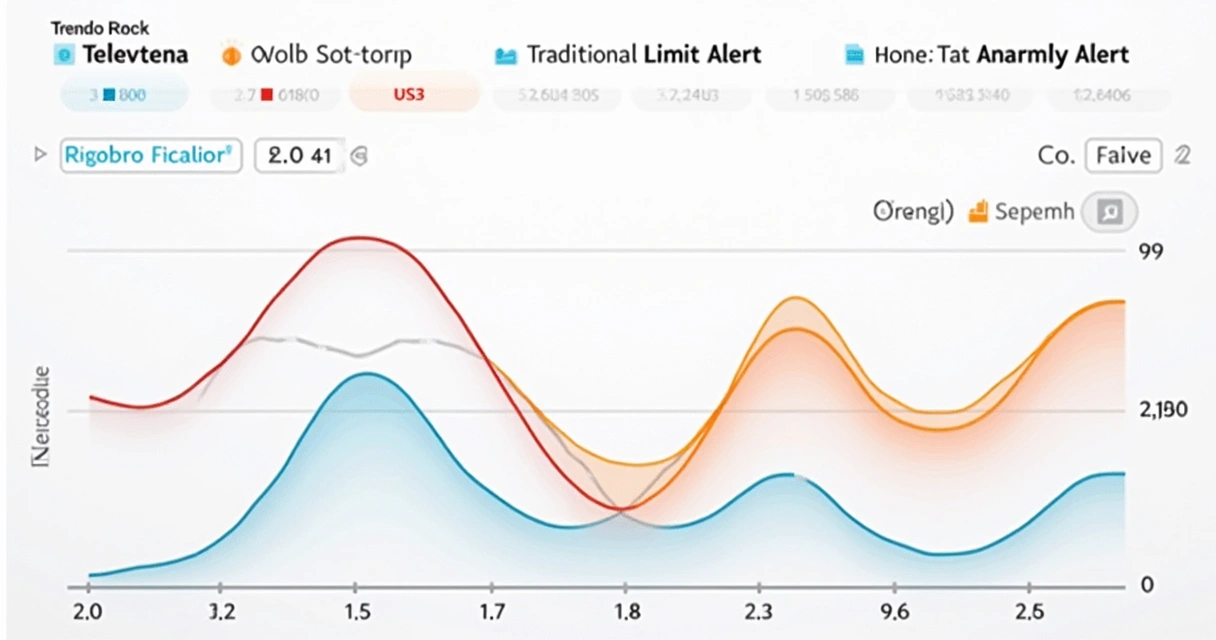
In simplified form, predictive analysis in telemetry relies on three major methods, all embedded in DROME Predict's current capabilities:
-
Spike identification: Detecting exceptional values relative to the historical pattern.
-
Drift detection: Pointing out slow and progressive changes that can prevent silent destruction of important equipment or supplies.
-
Future violation estimates: Calculating the probability that the limit will be exceeded within a predicted timeframe, triggering preventive alerts.
What's interesting is that for each monitored environment, we adjust the statistical methods according to the client's needs, without cookie-cutter recipes. And at DROME, we can start predictive monitoring on day one, a relevant differentiator compared to some competitors who require long learning periods before generating useful results.
Direct Practical Benefits
Theory doesn't always convince managers focused on risk and direct economics. In my daily contact with clients, I've heard reports of regulatory audits, irreplaceable inventory losses, and fines for failures that could have been prevented if statistical analysis had been applied correctly.
I use not only quantitative advantages as arguments, such as loss reduction and decreased maintenance costs, but mainly the peace of mind of knowing that the system is capable of alerting "from the future to the present." Some benefits I see in major environments:
-
Biosecurity and sample integrity: Ensuring that pharmaceutical and biomedical laboratories maintain storage conditions without undetectable deviations.
-
Food industry: Preventing silent degradation of supplies and exposure to health risks, quickly discriminating technical failures from natural fluctuations.
-
Industrial operations: Reducing downtime and corrective maintenance costs, with decisions based on real failure probabilities rather than mere assumptions.
In the article on how data analysis can predict temperature deviations, there are concrete examples of the practical impact that good statistical treatment has generated in logistics and environmental operations monitored by my team.
Evolution Beyond Market Standards
In the sector, some providers promise real-time intelligence but limit themselves to classical and inflexible models. Testing some of these alternatives in the field, I realized there are limits when the provider itself depends on third-party methodologies or long calibration periods before delivering minimally reliable predictions.
Truly effective solutions learn quickly, adjust themselves, and anticipate the unexpected.
Unlike these providers, DROME is built on a robust database with hundreds of thousands of automatically labeled events and an architecture designed from the start for anticipation, not just alarming. This is why we win in agility, accuracy, and integration with clients' real environments.
I'd like to invite those interested in the topic to also visit our content on how predictive analysis can prevent supply loss and the application of telemetry in fleet management, where we show different scenarios of actual gains.
How Does Statistical Analysis Work in Practice?
When asked if statistical analysis is only for large companies, I answer with confidence that any operation seeking reliability can benefit from this resource. At DROME, for example, each sensor sends frequent readings, which are checked and organized in seconds.
-
The system identifies normal patterns, adjusting as seasonality and local operating conditions change.
-
When detecting behavior outside the expected range, whether a sudden oscillation or a slow change trend, the algorithm automatically calculates the risk of parameter violation in the next operating cycles.
-
These data and alerts are presented in clear dashboards, accessible in real time by managers.

This is a flow that doesn't depend solely on sophisticated artificial intelligence but also on human judgment, since configurations can be customized according to the degree of risk and the peculiarities of each client.
Conclusion: The Future of Telemetry Passes Through Statistical Analysis
In my career, I've found that the difference between passive and intelligent management lies in the bold use of statistical analysis. With it, telemetry stops being merely a record and becomes an active tool for risk management and results assurance.
If you want to transform your operation's monitoring or better understand the universe of applied statistical analysis, I also recommend reading our article on information technology and data analysis in monitoring.
I believe that getting to know DROME Predict is the next step for those who need to anticipate problems instead of just reacting to them. Learn more about our solutions and bring your operation into the future of safety and predictability.