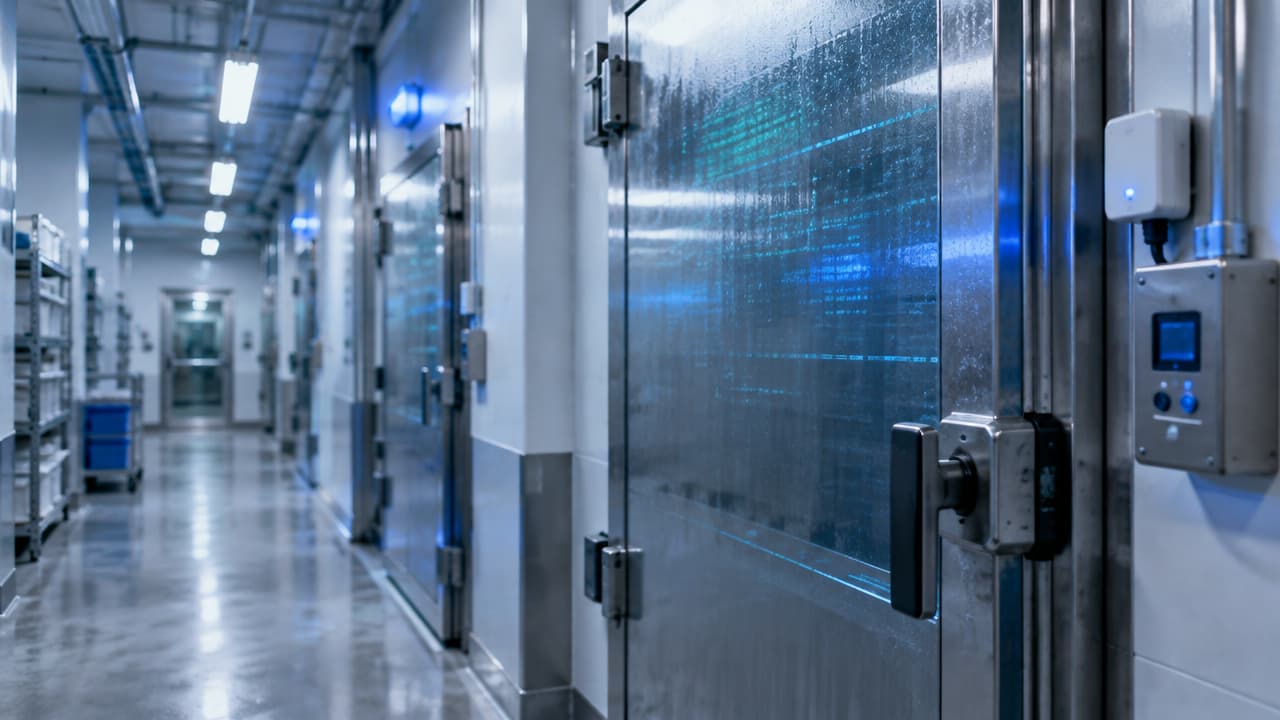
A remote command that prolongs defrost can transform a digital incident into physical loss of food or pharmaceuticals. Reports from French networks indicated approximately 400 supermarkets affected, although the total extent was not confirmed. The episode demonstrates why your team must separate control, measurement, and product decision-making.
According to the BBC report on the attack, Intermarché reported that some equipment reached 50 °C for six hours. Danfoss did not confirm this value. Two stores in Alsace reported combined losses of €270 thousand, a local figure, not a confirmed national total.
What the incident teaches about refrigeration controls
- A digital command can alter the thermal behavior of physical equipment.
- Programmed temperature, measured temperature, and product temperature are different quantities.
- Disconnecting the internet can contain exposure, but does not restore refrigeration or release products.
- Independent measurement only helps if its architecture does not share the same failures as the control system.
How prolonged defrost heats the product
Refrigeration equipment executes defrost cycles to remove ice from the evaporator. During a normal cycle, the system temporarily interrupts or reduces refrigeration and temperature rises for a limited period. In the French incident, attackers altered commands to keep equipment heating, according to the mechanism description published by the BBC.
Danfoss reported that affected equipment were older models unable to receive the necessary security update. The company also stated it had long advised customers to maintain systems with active support. Available material does not identify the initial vector, exploited vulnerability, or attack attribution.
This mechanism matters in a hospital pharmacy or laboratory because remote control can command the cycle while staff monitors a different reading or measurement point. The consequence does not depend on a conventional failure alert: equipment may be obeying an altered command.
Three temperatures describe different parts of the risk
Programmed temperature is the target set on the controller. Measured temperature in the equipment comes from a probe at a specific location, such as air return or chamber interior. Effective product temperature also depends on its position, packaging, mass, and exposure time.
A rapidly rising air reading does not mean every vial reached the same temperature at that instant. But it also does not allow concluding that the batch remained protected. To assess an excursion, quality must use representative data, continuous history, product characteristics, and previously approved criteria, not just the controller display.
In an ultra-low freezer, for example, it is worth checking where the control probe is located and where staff measures cargo condition. A difference between these points may delay deviation perception or lead to misinterpretation during an audit.
How to prepare defense and response layers
The plan must reduce the chance of unauthorized alteration and make clear what to do when thermal behavior changes. A practical checklist for engineering and maintenance includes:
- Inventory controllers, models, software versions, connections, and technical contacts.
- Define treatment for unsupported equipment, including replacement, isolation, or documented compensatory measures.
- Segment corporate and operational networks, limiting routes between them to what operations require.
- Restrict remote access, identify users, and require adequate authentication with periodic permission review.
- Plan and record updates, tests, and parameter changes, including who authorized each modification.
- Maintain a contingency plan indicating alert contacts, product transfer, and quality criteria for quarantine and release.
Disconnection may be part of containment, but is not a complete action. After interrupting remote access, staff must still verify that compressor, defrost, and alarms operate as expected, preserve records, and decide on products per quality procedure.
Why measurement must be independent of the controller
An external probe to refrigeration control can reveal that equipment is heating even when the controller shows a stable value. This independence, however, is not assumed: it is worth mapping electrical power, sensors, concentrators, networks, and cloud access to identify shared components that a failure or breach could also affect.
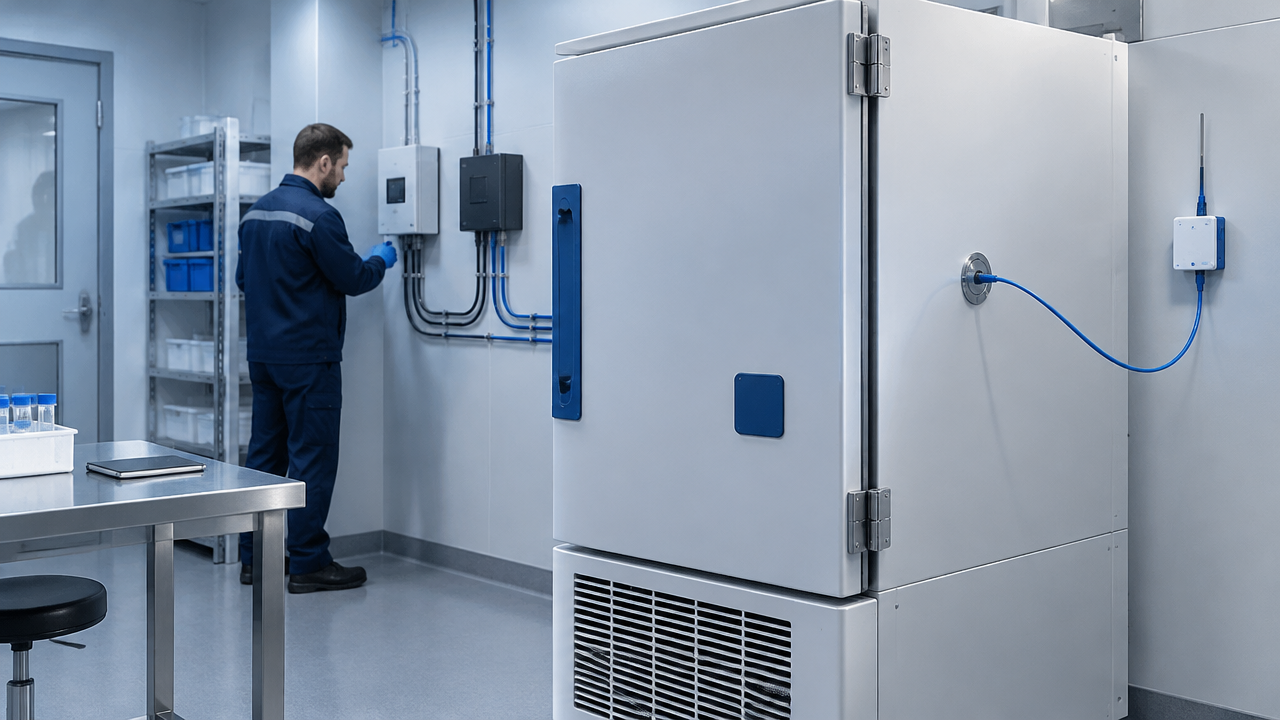
To distinguish expected defrost from deviation, monitor cycle duration and temperature rise rate. Cross these signals with compressor current and door opening: an open door may explain localized elevation, while prolonged heating without normal recovery sequence requires immediate verification.
At DROME, the STE Satellite Sensor measures temperature, the SUL uses PT100 probe for ultra-low temperatures, and the SDT monitors current and door opening. The CTD Concentrator offers cellular modem, 12-hour battery, and 20-day buffer. The buffer maintains readings recorded during an interruption, but does not mean they will be transmitted while communication is unavailable.
DROME Predict crosses more than 15 parameters from the same asset to anticipate operational failures, with informed advance notice of 30 to 60 minutes. This window is not guaranteed during malicious heating, and the feature does not detect intruders. Monitoring is not enough: staff must recognize deviations early and have an executable response.
What questions engineering, maintenance, and quality must answer
Engineering can verify whether the controller and independent measurement share network, power, or credentials. Maintenance can confirm who alters parameters, how records are preserved, and who responds to an alert outside business hours.
Quality can define who authorizes transfer, when product enters quarantine, and what data supports its release. The closing question is direct: could the same compromise alter control, affect measurement, and interrupt communication without three responsible parties noticing?
Frequently asked questions
What controls reduce cybersecurity risk in cold chain equipment?
The greatest operational risk appears when the same compromised system can alter refrigeration command and hide or distort the measurement used to decide batch disposition. Therefore, inventory, access control, change logging, independent measurement, and contingency procedures must function as separate layers.
Does independent measurement prove products remain intact?
No. An independent probe shows thermal condition at the point where it is installed, but alone does not prove the temperature of each product or its integrity. Quality must consider probe position, exposure history, product characteristics, and documented criteria for quarantine and release.
Does disconnecting refrigeration from the internet resolve the incident?
No. Disconnecting equipment may reduce exposure to remote commands, but does not automatically restore the refrigeration cycle. It also does not confirm how long the product was outside range. Staff must verify equipment status, record temperatures, and apply contingency and quality criteria.
How do you distinguish normal defrost from abnormal heating?
Compare observed defrost with the expected profile for that equipment: duration, temperature rise, compressor current, and door opening. Short defrost with predictable recovery differs from prolonged heating or heating without recovery. Limits and tolerances should reflect the equipment, installation, and local procedure.
Does DROME Predict detect cyber attacks?
No. DROME Predict analyzes more than 15 parameters from the same asset to anticipate operational failures, with informed advance notice of 30 to 60 minutes. This window is not guaranteed during malicious heating, and the analysis should not be presented as intrusion detection or substitute for cybersecurity controls.
Read next
7 Signs of Sensor-to-Gateway Communication Failure
Identify common issues in sensor-to-gateway communication to prevent data loss and IoT monitoring failures.

SaaS Compliance Documentation Checklist
Learn how to organize compliance documentation in SaaS to ensure simplified auditing, security, and regulatory conformance.

How IT Transforms Data Monitoring and Analysis
Discover how IT is revolutionizing data monitoring and analysis through technological innovations.