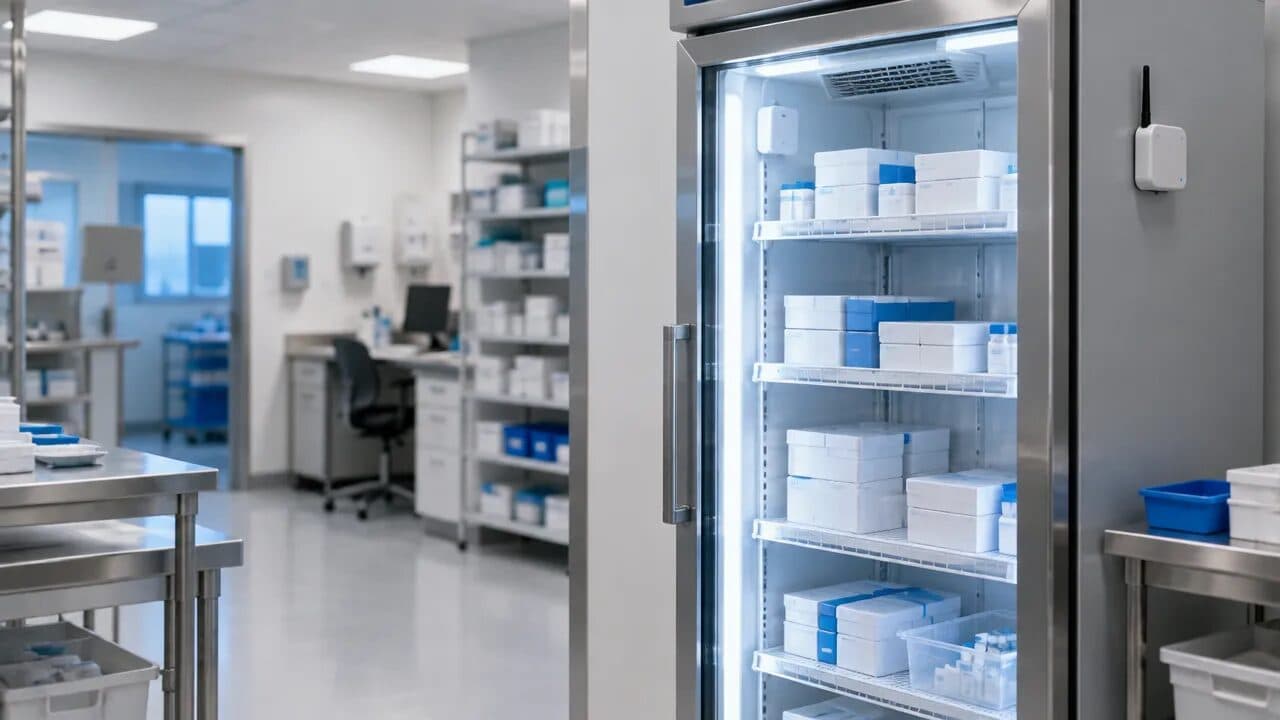
A hospital may have inventory, purchasing, and work orders centralized in the ERP, while medication refrigerator temperatures remain in separate spreadsheets. Integration only helps when it connects the reading to a workflow capable of identifying the asset, routing the event, and recording the response. Centralizing administrative data does not, by itself, prevent a thermal failure.
Key points that define useful integration
- Thermal readings must maintain linkage with asset, location, time, and data quality.
- Local storage preserves records during an outage but does not guarantee remote alerts during that period.
- Alarm thresholds and predictive analysis address different problems.
- ERP, maintenance, pharmacy, and quality must agree on who receives, verifies, and documents each event.
Isolated thermal records delay decision-making
Fragmentation appears when the team consults the ERP to find which refrigerator contains a specific lot but must open another screen or spreadsheet to check the temperature. During shift changes, someone may transcribe the record, verify the time, and try to associate it with the correct equipment. Each manual step creates an opportunity for error or delay.
Thermal data may also arrive without operational context. A reading outside the range does not, by itself, indicate whether there was an open door, power failure, compressor shutdown, or sensor issue. Without asset identification and a defined responsible party, the team wastes time locating the information before assessing the risk to stored products.
A well-designed integration links the asset history to the response workflow. This reduces reconciliation between systems but does not replace clinical or technical decision-making. Maintenance verifies the equipment; pharmacy evaluates the medications; quality documents the deviation per local procedure.
Data travels through the sensor, network, and cloud
In the DROME architecture, the STE Satellite Sensor measures temperature and sends the reading via LoRa to the CTD Concentrator. The CTD forwards the data to the DROME cloud via an available connection, such as Wi-Fi, Ethernet, or cellular network. The reading can then appear in the monitoring system and feed alerts or analyses according to operational configuration.
The CTD has a battery for up to 12 hours and local storage for up to 20 days, per DROME specifications. These resources help keep the equipment running and preserve data during a connection interruption. Storing the reading does not mean transmitting it at that moment: if external communication fails, alerts that depend on the cloud may not arrive until the connection is restored.
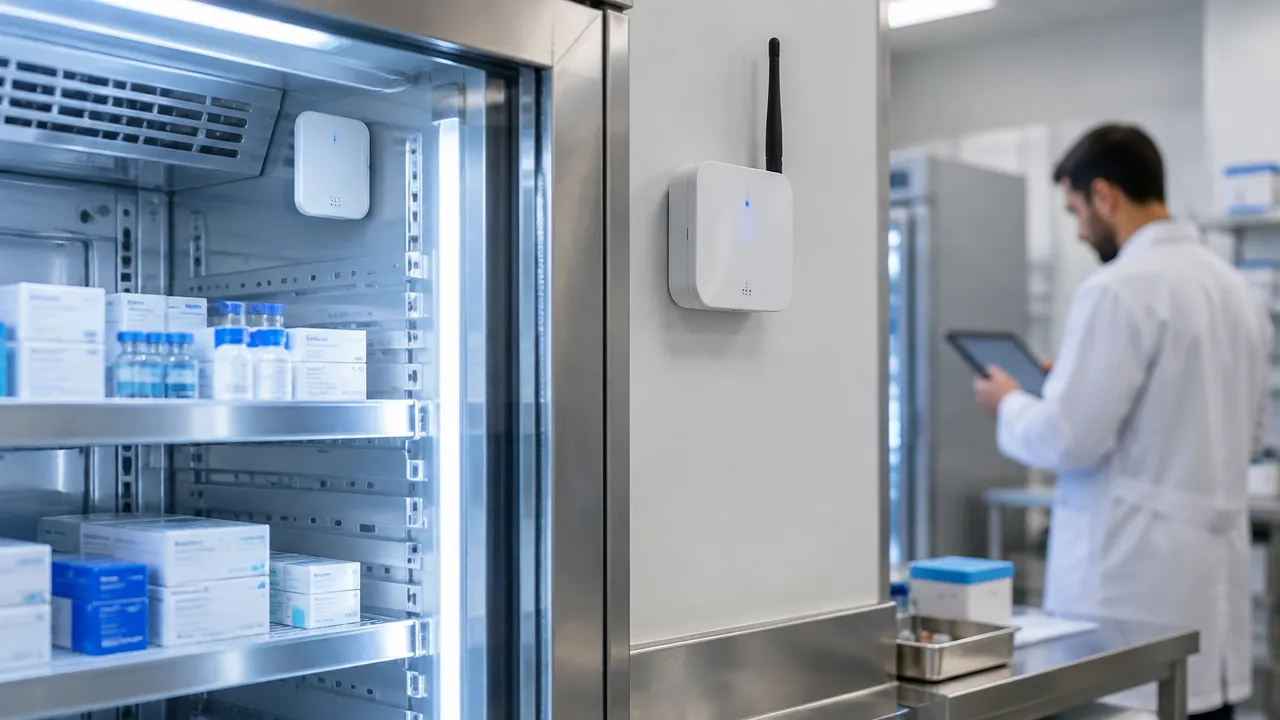
During deployment, it is worth testing collection, local recording, synchronization recovery, and the alert delivery path separately. An unavailability test should confirm what the team can see during the outage and what becomes available only afterward. This distinction prevents treating record continuity as communication continuity.
The ERP must receive data that enables action
An interface is useful only if it preserves the context needed to interpret and handle the event. Before connecting systems, clinical engineering, IT, pharmacy, and quality must agree on which fields will be sent, who is responsible for each step, and which system holds the official record of the decision.
- Asset identification: unique code, equipment type, and link to inventory.
- Location: unit, department, and position of refrigerator or chamber.
- Reading: value, unit of measure, time, and timezone used.
- Quality: measurement condition, sensor status, and indication of missing or invalid data.
- Event and response: type of occurrence, assigned responsible party, time of awareness, verification, and recorded action.
Interfaces, authentication method, update frequency, and ERP compatibility must pass technical validation. Confirm whether the destination system accepts the fields, how it handles duplicates and delays, and how it records communication failures. Do not assume a native integration exists without vendor confirmation and testing in the hospital environment.
Recording, alarm, and prediction are not the same function
A record documents the measurement; an alarm compares the reading to a defined threshold; predictive analysis looks for patterns associated with failure progression. The team must know which mechanism generated each alert, because the response and expected evidence change with the event.
| Resource | What it informs | Operational limitation |
|---|---|---|
| Thermal record | Measured value and its history | Does not determine cause or action by itself |
| Threshold alarm | Reading that exceeded a configured range | May alert after the condition has already changed |
| Predictive analysis | Pattern that may precede a failure | Is a prediction, not a guarantee of outcome |
DROME Predict combines more than 15 parameters from the same asset and, per DROME specifications, can issue alerts 30 to 60 minutes before failure, with indication of cause and corrective action. This window describes the system's stated capability, not universal advance notice for any equipment, failure mode, or installation condition.
An event must reach the right team
Consider a medication refrigerator whose reading begins to drift outside the defined range. The maintenance team receives the event and verifies electrical supply, door closure, compressor operation, and sensor condition. The response record must identify who verified the equipment, when they acted, and what they found.
In parallel, pharmacy evaluates the medications per local procedure, considering temperature history and product characteristics. Quality documents the deviation, evaluation, decision, and any corrective actions. If the hospital uses an ERP or maintenance system to open a work order, the integration can transport the agreed data, but responsibility assignment remains a process decision.
This workflow requires traceable calibration and intact records. The history must preserve the original reading and allow verification of changes, times, users, and justifications per applicable system controls. Role-based access reduces unauthorized changes; evidence of calibration, alarms, awareness, and treatment help reconstruct the event in an audit.
Compliance depends on use and process
RDC 430/2020 addresses good practices for medication distribution, storage, and transport; RDC 658/2022 covers good manufacturing practices. ANVISA Guide 33 may be relevant for qualification and validation activities, depending on context. 21 CFR Part 11 applies when electronic records and signatures meet U.S. regulatory requirements.
Applicability depends on the activity, products, system, and institutional procedures. Integrating readings into the ERP does not, by itself, prove adequate calibration, access control, or record integrity, nor does it guarantee audit approval. Quality and IT must define requirements, validate the workflow, and maintain evidence compatible with intended use.
Checklist for evaluating deployment
- Clinical engineering: Is the sensor associated with the correct asset? Have collection and buffering been tested during power or connection loss?
- Quality: Is there traceable calibration, intact history, and evidence of who handled each event?
- Pharmacy: Is there a procedure to evaluate products after excursion and record the decision?
- IT: Have interfaces, authentication, frequency, synchronization, and failure handling been tested with the actual ERP?
- Operations: Is it clear who receives the alert, who assumes the response, and how the team escalates the event if there is no response?
Integration is ready for use when the team can reconstruct the sequence from measured data to documented decision and act within the time the risk allows.
Frequently asked questions
What does integrated temperature monitoring mean in a hospital?
Integrated monitoring connects thermal readings to an event response routine. This may involve equipment identification, deviation recording, routing to the responsible team, and action documentation. Connection to an ERP, by itself, does not detect the cause or ensure someone can act in time.
How does the temperature sensor work in an integrated architecture?
The STE Satellite Sensor measures temperature and sends data via LoRa to the CTD Concentrator. The CTD forwards readings to the DROME cloud when a connection is available. Collection frequency, recorded times, and equipment identification must be validated in the project so the history is useful to operations and audit.
What happens to data if the connection drops?
The battery keeps the CTD running for up to 12 hours, and local storage preserves data for up to 20 days, per specifications provided. This buffer allows readings to sync after the connection returns. It does not equal cloud alert transmission while external access is unavailable.
What is the difference between recording, alarm, and failure prediction?
Recording is the stored reading with time, unit, and asset identification. Threshold alarm notifies when the measurement exceeds a configured range. Predictive intelligence analyzes patterns and relationships between variables to anticipate a possible failure. These are different functions, and one does not automatically replace the others.
Does integrating monitoring into the ERP guarantee compliance?
No. Integration can facilitate record location and action documentation, but compliance also depends on process, calibration, access control, data integrity, and available evidence. Application of standards such as RDC 430 or 21 CFR Part 11 depends on the regulatory scope of the operation.
Read next

How AI Predicts Hospital Freezer Maintenance
Discover how artificial intelligence detects failures and prevents losses in hospital freezers with real-time monitoring.

Checklist to Implement Hospital Cold Chain Without Failures
Learn how to ensure thermal control, IoT monitoring, and real-time notifications in your hospital cold chain without failures.

Prevent Cold Chain Errors: Temperature Monitoring in Healthcare
Learn how to prevent temperature control failures in healthcare with efficient monitoring.