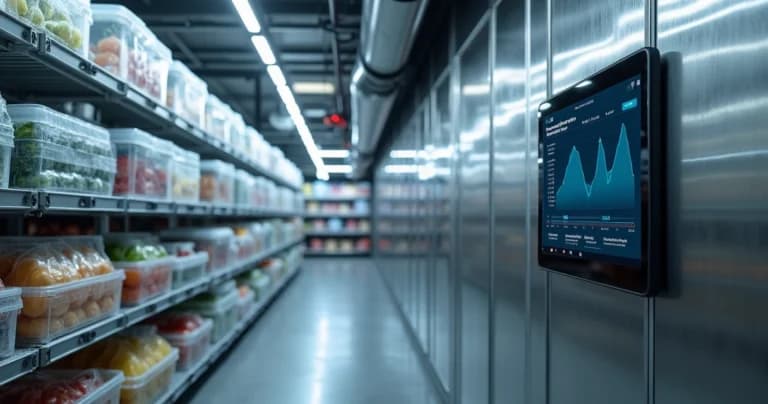
When I talk with teams operating cold storage chambers, I almost always hear the same pain point. The alert arrives, but it arrives too late. Temperature drifted out of range, the alarm sounded, and the product was already compromised. After seeing this scenario so many times, I started advocating for a simple idea: monitoring is good, predicting is better.
In practice, configuring predictive sensors is not just powering up equipment and setting high and low limits. I see this as contextual work—reading operational patterns and fine-tuning. That's exactly where platforms like DROME stand out, because they combine historical data, telemetry, and predictive intelligence to alert you before a violation occurs.
The best alert is the one that arrives before damage happens.
What Changes in a Predictive Sensor?
A standard sensor reports the current value. A sensor configured for predictive use helps interpret behavior. It sounds minor, but it changes everything. Instead of waiting for a reading to breach the limit, the system begins observing out-of-pattern spikes, slow drifts, and risk signals in the coming hours.
Good parametrization means teaching the system to distinguish normal variation from a problem signal.
I like to start with three simple questions:
-
What operating range is acceptable for the stored product?
-
What rate of variation is normal for that equipment?
-
How much time does the team need to act before loss occurs?
These answers prevent a common mistake. Many people copy the same configuration across all chambers. But a vaccine chamber, a frozen food chamber, and a laboratory supplies chamber don't behave the same way. I've seen technically correct installations fail because parametrization ignored the real-world use of the environment.
Start with Well-Defined Basics
Before activating any predictive layer, I configure the operational foundation. Without it, prediction starts weak. The points I review first are these:
-
Target temperature range.
-
High and low alert limits.
-
Reading interval.
-
Physical sensor position.
-
Rules for loading, unloading, and door opening times.
The reading interval deserves attention. If it's too long, the system misses early deviation signals. If it's too short, it can generate noise without real gain. In cold storage chambers, I typically see good results with frequency sufficient to capture microvariations without overloading operations.
Good prediction depends on clean, consistent data collected at an appropriate frequency.
Those wanting to dive deeper can consult the content on cold chain monitoring, which shows how platform architecture influences response quality.
How to Set Intelligent Limits
In my experience, the biggest mistake is treating operational limits and predictive limits as the same thing. They're not. The operational limit marks the violation. The predictive limit must come first, when there's still time to react.
I typically work with three layers:
-
Ideal range, where equipment operates without risk signals.
-
Attention range, where small changes already warrant observation.
-
Predictive action range, where violation probability rises and the team must act.
This model is more mature than many traditional market systems, which still stop at reactive alarms. DROME goes further by learning from sensor and equipment history, making alerts more useful and less generic.
Which Predictive Parameters Would I Adjust First?
When the platform already collects history, I prioritize parameters that deliver quick response and reliable reading. Generally, I start with these groups.
First, I adjust spike sensitivity. This helps detect abrupt variations, such as door open beyond normal time, seal failure, or early performance loss.
Next, I configure drift. This point is valuable because it captures slow changes, almost invisible day-to-day. A tired compressor, for example, may not trigger an alarm today, but shows a warming trend over the week.
Finally, I activate the prediction window. In it, the system estimates violation probability in the coming hours. I prefer windows aligned with the operation's real response capacity.
-
1 to 2 hours for environments with continuous on-site staff.
-
4 to 6 hours for operations with scheduled technical response.
-
12 to 24 hours for risk management and planned maintenance.
The best predictive window is one that gives real time to act, not one that looks most sophisticated in the report.
This reasoning aligns well with what I discussed in predictive maintenance in cold storage control, where I show how prediction without practical action loses value.
How to Reduce False Alerts?
I take this topic seriously. False alerts exhaust the team. After a while, nobody reacts with proper urgency. To avoid this, I always separate expected operational events from real anomalies.
Some examples help:
-
Scheduled door opening during loading time should not carry the same weight as an unexpected temperature spike outside routine.
-
Automatic defrost must enter the reading context.
-
Sensors near air outlets may register different oscillation than the chamber center.
I also recommend reviewing physical sensor placement. Sometimes the problem isn't the algorithm. It's the installation point. I've seen a sensor next to the door generate a series of alerts that looked like serious failure, when in fact it reflected a poor location choice.
If the focus is reliability over time, it's worth reading about how to extend sensor lifespan in cold environments and also about how to prevent IoT sensor failures in cold chains.
The Role of History and Contingency
I trust predictive parametrization more when it converses with real history. It's not enough to know the chamber should operate at a certain temperature. You need to know how it actually behaves across shifts, days of the week, usage cycles, and peak load times.
That's why DROME's approach makes sense. The platform is built on historical telemetry data and violation events. This shortens the path from monitoring to predicting.
Without history, there's an alarm. With history, there's context.
Another layer I never skip is the response plan. If the system predicts a violation, someone needs to know what to do. Technical parametrization only closes when contingency is defined. For this point, I recommend the material on planning contingency for cold storage failures.
A Simple Roadmap for Better Parametrization
If I had to sum up my method in a quick roadmap, I'd do it like this:
-
I map the product type and acceptable thermal range.
-
I review sensor position and reading interval.
-
I define operational limits and predictive limits separately.
-
I mark normal routine events so the model doesn't confuse them.
-
I adjust sensitivity for spike, drift, and violation prediction.
-
I validate alerts with the team over several operation cycles.
-
I refine parameters based on collected history.
I like this process because it's technical but not complicated. And when the company uses a more mature solution, like DROME, much of this work becomes clearer, since data and alerts communicate with each other.
Conclusion
Configuring predictive sensors in cold storage chambers is deciding how much risk the operation accepts and how much time it wants to gain before loss. I think this way because I've seen the difference between chasing the problem and acting early. When the system understands pattern, trend, and context, the alert stops being a shock and becomes real support for the team.
If you want to move away from reactive monitoring and advance toward an operation that anticipates failures with greater confidence, it's worth learning more about DROME and seeing how our technology can support your cold chain.