
Automating environmental inventory in hospitals, in practice, means replacing dispersed records with a continuous, auditable, and actionable database. This is especially important for pharmacies, laboratories, operating rooms, CME, and any area where environmental variation affects supplies, equipment, or patient safety. By 2026, the most mature trend is not just monitoring, but transforming environmental data into operational priority.
To get there, the hospital needs to combine sensors, compliance rules, response workflows, and analytical intelligence. When this structure works, inventory stops being a delayed snapshot and starts guiding decisions before deviation becomes loss, disruption, or clinical risk.
Key highlights to structure automation
- Start with critical areas, where temperature, humidity, and power directly affect quality and safety.
- Automate data capture with sensors and telemetry, avoiding typical gaps in manual checklists.
- Standardize limits and evidence to facilitate audit, investigation, and rapid response.
- Integrate operations and maintenance, because many environmental deviations stem from unstable assets.
- Use AI to prioritize risk, identifying patterns that precede failures and recurrences.
- Expand in phases, with simple goals, clear indicators, and buy-in from clinical and technical teams.
Effective automation starts with the right inventory, not technology
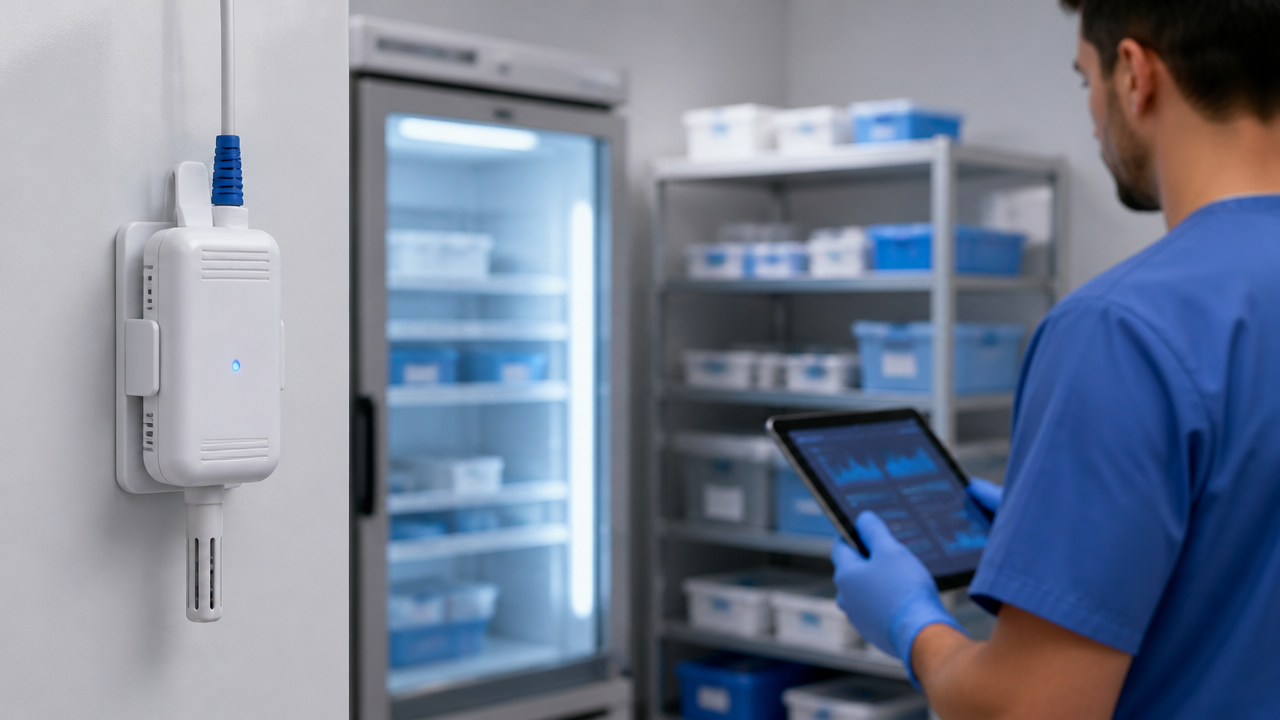
The first step is defining what really needs to enter the environmental inventory. In a hospital, this includes environments, assets, monitored variables, acceptable ranges, criticality, responsible parties, escalation routes, and evidence required for audit. Without this design, the system collects data but does not organize decision-making.
A practical way to map scope is to divide inventory into four layers:
- critical areas, such as pharmacy, laboratory, sensitive storage, and rooms with biomedical equipment;
- assets that influence the environment, such as refrigerators, freezers, UPS systems, HVAC, and sensors;
- monitored variables, such as temperature, humidity, door opening, and power loss;
- operational rules, such as limits, maximum time out of range, and responsible parties for action.
This design avoids a common mistake: monitoring everything with the same urgency. Instead, the hospital classifies risk by clinical impact, asset value, and regulatory criticality.
Which processes should leave the spreadsheet first?
Manual records should be replaced first where a small deviation generates large impact. This typically happens in storage of medications, vaccines, blood products, samples, laboratory supplies, and equipment that depend on stable conditions to operate safely.
In practice, prioritize processes with three signs of fragility:
- collection on paper or spreadsheet with fixed schedules, which may miss the real moment of deviation;
- dependence on human verification to identify recurrences;
- difficulty reconstructing complete history during audit or investigation.
When these points appear, automation generates immediate value. The hospital begins recording continuously, reduces evidence gaps, and responds in minutes, not just at the next scheduled check.
This is where platforms like DROME gain relevance. By combining continuous monitoring, telemetry, and artificial intelligence, operations stop acting only when the alert has already triggered and start observing instability trends before critical occurrence.
Sensors and telemetry solve data capture, but don't solve operations alone
Sensors are the foundation of automation, but real gain appears when data enters a clear operational workflow. It's not enough to measure temperature and humidity. The system must contextualize where the deviation occurred, for how long, which asset is involved, and who should act.
Therefore, a minimal architecture for 2026 should include:
- sensors with continuous reading and centralized history;
- alerts by criticality, avoiding excess of irrelevant notifications;
- corrective action record, with responsible party, time, and outcome;
- consolidated view by area, unit, and asset type;
- audit trail ready for internal and external inspections.
This model reduces a silent problem in many hospitals: accumulation of alerts without treatment. When automated inventory already classifies the event and ties data to the response routine, the team works with real priority, not noise.
How to use AI without making the project overly complex?
The best application of AI in hospital environmental inventory is simple: prioritize risk before failure. Instead of promising full autonomy, models should help identify instability patterns, recurrence of deviations, and anomalous behavior of assets and environments.
This can appear in situations such as gradual increase in thermal oscillation in a refrigerator, repetition of alarms in the same shift, or loss of stability after excessive door opening. Alone, these signals seem small. Together, they indicate higher probability of critical event.
DROME's approach fits well in this scenario because it uses operational history to recognize patterns and support decision-making. For the hospital, this means migrating from reactive logic to predictive logic, with smarter maintenance, less supply loss, and more operational safety.
The secret is to start with few use cases. First, detect anomalies. Then, classify recurrence. Next, suggest inspection and maintenance priorities.
Governance defines whether automated inventory becomes compliance proof
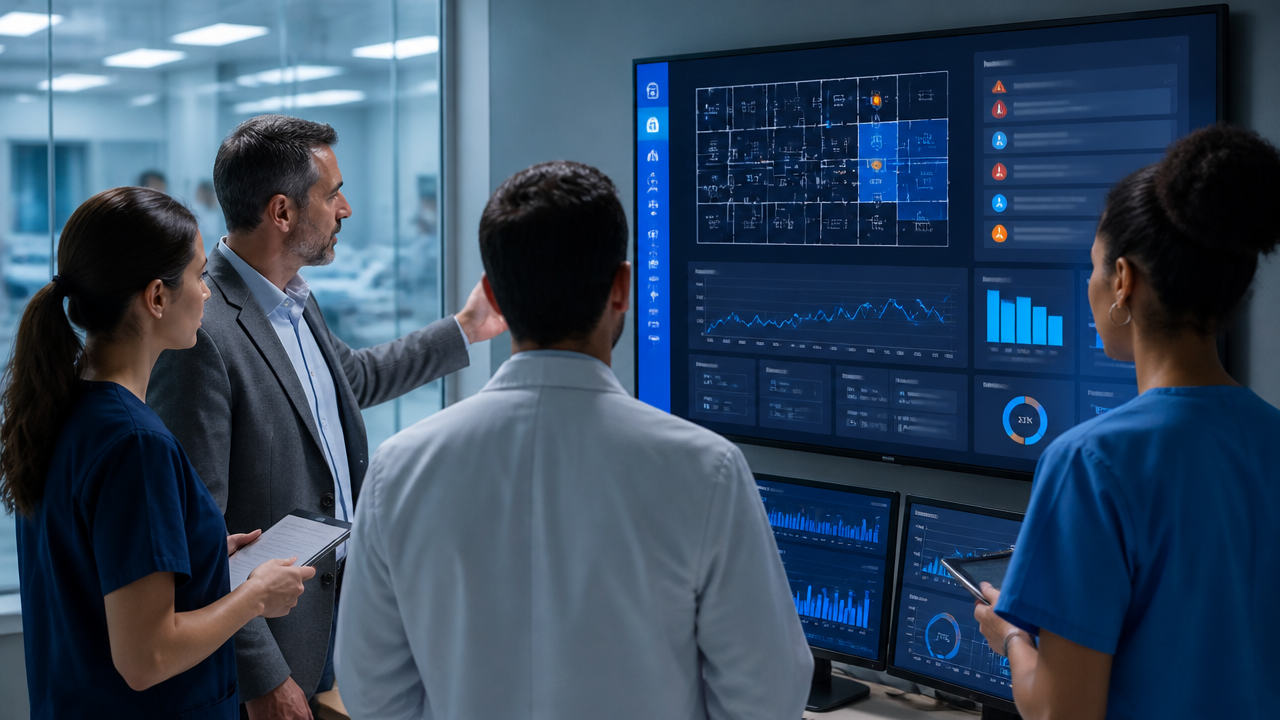
An environmental inventory is only useful for compliance when data has context, integrity, and traceability. This requires formal rules for asset registration, sensor calibration, limit review, alarm treatment, and history retention.
A simple table helps organize governance:
| Element | What to standardize | Expected result |
|---|---|---|
| Registration | Area, asset, criticality, and responsible parties | Consistent and searchable inventory |
| Limits | Acceptable ranges and maximum tolerance time | More precise alarms |
| Response | Escalation, deadline, and corrective action | Shorter reaction time |
| Evidence | History, logs, and justifications | Simpler audit |
| Review | Recurrence analysis and periodic adjustments | Continuous improvement |
When this governance exists, inventory stops being merely operational. It begins to support investigation, risk management, and executive decision-making.
A viable roadmap for implementation by 2026
Hospitals don't need to transform their entire infrastructure at once. The safest path is implementation in short waves, with objective goals and expansion as the process matures.
- Map criticality: list areas, assets, and variables with greatest clinical and regulatory impact.
- Digitize collection: install sensors, centralize history, and eliminate parallel records.
- Define response: configure alerts, responsible parties, and escalation by severity.
- Measure performance: track deviations, response time, and recurrence by asset.
- Add intelligence: use predictive models to anticipate failures and plan maintenance.
- Expand with standard: replicate structure to new areas without losing governance.
This roadmap works because it respects hospital reality. It reduces friction with teams, delivers visible gains early, and creates a solid foundation for smarter, more reliable, and scalable environmental inventory.
Frequently asked questions
What goes into a hospital environmental inventory?
A hospital environmental inventory is the continuous record of conditions affecting critical areas, such as temperature, humidity, door opening, power, and equipment status. It serves to prove compliance, guide corrective actions, and reduce losses of medications, samples, vaccines, and sensitive materials.
Are spreadsheets still sufficient to control critical environments?
No. Spreadsheets help in small operations, but depend on manual collection, have low traceability, and complicate audits. In hospitals, the safest model combines sensors, automatic records, alerts, and centralized history, reducing human errors and accelerating response to deviations.
How long does it take a hospital to see gains from automation?
First gains typically appear in a few weeks, mainly in standardization of records, reduction of manual rounds, and improved response to deviations. Returns tend to grow when the hospital integrates monitoring, maintenance, compliance, and predictive analysis into the same routine.
Which indicators show that automation is working?
The most useful indicators are deviation rate per area, average response time, time out of acceptable range, percentage of monitored equipment, number of recurrent occurrences, and history availability for audit. These data show whether operations are just reacting or truly preventing risk.
Can medium-sized hospitals also automate this process?
Yes, as long as the project has clear priorities. The most efficient path is to start with critical areas, such as pharmacy, laboratory, CME, and cold rooms, then expand in phases. This reduces initial investment, facilitates team buy-in, and delivers faster operational results.
Read next

Implementing Patient Safety Cores in Healthcare Services
Discover how to structure Patient Safety Cores according to PNQSP 2026 and strengthen surveillance with DROME.
Resolve Telemetry Sensor Failures in Hospitals
Telemetry sensors play an increasingly vital role in hospital environments. I've witnessed how temperature, humidity, and parameter monitori…
Map Thermal Risk Critical Points in Clinics
Identify and assess thermal risk critical points in clinics to prevent losses and ensure the integrity of temperature-sensitive supplies.