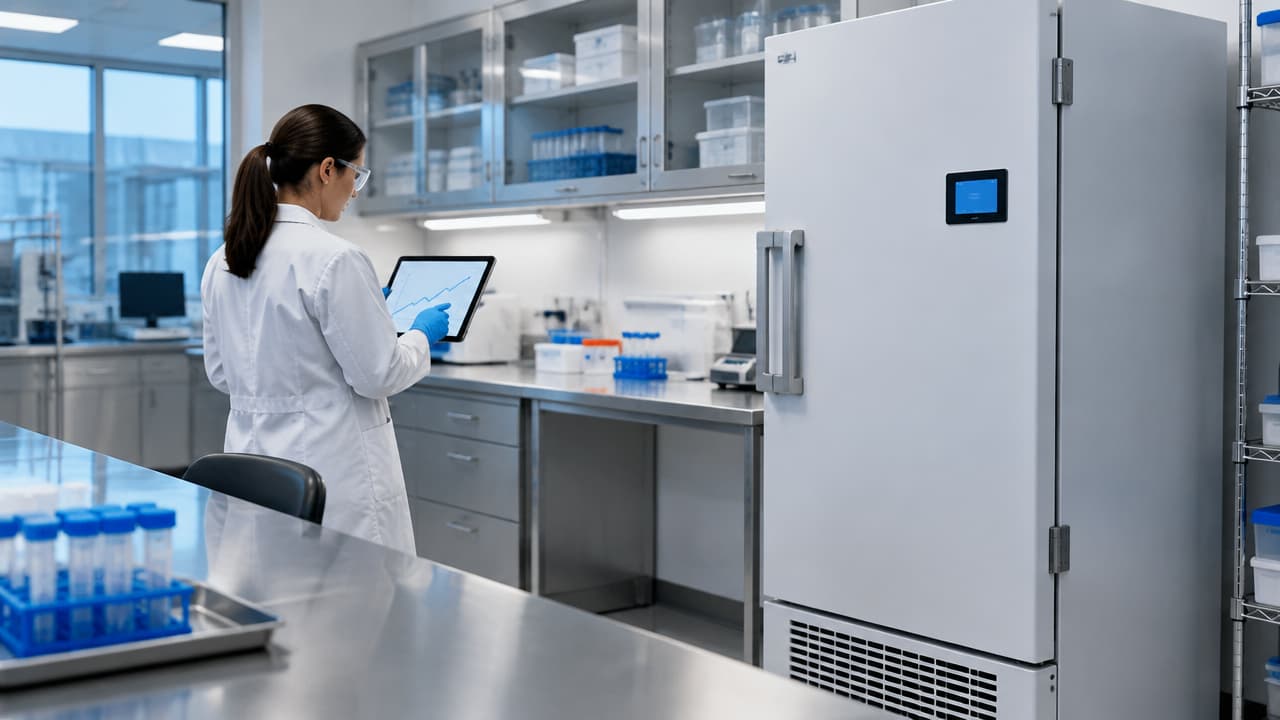
In clinical research, a temperature reading taken at the start of a shift does not reveal what occurred overnight. Automated monitoring records temperature over time, but continuous logging and failure prediction are different capabilities. For quality, maintenance, and sample custodians, this distinction determines when the team discovers a deviation and how much time remains to act.
What changes when temperature no longer depends on manual notes
- Automatic readings reduce gaps between manual checks and transcription risk.
- A threshold alarm indicates that the defined condition has already been exceeded.
- Predictive analysis can recognize failure signals before thermal excursion, if adequate data and patterns exist.
- Local memory preserves records during network interruption, but does not guarantee remote alert delivery during that period.
These functions serve different control stages. The team must separately evaluate data collection, storage, alert communication, and failure anticipation capability.
Why manual measurements leave intervals without evidence
A spreadsheet records the moment someone checks the display, not necessarily the equipment behavior between checks. If a door remains improperly closed after a shift change, the next reading may only show that temperature has changed, without indicating when the trend began.
The manual process also depends on correct reading, equipment identification, time, and transcription. A number entered in the wrong row may appear valid until review or audit. Electronic records reduce these steps, but still require synchronized clocks, unambiguous asset identification, access rules, and change management.
For study samples, the storage reference must come from the approved protocol and material specifications. No single range applies to all research, medications, or biological samples.
Recording an excursion is not the same as predicting failure
A system configured with limits only triggers when temperature reaches the alarm value. It documents the excursion and can alert the team, but the alert may arrive after the condition has already left the defined range.
Predictive analysis seeks earlier signals, such as changes in equipment behavior that, together, may indicate an impending failure. At DROME, DROME Predict crosses more than 15 parameters from the same asset and can issue alerts with an informed lead time of 30 to 60 minutes, including probable cause and suggested corrective action. This interval depends on the detectable pattern and asset conditions; it is not a universal guarantee for every event.
Therefore, it is worth distinguishing three events in the procedure: abnormal trend, limit excursion, and material evaluation after an excursion. Each may require different responsible parties and decisions.
Sensor, probe, and gateway serve distinct functions
The STE Satellite Sensor measures temperature wirelessly and transmits data via LoRa. For ultra-low freezers, the SUL variant uses a PT100 probe, suitable for measurement at very low temperatures. The measurement point selection should follow thermal mapping and equipment qualification, not merely sensor installation convenience.
The CTD Concentrator receives data and forwards it via available connection. It has battery backup for up to 12 hours and local buffer for up to 20 days, per DROME specifications. This buffer preserves readings during connection unavailability; alone, it does not deliver remote notifications while the gateway cannot communicate.
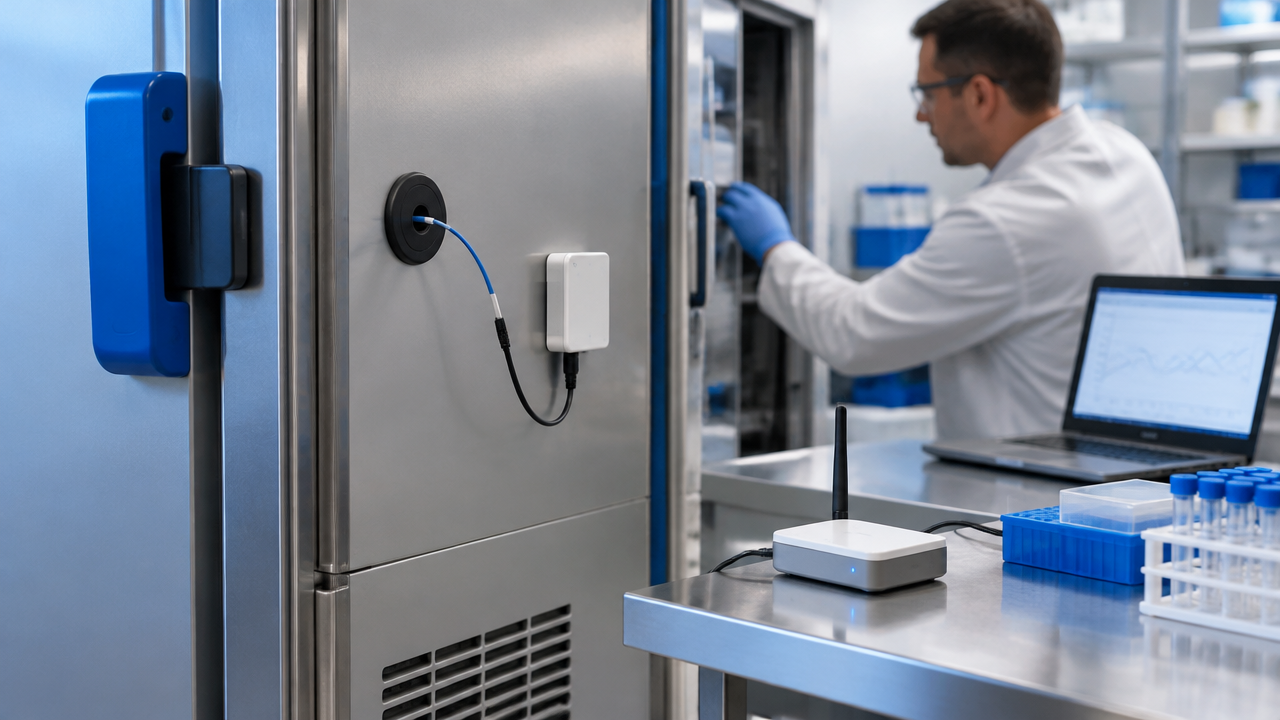
During deployment, also confirm how the system signals communication loss. The routine must specify who verifies the condition, how local records will be recovered, and which alternative channel the team will use to alert on-call staff.
How to define an implementation that generates usable evidence
Before installing sensors, the team must document intended use, covered assets, and response workflow. IQ, OQ, and DQ qualification must demonstrate, respectively, that installation was performed as planned, that functions operate per defined criteria, and that the system meets intended use in the actual process.
- Position sensors per thermal mapping and equipment critical points.
- Define traceable calibration, acceptance criteria, and handling of out-of-specification results.
- Configure warning and alarm limits per study protocol and material specifications.
- Assign each alert level to a responsible party, response timeframe, and escalation rule.
- Test power loss, connection failure, data recovery, and corrective action documentation.
Alerts may arrive via WhatsApp, SMS, email, or voice. The choice should reflect service routine: a notification reaching an unmonitored inbox overnight does not equal a confirmed response workflow.
Digital integrity requires controls beyond the sensor
21 CFR Part 11 addresses electronic records and signatures used in regulated contexts. Installing sensors does not, by itself, prove that a process meets these requirements. Quality must evaluate the system and procedures, including access control, audit trail, record preservation, backups, and validation compatible with intended use.
In practice, evidence must allow reconstruction of what happened: which equipment generated the data, when the event occurred, who received the alert, what evaluation was performed, and what action was documented. The procedure must also specify how to correct a record without erasing the original history.
How to evaluate results without assuming savings
Consider a hypothetical scenario: overnight, the system detects an abnormal trend in an ultra-low freezer storing study material. The on-call team receives a predictive alert, checks equipment behavior, and consults the study protocol before deciding whether to transfer material to a qualified asset. Then, they document the evaluation, intervention, and sample disposition.
The alert supports decision-making but does not replace team judgment or contingency planning. Before and after implementation, track time spent on records, quantity and duration of data gaps, time between alert and acknowledgment, and time to intervention. These indicators show what changed in routine without assuming a savings percentage.
When evaluating your routine, start with assets, measurement points, and the path an alert takes to the responsible team. DROME can help review this workflow with quality and maintenance.
Frequently asked questions
How does automated temperature monitoring work in clinical research?
The sensor automatically measures temperature and records readings per system configuration, without depending on manual notes each shift. The team must still define measurement points, limits, responsible parties, calibration, and deviation response. Automating collection reduces manual steps but does not replace the study's approved procedure.
Where should temperature sensors be installed in refrigerators and ultra-low freezers?
The number of sensors depends on equipment, identified critical points, and storage protocol. Position should reflect conditions relevant to stored material, based on mapping and equipment qualification. A poorly positioned sensor may record a condition different from what matters for the sample.
What happens to data when connection is lost?
Local memory maintains readings on the equipment or gateway during connection interruption, within configured capacity. This does not mean remote alerts will be delivered while no communication channel is available. It is worth defining how the team will detect unavailability and how to recover data afterward.
Does installing sensors guarantee 21 CFR Part 11 compliance?
No. Sensors and digital records can support controls and evidence, but compliance also depends on system validation, record integrity, access control, audit trail, defined procedures, and responsibilities. The quality team must evaluate intended use and applicable requirements before approving the process.
Read next
Clean Room Trends: Advanced Pressure & Air Quality Control
Explore emerging trends in advanced pressure control and air quality management for clean rooms, essential for hospital and industrial criti…

Dissolved CO2 Monitoring in Cell Cultures
The importance of precise dissolved CO2 monitoring in cell cultures to optimize biotechnology processes.
Temperature Probe Calibration in Cold Chain
Understand error, drift, and uncertainty in probe calibration, what to verify in the certificate, and how to assess deviations without autom…