
Predicting cold chain failures requires shifting from reactive logic to continuous monitoring of operational behavior. Instead of waiting for product to exit the safe range, teams act when data indicates risk is forming. For hospitals, laboratories, pharmaceutical manufacturers, and sensitive logistics, this means fewer losses, greater traceability, and faster decisions.
In practice, prediction depends on three layers: reliable sensors, real-time analysis, and well-defined operational response. When these pieces work together, the cold chain moves from being simply monitored to being managed with intelligence.
Key points to anticipate failures
- Isolated data is not enough: value lies in interpreting trend, context, and speed of change.
- Not every deviation starts at the thermometer: open doors, unstable power, delayed routes, and equipment failure typically appear before thermal excursion.
- Useful alerts are actionable: the system must indicate priority, probable impact, and next step.
- Operational history improves accuracy: the larger the event database, the easier it is to separate noise from real signal.
- Prediction without process loses value: the team must know who responds, in how long, and with which protocol.
The most common mistake is treating cold chain as a snapshot, not a film
Failures rarely emerge instantaneously. In most operations, the problem appears as a sequence of small signals: equipment takes longer to recover temperature, a door opens with abnormal frequency, humidity shifts outside pattern, or electrical oscillation repeats at specific times.
When monitoring only looks at the final limit, it sees the problem too late. Continuous reading shows the asset's trajectory, not just an isolated point. This is why temporal analysis, minute by minute, is usually more valuable than a spreadsheet of sparse measurements.
DROME's approach makes sense precisely at this point: combining continuous monitoring, telemetry, and Artificial Intelligence to identify patterns that precede failures and support decision-making before operational impact.
Which data really helps anticipate a failure
Prediction improves when the system observes more than one variable at a time. Temperature remains central, but alone it does not explain the cause of risk or indicate the best moment to intervene.
The most useful signals typically are:
- internal and external asset temperature
- relative humidity
- accumulated time outside range
- recovery time after opening
- frequency and duration of door openings
- power oscillations
- equipment vibration and performance
- location and transit time, in mobile operations
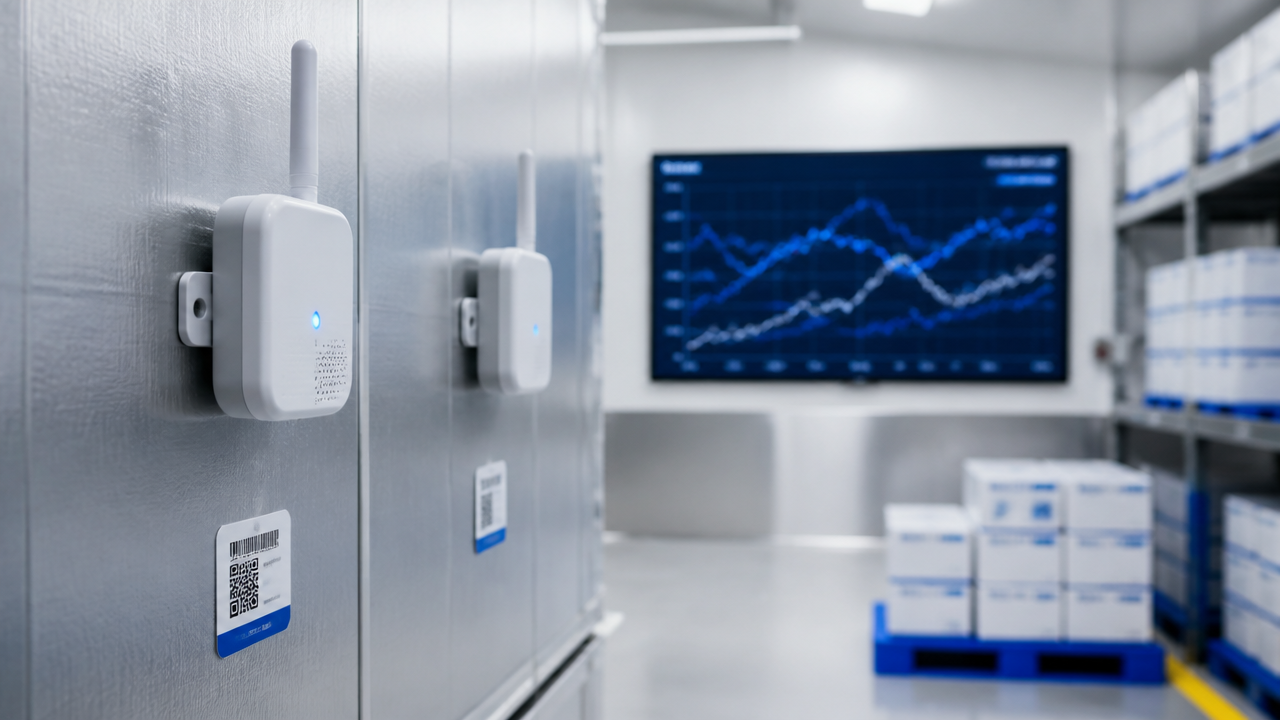
Real gain appears when these signals are correlated. A temperature spike may be tolerable in one context and critical in another. If there was programmed opening for just seconds, risk may be low. If the increase came with slow recovery and unstable power, the scenario changes completely.
Useful anomaly is one that explains risk, urgency, and probable cause
Detecting anomaly is not just saying something went abnormal. What matters for operations is knowing whether that deviation represents real risk, with what urgency it must be addressed, and what the probable cause is. Without this, the team receives many alarms and learns to ignore them.
Good real-time analysis crosses acceptable range, historical behavior, and operational context. With this model, the system can perceive situations like these:
- gradual elevation that precedes refrigeration failure
- recurring instability at peak operational hours
- compressor working harder to maintain the same range
- route with stops too long for load sensitivity
This is the step that differentiates monitoring from prediction. Instead of reacting to the final symptom, operations respond to the precursor pattern. In critical environments, even a few minutes of advance notice change the outcome.
How to turn alerts into preventive action
Predicting without acting does not reduce loss. The system must translate risk into a clear flow, with priority, responsible party, and defined procedure. When this does not exist, the alert becomes just another notification.
An efficient routine typically follows this sequence:
- identify the event and classify criticality level
- notify the right person, on the right channel
- recommend the first operational action
- record response time and outcome
- feed the model back with the result

In practice, this may mean transferring load to another unit, prioritizing maintenance, temporarily blocking an asset, reviewing a route, or checking a seal before temperature exceeds the limit. The difference between loss and containment lies in this organized speed.
Predictive maintenance begins when operational data becomes failure pattern
Cold chain equipment rarely fails without warning. The challenge is recognizing degradation signals early enough to plan intervention. When operational history is consolidated, it becomes easier to identify repeated behaviors before a breakdown.
The table below summarizes the difference between the three most common management levels:
| Approach | When it acts | Main limitation |
|---|---|---|
| Reactive | After failure | Higher risk of loss and disruption |
| Preventive | By calendar | May replace too early or too late |
| Predictive | When pattern indicates degradation | Depends on consistent data and contextual reading |
For cold chain, predictive maintenance is especially useful because it reduces unnecessary interventions and concentrates effort on the most critical assets. Instead of treating all equipment equally, operations prioritize those showing increasing risk.
Which sectors gain most from this model
Any operation with temperature-sensitive products benefits, but impact is greater where failure compromises safety, compliance, or care continuity. This includes hospitals, laboratories, pharmaceutical manufacturers, distribution centers, and refrigerated transport.
In hospitals, focus typically is on medications, vaccines, blood components, and support equipment. In laboratories, concern falls on samples, reagents, and analytical stability. In pharmaceutical manufacturing, priority is protecting batches, audit, and traceability throughout the entire journey.
In these scenarios, AI applied to monitoring gains value because it helps prioritize events, learn from history, and reduce dependence on purely manual inspections. This movement is what enables moving from simple tracking to predictive risk management.
How to start without complicating operations
The best path is to start where failure costs most. This normally means mapping critical assets, reviewing acceptable limits, and standardizing data collection before expanding the project.
An initial plan typically includes:
- select critical chambers, refrigerators, freezers, or routes
- install reliable sensors and define calibration
- organize history by asset, batch, or load
- configure alerts by criticality, not just fixed limit
- define response protocol and responsible parties
- review events monthly to train process and model
When this foundation is ready, technology begins learning from operations itself. The result is a more predictable cold chain, less exposed to silent losses, and better prepared to act before rupture happens.
Frequently asked questions
How does cold chain failure prediction work?
Failure prediction combines sensors, operational history, and context rules. The system monitors temperature, humidity, door opening, time outside range, and equipment behavior. When it identifies an abnormal pattern before rupture, it generates an alert for preventive action, instead of warning only after loss.
Which data is most important to anticipate a breakdown?
The most useful signals vary by operation, but typically include temperature, humidity, exposure time, power oscillation, opening frequency, geolocation, vibration, and compressor performance. The better the context of this data, the greater the ability to differentiate normal variation from real risk.
What is the difference between monitoring and predictive analysis?
Simple alarms warn when the limit has already been exceeded. Predictive analysis tries to recognize trends that typically precede deviation, such as gradual loss of efficiency, increased thermal recovery time, or repeated instability pattern. This expands the team's response time.
Who benefits most from this type of monitoring?
Hospitals, laboratories, pharmaceutical industries, distributors, and logistics operators typically benefit most. In all these scenarios, cold chain protects sensitive items, such as vaccines, medications, samples, and biological supplies, that may lose value or safety after thermal excursion.
Is it possible to start with a small operation?
Yes, as long as implementation starts with clear priorities. The safest path is to choose critical assets, standardize sensors, validate operational limits, and integrate alerts into team routine. With this scope, even smaller operations can reduce losses and gain traceability without overly complex projects.
Read next
Hidden Costs of Hospital Cold Chain Waste
Financial impacts and clinical risks of hospital cold chain waste due to equipment failures and inadequate storage.
Using hwmonitor to Monitor Temperature-Sensitive Supplies
Learn how to use hwmonitor with IoT sensors to control temperature and issue real-time alerts for temperature-sensitive supplies.
Temperature & Humidity Data Logger: Applications & Selection Guide
Explore applications, calibration criteria, and best practices for selecting temperature and humidity data loggers for environmental control…