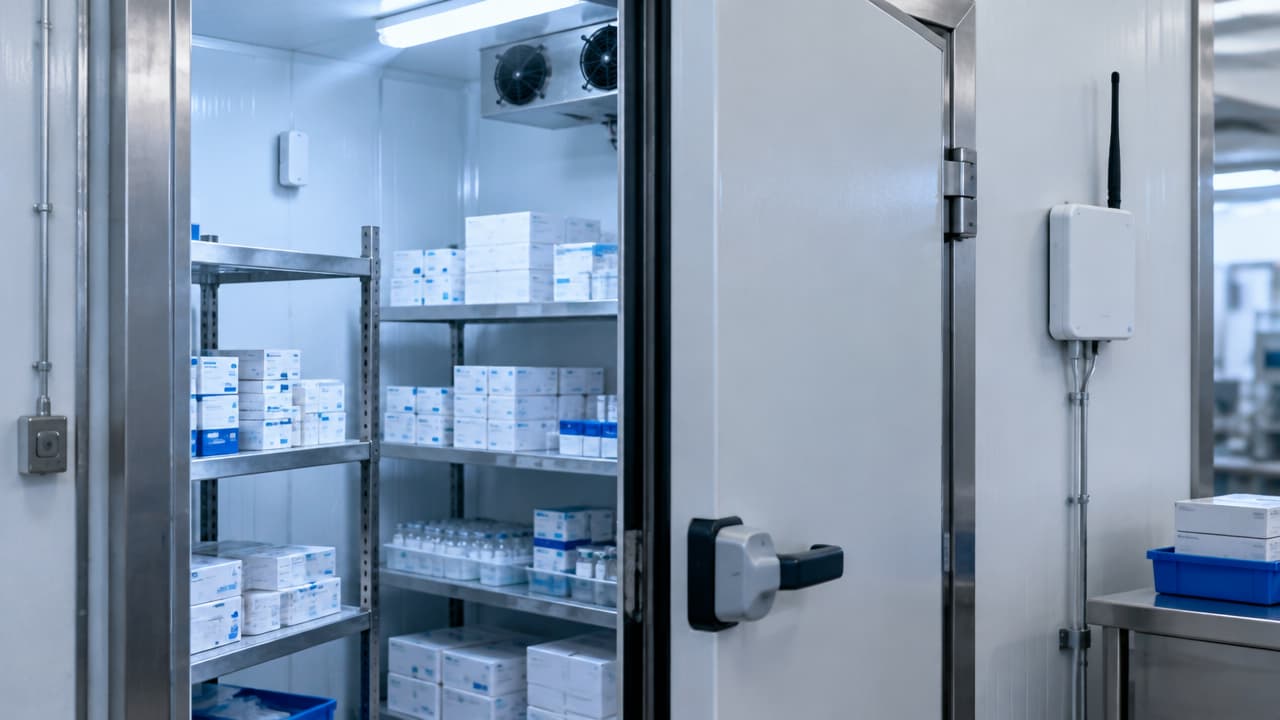
In a medication refrigerator, the Satellite Sensor measures temperature and transmits the reading by radio to a concentrator. LoRa handles that transport; it does not measure temperature nor guarantee, by itself, that the alert will reach the team. In critical areas, installation is reliable only when coverage, records, connectivity, and operational response work together.
The factors that determine a reliable installation
- LoRa transmits data between the sensor and the concentrator without requiring WiFi on that link.
- Walls, metal, antennas, and transmission frequency alter coverage and consumption.
- The concentrator needs cloud connection to forward alerts; the buffer preserves records during outages, but does not deliver alerts immediately.
- Calibration, qualification, and predictive analysis belong to the complete system, not the radio.
LoRa transmits the reading, but does not measure temperature
The sensor and radio perform different functions. The Satellite Sensor STE measures temperature; the STH measures temperature and humidity. The measurement circuit generates the data, and the LoRa radio sends packets to a nearby concentrator.
LoRa is a radio communication technology. LoRaWAN is a network protocol that can use this technology, but the names are not interchangeable. DROME specifies the LoRa link between its sensors and the CTD Concentrator; it is not necessary to assume that this link is a LoRaWAN network. The LoRa Alliance description of LoRaWAN helps distinguish the protocol from the radio layer.
Greater range and low consumption come with capacity limits and depend on link configuration. In practice, the interval between transmissions affects energy spent and how quickly a new reading reaches the concentrator. Therefore, measurement interval and transmission interval must be evaluated separately.
DROME architecture separates the radio link from cloud connection
In DROME architecture, STE or STH sensors send readings via LoRa at 915 MHz frequency to the CTD Concentrator. The CTD forwards data to the cloud via Ethernet, WiFi, or cellular modem. Thus, the sensor does not depend on local WiFi to communicate with the concentrator, but the concentrator needs an outbound connection to transmit records and alerts to the cloud.
The declared autonomy of the Satellite Sensor is 12 months, and the declared range is up to 2 km. These values are not guarantees for any building: they depend on the environment, configuration, and installation conditions. A cold storage unit inside a hospital is not equivalent to an unobstructed line of sight.
Metal walls change coverage and consumption
Metal structures can reflect, attenuate, or block the signal. Closed doors, insulating panels with metal coating, and equipment between the sensor and antenna alter the radio path. A reading that arrives with the door open during installation does not prove it will arrive under normal operating conditions.
Antenna position and orientation also matter. Additionally, more frequent transmissions can increase consumption; weak signal conditions may require additional send attempts and reduce autonomy. The team must test the link at the actual installation point, with doors closed and assets in their usual position.
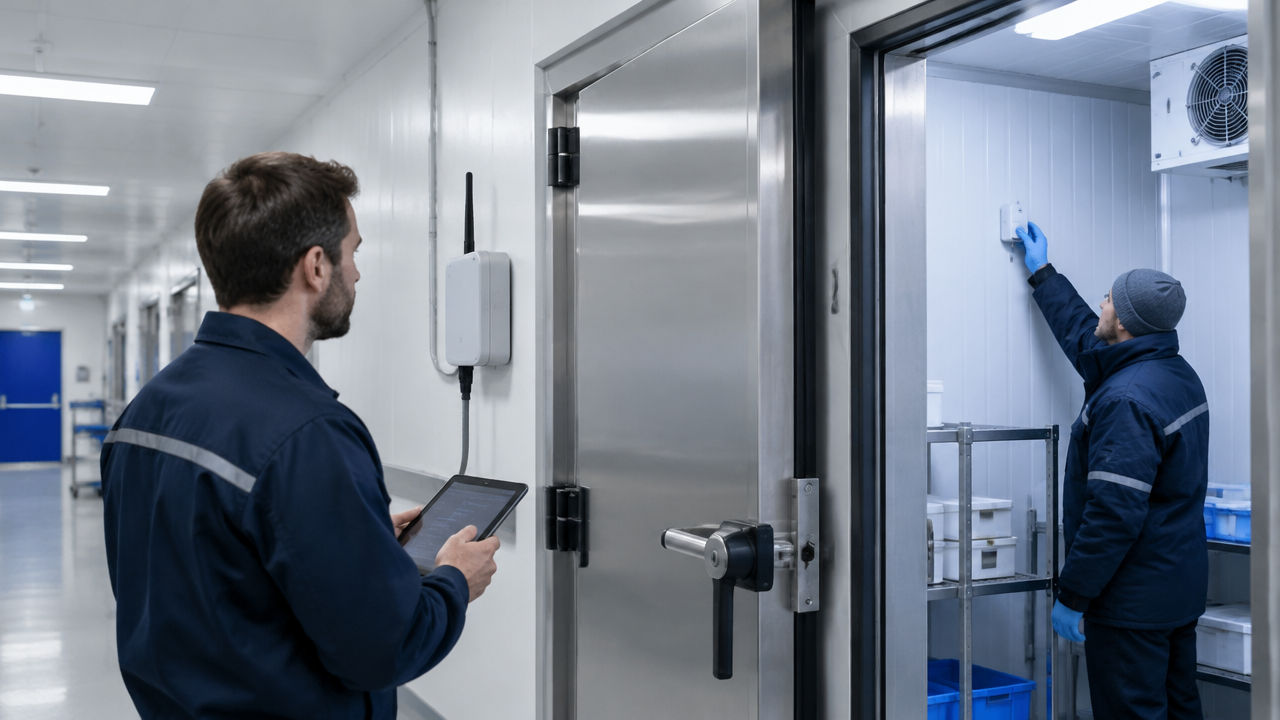
This survey is especially useful in cold storage units, blood banks, and areas with multiple metal barriers. Record where the signal was tested and repeat the test if the team relocates the concentrator, antenna, or room layout.
The buffer preserves records, but does not replace real-time alerts
The CTD Concentrator has a declared 12-hour battery and buffer for 20 days of records. If the external connection drops, local storage can preserve data for later transmission when communication returns. This protects historical continuity, but does not mean an alert will be delivered to the team during cloud connection unavailability.
In evaluation, it is worth distinguishing three events: power loss, loss of the link between sensor and concentrator, and loss of the concentrator's connection to the cloud. Each can affect a different stage. Test how the system signals each condition, which records it maintains, and when pending data is sent after recovery.
Which criteria should you evaluate before approving installation?
- Validated coverage: test each planned position, including with doors closed and barriers in normal condition.
- Defined intervals: confirm the periodicity of measurement and transmission, which may differ.
- Measured latency: record the time between reading, cloud receipt, and team notification.
- Traced calibration: verify certificates, sensor identification, and calibration history.
- Tested failures: evaluate power loss, radio interruption, and cloud access unavailability.
- Verified recovery: check if stored records are sent after reconnection and if gaps remain identifiable.
For a medication refrigerator or blood bank, it is not enough to verify that a value appears on the dashboard. The test must show that the reading arrives within a timeframe compatible with the process and that a communication failure is not confused with stable temperature.
Compliance depends on the system and records
LoRa, by itself, does not prove compliance with ANVISA or FDA. The evaluation considers system use, calibration, record integrity, audit trail, and IQ/OQ/PQ qualification. RDC 658 addresses good manufacturing practices for medicines; 21 CFR Part 11 addresses records and electronic signatures in applicable contexts. The 21 CFR Part 11 rule in eCFR describes the corresponding regulatory requirements in the United States.
Therefore, document the installation and test the complete flow: from calibrated sensor to stored record to received notification. The radio protocol is only one part of that evidence.
Transmitting measurements is not the same as anticipating failures
A limit alert warns when temperature crosses a configured range. Predictive analysis looks for patterns that may precede that excursion, allowing investigation before the product goes out of range. The first function depends on limits and measurements; the second depends on asset data analysis.
DROME Predict crosses more than 15 parameters from the same asset. According to data provided by DROME, it can alert 30 to 60 minutes before failure, with indication of cause and corrective action. This prediction is not produced by LoRa or temperature alone: the radio transports data, while the analytics layer interprets equipment behavior.
Before choosing an installation, request evidence of coverage at the site, record continuity and recovery, and total time until the team receives an alert. The operational question is whether there is still time to act before loss of range.
Frequently asked questions
What is LoRa in temperature monitoring?
LoRa is a radio technology used to transmit data over long distances with low energy consumption. It does not measure temperature. A sensor, such as the Satellite Sensor STE, performs the measurement; the radio sends that reading to a concentrator. LoRaWAN is a network protocol that can use LoRa, but the terms are not synonymous.
Do LoRa sensors need WiFi?
Not for communication between the Satellite Sensor and CTD Concentrator: that link uses LoRa radio. The concentrator, however, needs a connection route to the cloud via Ethernet, WiFi, or cellular modem. Without this access, it can store records but cannot forward alerts to the cloud at that time.
Why can the LoRa signal fail inside a cold storage unit?
Walls, doors, and metal panels can attenuate or block the signal, especially in cold storage units with metal coating. Antenna position and orientation, distance, and transmission frequency also influence coverage and battery consumption. Therefore, it is worth testing the link on-site before approving installation.
Does LoRa guarantee compliance with ANVISA or FDA?
No. LoRa defines a form of radio communication, not compliance of the entire system. The evaluation also considers calibration, integrity and traceability of records, access control, failure handling, and IQ/OQ/PQ qualification. Applicable requirements depend on use and the regulatory context of the facility.
How do you differentiate a temperature alert from a failure prediction?
Predictive analysis uses more information than an isolated temperature reading. According to data provided by DROME, DROME Predict crosses more than 15 parameters from the same asset and can alert 30 to 60 minutes before failure, indicating cause and corrective action. This capability comes from analysis, not from LoRa radio.
Read next
Cold Chain: Anticipate Failures with Real-Time Data
See how real-time data helps predict cold chain failures, reduce losses, and accelerate response in critical operations.
Hidden Costs of Hospital Cold Chain Waste
Financial impacts and clinical risks of hospital cold chain waste due to equipment failures and inadequate storage.
Using hwmonitor to Monitor Temperature-Sensitive Supplies
Learn how to use hwmonitor with IoT sensors to control temperature and issue real-time alerts for temperature-sensitive supplies.