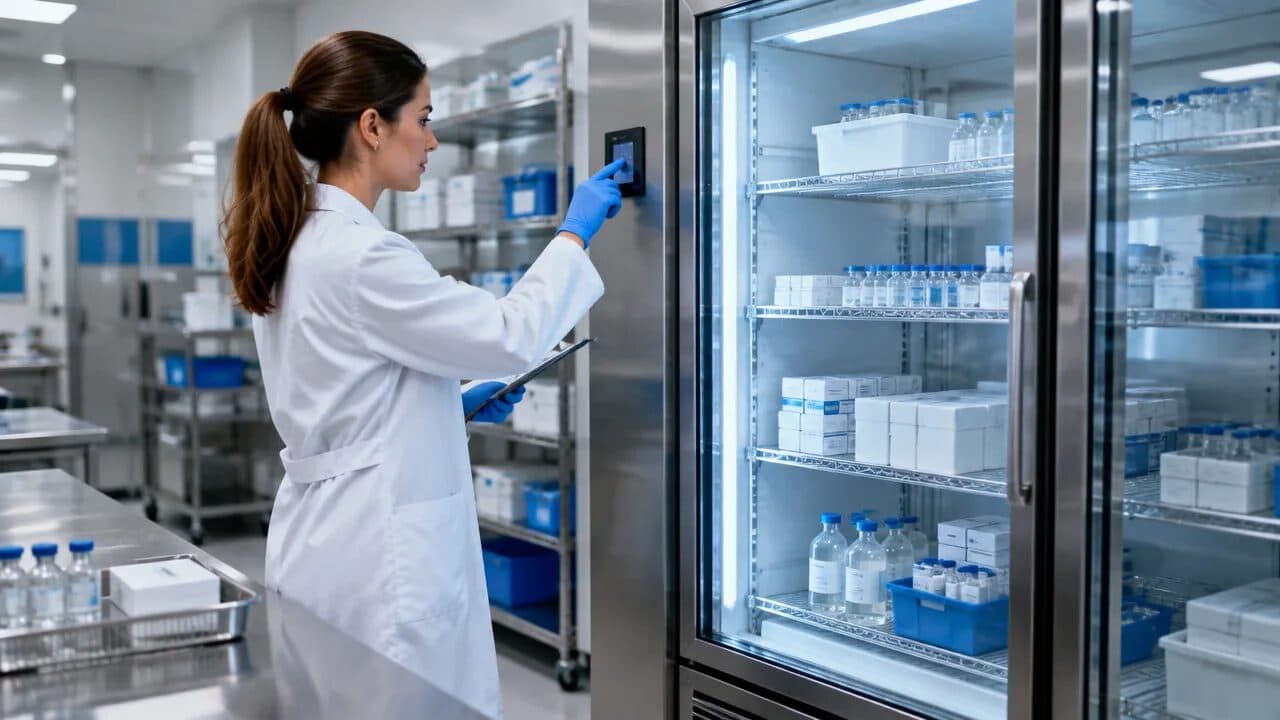
During Breast Cancer Awareness Month, cancer care gains visibility. For hospital pharmacy, protecting monoclonal antibodies like trastuzumab begins before infusion: it requires controlling each transfer and deciding with evidence when a thermal excursion occurs. Many closed vials require storage between 2 °C and 8 °C, but this range does not automatically apply to transport, preparation, or administration.
Control depends on the stage and drug presentation
- Verify the package insert conditions and stability data of the product received.
- Record temperature from receipt through storage, internal transfer, and preparation.
- Treat historical data, limit alarms, and failure prediction as separate functions.
- Segregate affected units and document evaluation before deciding their disposition.
The thermal chain continues after the drug arrives at the pharmacy
Risk can emerge at the receiving dock, during volume verification, in refrigerator or cold room storage, during internal transfer, and while waiting for preparation. Entry time into equipment and time outside it must be traceable, especially during shift changes or delays in the preparation room routine.
The package insert for the presentation actually used defines specific conditions. An official product information for trastuzumab, for example, describes refrigerated storage of the closed vial and specific conditions after reconstitution or dilution. This illustrates why the storage range should not be extended, without verification, through administration.
A vial with no visible change does not prove it maintained stability. Similarly, an excursion alone does not prove loss of efficacy nor mandate automatic disposal. Isolate potentially affected units, preserve lot identification, and ask the responsible pharmacist to evaluate duration, magnitude, and manufacturer guidance before recording the decision.
RDC 220/2004 addresses the operation of Antineoplastic Therapy Services. Its regulation covers storage and transport under conditions that preserve physicochemical stability, transport in isothermal containers, and records that allow tracing steps. Practical application must consider the official text of RDC 220/2004 and local health regulations. Thermal history aids audit, but does not replace procedures, equipment qualification, or pharmaceutical evaluation.
Sensor placement changes what the team can interpret
The sensor records air temperature at the point where it was installed. The product does not necessarily heat or cool at the same rate. Therefore, use thermal mapping to choose representative positions, considering hot and cold zones, air circulation, and load distribution. Avoid installing the sensor near the door or air outlet without justifying this position with thermal mapping.
Traceable calibration provides the basis for reading; alert limits and escalation provide operational consequence to the data. Define who receives the alert each shift, how much time they have to acknowledge it, and who assumes responsibility if there is no response. The contingency plan must also indicate how to transfer medications and how to record the decision when the refrigerator fails.
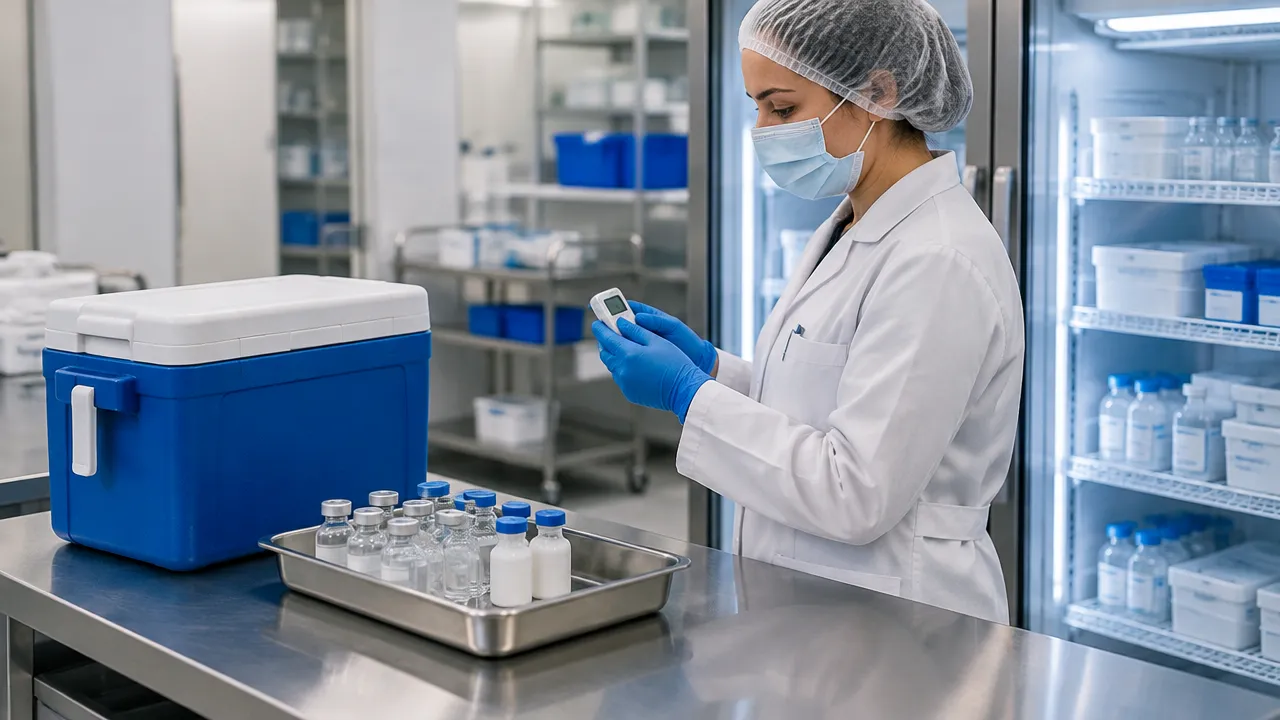
A trend may require investigation before the alarm limit
Consider a hypothetical example: the reading rises from 6.2 °C to 6.8 °C over 25 minutes, although the upper limit defined by procedure has not yet been reached. This trend does not confirm a failure nor determine universal action. It may justify early verification of equipment, door, load, and thermal curve, per local procedure.
Continuous recording shows the curve over time. Limit alarm warns when measurement crosses a configured value. Failure prediction seeks patterns that may precede excursion. These are complementary resources, not different names for the same alert.
In investigation, gather time, equipment identification, medications and potentially affected lots, thermal curve, alert acknowledgment, and actions taken. Also record pharmaceutical evaluation, manufacturer consultation, and justification for releasing, quarantining, or discarding units.
Data collection and failure prediction serve distinct roles
In DROME, the STE Satellite Sensor measures temperature and sends readings via LoRa to the CTD Concentrator. The CTD battery can sustain operation for up to 12 hours, and its buffer stores data for up to 20 days. These resources support collection continuity during interruptions, but do not maintain refrigeration nor guarantee remote alerts when connectivity is lost.
A record from an STE alone does not equal multivariate prediction. DROME Predict crosses more than 15 parameters from the same asset to identify patterns associated with failures. The platform was trained on 450,000 real labeled failures and can issue alerts with informed advance notice of 30 to 60 minutes, including cause and corrective action. This does not mean it predicts every occurrence.
Alerts can arrive via WhatsApp, SMS, email, or voice. The channel only produces useful response when linked to responsible parties, alert acknowledgment, and actions defined in the operational plan. Without this flow, the team may receive a notification without knowing who investigates or protects the medications.
A practical check closes gaps between reading and decision
- Confirm storage conditions in the package insert for each presentation.
- Verify thermal mapping, sensor position, and traceable calibration.
- Test alert limits, shift escalation, and alert acknowledgment.
- Define segregation, manufacturer consultation, and pharmaceutical decision for excursions.
- Verify records preserve curve, times, affected lots, and actions taken.
If you want to evaluate how this data flow can work in your environment, contact us at DROME.
Frequently Asked Questions
What temperature should be maintained for heat-labile oncologic medications?
The correct temperature depends on the presentation and process stage. Many closed vials of monoclonal antibodies remain between 2 °C and 8 °C, but transport, preparation, and administration follow the package insert and specific stability data. Confirm the condition of the product used by your service, rather than applying a general range.
Does every thermal excursion require medication disposal?
No. An excursion requires identifying and segregating potentially affected units, recording duration and magnitude, and referring the case to the responsible pharmacist. The decision must consider stability data and manufacturer guidance, with documented justification. The occurrence alone does not determine loss of efficacy nor mandate automatic disposal.
Does the sensor measure medication temperature inside the vial?
Generally, the sensor installed in the equipment records air temperature at the point where it was placed, not the temperature inside each vial. Thermal mapping helps choose representative positions. Since product and air may respond at different rates, evaluate the curve and context before deciding.
How to prevent refrigerator failures in oncology pharmacy?
Combine continuous recording with alert limits defined by procedure, sensors positioned per thermal mapping, and traceable calibration. Determine who receives each alert, how the on-call staff confirms receipt, and what actions they must take. Include contingency for equipment failure and record investigation and response adopted.
Read next
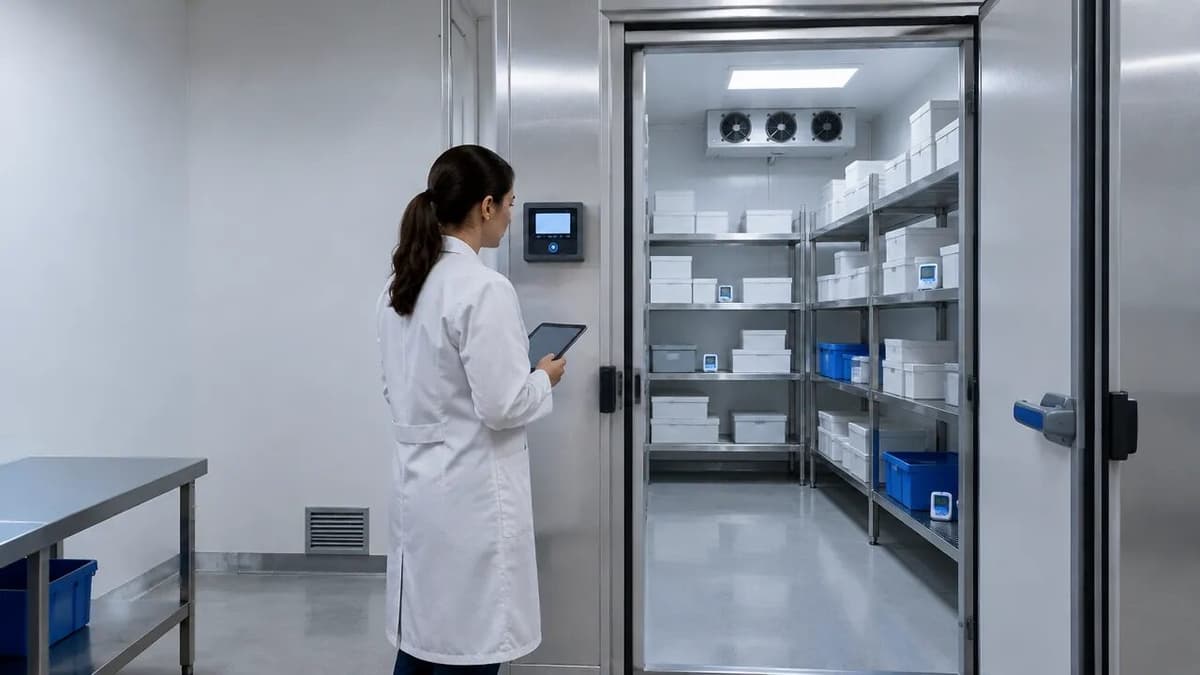
Cold Chamber Thermal Requalification: When to Repeat
Learn when to reassess thermal qualification of cold chambers, how to analyze installation and load changes, and what to document before rel…

7 Essential Vaccine Storage Practices at Fleury
Learn procedures for IoT sensor monitoring, preventive maintenance, and strict cold chain control at Fleury Vaccines.

7 Common Vaccine Monitoring Errors and How to Fix Them
Discover frequent vaccine monitoring errors and learn how to avoid failures to ensure safety and efficacy.