
Predictive failure assessment of pressure devices serves to identify deviations before equipment enters open failure. It is especially useful in hospitals, laboratories, and pharmaceutical operations, where an inaccurate reading can generate operational risk, loss of supplies, and interruption of critical processes. In practice, the greatest value lies in transforming seemingly small signals—such as drift, oscillation, and slow response—into prioritized maintenance decisions.
When this assessment is performed with continuous monitoring, telemetry, and analytical models, the team stops acting only by calendar or by late alarm. This is where DROME's approach gains relevance: using AI to anticipate risks in critical environments and support response before operational impact.
Highlights that really matter
- Failure rarely begins at the moment of alarm; it usually leaves prior signals in asset behavior.
- Pressure devices require contextual analysis, because the same deviation may be irrelevant in one line and critical in another.
- Predictive models work best when they combine history, usage regime, environment, and process criticality.
- Maintenance based solely on periodicity trades predictability for waste, especially in assets with uneven wear.
- Operational gain is not just avoiding downtime, but prioritizing what must be addressed first.
Why pressure devices fail before they "break"
In most cases, the problem appears first as performance degradation, not as immediate failure. A transmitter may begin to drift, a sensor may lose stability in certain cycles, or the system response may become slow at peak moments. If analysis is only binary—working or not working—these signals go unnoticed.
In critical environments, this detail changes risk management. A small reading error can cause inadequate adjustment, false alarm, out-of-range operation, or false sense of normalcy. That is why predictive assessment must look at asset trajectory, not just current state.
The central point is simple: a pressure failure almost never appears from nowhere. It is usually preceded by measurable patterns, provided the operation has consistent data to see them.
Which signals indicate growing failure risk
The most useful signals are those that show persistent change in behavior. An isolated event may be noise, but consistent repetition suggests real deterioration. In pressure devices, this applies to both electronic components and mechanical parts, and to the interaction between them.
What to watch for before open failure
- Gradual drift of measurement relative to expected standard.
- Frequent oscillations without equivalent change in the process.
- Longer response time after startups, peaks, or cleaning.
- Increase in intermittent alarms in the same operating range.
- Recurring difference between devices that should read similarly.
- Loss of stability after maintenance or calibration.
These indicators become more valuable when compared with context. A sensor in a clean room, for example, tends to degrade differently from a sensor exposed to vibration, humidity, or intense thermal cycles.
What data makes prediction reliable
Prediction depends less on a single measurement and more on the combination of history, collection frequency, and operational context. In other words, raw data gains value only when it allows answering whether the asset changed, when it changed, and under what condition it changed.
To achieve this, it is worth structuring analysis in layers:
| Layer | What it captures | Why it matters |
|---|---|---|
| Pressure signal | Trend, peaks, noise, drift | Shows direct change in device behavior |
| Operational condition | Load, cycle, temperature, humidity | Explains why the deviation occurred in that situation |
| Technical history | Calibration, maintenance, part replacement | Helps differentiate recurring failure from recent adjustment |
| Criticality | Clinical, productive, or regulatory impact | Defines the real priority for intervention |
Without this structure, the team sees alarms. With it, the team sees evolving risk.
How AI prioritizes what needs action first
The best use of artificial intelligence is not to replace engineering, but to expand its screening capacity. Instead of listing all deviations with equal weight, the analytical model evaluates historical pattern, deterioration speed, and potential impact to point out which assets require immediate response.
This is decisive in operations with many equipment. Without prioritization, the team reacts to the loudest item. With prioritization, it acts on the item with the greatest chance of generating loss, not necessarily the one that alarmed most.
In DROME's approach, this gain comes from combining continuous monitoring, telemetry, and learning models that recognize anomalies and evolve with new data. The expected result is not just an early alert, but a smarter reading of operational urgency.
When calendar-based maintenance leaves money and safety on the table
Replacing, adjusting, or inspecting everything on the same schedule seems prudent, but usually mixes healthy assets with assets in real degradation. The effect is well known: part of the team stays busy with low-value routine while the most important signals compete for attention.
In pressure devices, this problem is even more sensitive because wear does not advance at the same rate across all points of operation. Two identical sensors may age differently because of installation, process, environment, and usage load.
Where predictive assessment usually generates the most results
- Lines with frequent pressure and load variation.
- Processes where reading influences safety, quality, or compliance.
- Equipment whose access for inspection is difficult or disruptive.
- Environments with large asset volume and lean staff.
In these scenarios, predicting better means intervening fewer times, but at the right moment.
How to implement without halting operations
The most efficient implementation starts small and guided by criticality. It is not necessary to model the entire asset fleet in the first month. It makes more sense to start with devices whose failure affects safety, cold chain, process quality, or clinical continuity.
A practical roadmap includes:
- Map pressure devices by operational criticality.
- Standardize collection, frequency, and data quality.
- Link maintenance events to measurement history.
- Define anomaly criteria and response levels.
- Validate the model with the technical team and adjust false positives.
- Gradually expand to other assets and areas.
This design reduces friction and accelerates confidence. When the team sees that the system helps make better decisions, adoption grows naturally.
What changes for hospitals, laboratories, and pharmaceutical industry
The benefit is not just technical, but operational and strategic. In hospitals, anticipation reduces the risk of unavailability in sensitive systems. In laboratories, it improves process stability and preserves traceability. In pharmaceutical industry, it strengthens control, continuity, and predictability in stages that do not tolerate silent deviation.
In all these contexts, maturity lies in moving away from reactive monitoring and advancing toward risk-oriented prevention. This is exactly the movement that differentiates solutions like DROME's: the platform does not limit itself to recording behavior, it uses history to indicate when behavior begins to deviate from expected.
When minutes make a difference, predicting failure stops being a convenience. It becomes a concrete layer of operational protection.
Frequently asked questions
What is predictive preventive maintenance in pressure devices?
Predictive maintenance is the approach that monitors real equipment behavior to estimate when failure risk begins to rise. In pressure devices, this includes drift trend, signal instability, out-of-pattern response, and correlation with temperature, vibration, and usage regime.
What are the most useful failure analysis methods in this context?
The most useful methods combine functional inspection, trend analysis, comparison with historical pattern, anomaly evaluation, and correlation between operational variables. In critical environments, the gain appears when these methods stop being isolated and start feeding automatic risk prioritization.
What instrument is used in predictive maintenance to assess pressure devices?
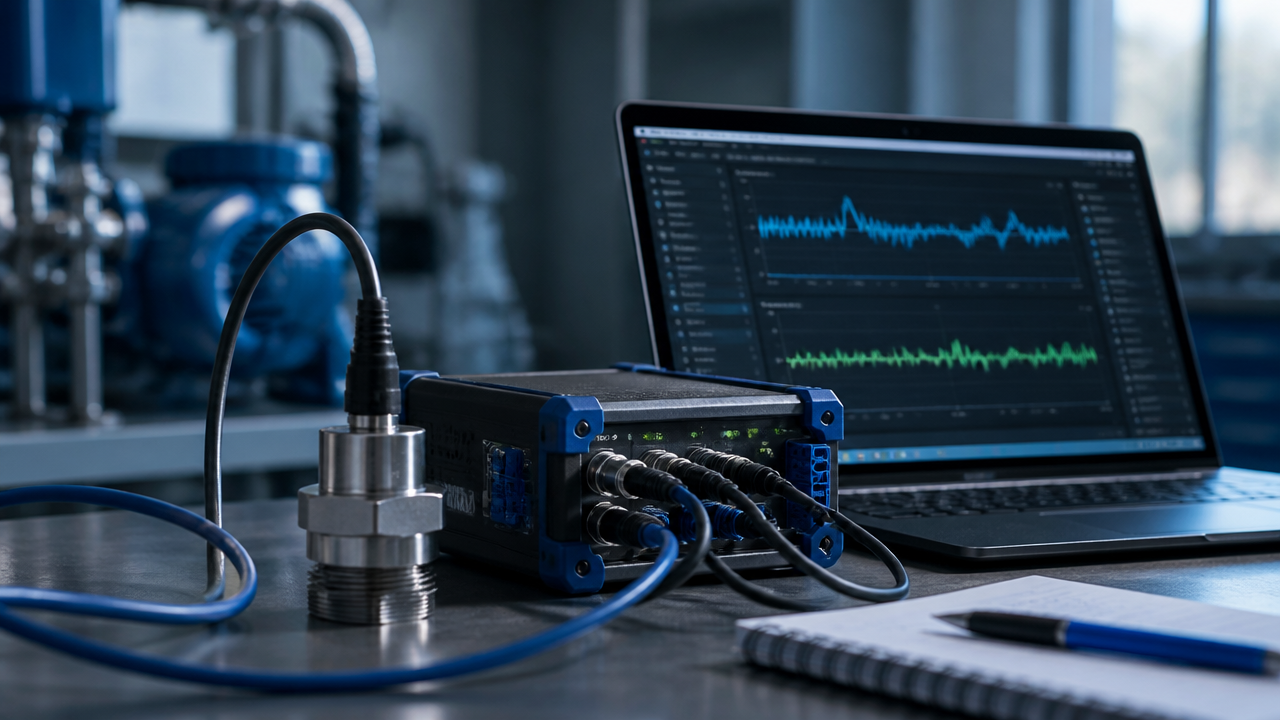
The instrument varies depending on the asset, but the logic is the same: reliable sensors, continuous telemetry, and analytical software. In pressure devices, transmitters, dataloggers, and platforms with analytical intelligence allow seeing subtle deviations that rarely appear in spot manual inspections.
What do MTTR and MTBF mean in predictive assessment?
MTBF and MTTR remain relevant, but are not sufficient alone. For pressure, it is worth monitoring signal drift, alarm frequency, time out of range, recurrence after adjustment, and asset criticality. These indicators help separate a point deviation from a forming failure.
What are two examples of predictive maintenance in pressure devices?
Two practical examples are monitoring a transmitter that begins to oscillate before losing stability and identifying a valve or pressurized line whose behavior changes after repeated cycles. In both cases, intervention occurs before downtime, supply loss, or clinical risk.
Read next

Operational Data for Predictive AI in 2026
Learn how to organize operational data for predictive AI in 2026 and transform telemetry, context, and history into faster, safer decisions.

AI in Clinical Emergencies: Faster, Safer Decisions
See how AI helps hospitals prioritize risks, accelerate responses, and support safer clinical decisions in emergency scenarios.

Interpreting Probabilities in Industrial Predictive Models
Learn how to interpret probabilities in predictive models to anticipate equipment failures and improve industrial asset management.