
Parameterizing AI to detect risks in clean rooms means transforming a complex environment into operational signals that the system can interpret with context. This is especially useful for quality, engineering, facilities, and production teams that need to act before an environmental variation becomes a deviation, batch loss, or shutdown. In practice, good configuration combines the right sensors, reliable history, dynamic limits, and continuous model review.
In critical environments, the goal is not just to receive alerts. It is to recognize the patterns that precede failures, distinguish noise from real risk, and prioritize what threatens operational stability. This is exactly where platforms like DROME gain relevance, by combining continuous monitoring, telemetry, and predictive intelligence.
Key points to get parameterization right
- Start with operational risk, not the algorithm. First define what can compromise product, process, or compliance.
- Monitor variables that influence each other, such as particles, pressure, temperature, humidity, doors, and equipment status.
- Create a baseline by context, separating shifts, routines, campaigns, and different operating modes.
- Use fixed and dynamic limits together, because compliance and anticipation solve distinct problems.
- Validate alerts with operations, to reduce false positives and increase system confidence.
- Recalibrate the model whenever there is maintenance, filter replacement, layout change, or process modification.
The first step is defining which risks the clean room really needs to anticipate
Parameterization works best when it comes from concrete failure scenarios. Before talking about the model, it is worth listing which events have real impact, such as particle increase, loss of differential pressure, thermal oscillation, humidity outside range, slow recovery after door opening, and HVAC system degradation.
This mapping avoids a common mistake: monitoring everything with equal weight. In a clean room, not every deviation has the same urgency. A brief temperature spike may have less impact than a persistent trend of unstable pressure between areas with different classifications. The AI must reflect this risk hierarchy.
A practical way to start is to organize events into three groups:
- contamination risks, linked to particles, pressure, and personnel flow
- environmental stability risks, linked to temperature, humidity, and recovery
- infrastructure risks, linked to HVAC, filters, doors, power, and sensors
When configuration starts from this logic, the system stops merely recording deviations and begins to prioritize what truly threatens the environment.
Which parameters should AI monitor in a clean room?
The best models observe a lean set of critical variables, but with good temporal quality and operational context. Instead of feeding the algorithm with everything that exists, the most effective strategy is to choose signals that explain environmental behavior and reveal cause-and-effect relationships.
In most cases, the foundation includes particles, differential pressure, temperature, relative humidity, door status, HVAC alarms, occupancy regime, and cleaning or maintenance events. When applicable, vibration, exhaust status, stabilization time after intervention, and data from equipment that alters thermal load or airflow also enter.
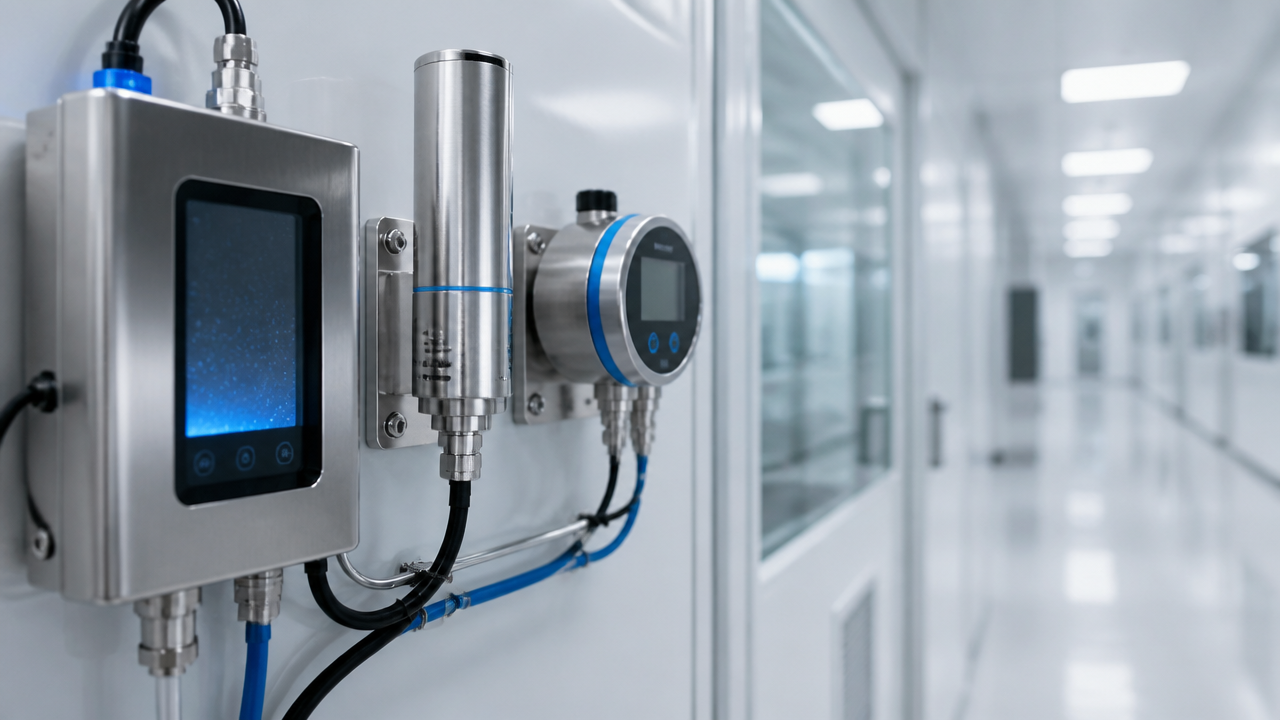
The decisive point lies in signal combination. Particles alone tell an incomplete story. Particles associated with pressure drop, recurrent door opening, and slow system response already form a much more useful pattern for early detection. The DROME platform can exploit exactly this type of correlation to transform dispersed data into actionable alerts.
Good baseline is more important than sophisticated model
AI performance depends less on algorithm name and more on reference behavior quality. A well-built baseline shows how the room behaves when stable, allowing identification of relevant deviations before they reach the critical limit.
This baseline should not be unique for the entire operation. Clean rooms change profile as shift, campaign, workload, hygiene routine, and human intervention change. If the model mixes different contexts as if they were equal, it learns false normalities and either alerts too much or too little.
In practice, it is worth segmenting data by context:
- hours of higher and lower occupancy
- days with production and days without production
- periods before and after maintenance
- startup, stable regime, and shutdown situations
It is also important to clean the history. Data with miscalibrated sensors, long gaps, or unannotated events can contaminate training. In critical environments, a simple model trained on reliable data is usually more useful than a complex model fed with noise.
Is it better to use fixed limits or dynamic limits?
The safest answer is to use both. Fixed limits remain the reference for formal control, qualification, and immediate response. Dynamic limits help identify abnormal trends, even when the variable is still within acceptable range.
This combination solves a typical clean room problem: many deviations do not start with a sudden rupture. They appear as gradual deterioration. Pressure is still compliant, but oscillates more than usual. Temperature stays within range, but takes longer to recover. Particle count did not spike, but lost stability.
This is exactly where AI creates value. Instead of waiting for the traditional alarm, the system learns the expected pattern and signals when the environment begins to behave atypically. For operations, this means more time to investigate cause, adjust equipment, and avoid non-compliance.
| Layer | Main function | Practical example |
|---|---|---|
| Fixed limit | Ensure compliance and immediate response | Pressure below defined minimum |
| Dynamic limit | Detect unusual trend | Pressure oscillation above historical pattern |
| Signal correlation | Understand probable cause | Elevated particles after frequent door opening |
Can AI detect risk before non-compliance occurs?
Yes, as long as parameterization has operational context and governance. The model does not predict the future magically. It identifies patterns that, in history, tend to appear before loss of stability. When these signals repeat, the team receives an early indication to act.
In practice, this can appear in several forms:
- increased variability before formal deviation
- longer recovery time after door opening
- gradual behavior change after filter replacement
- abnormal relationship between temperature, humidity, and system load
The operational gain is significant because response becomes planned, not reactive. Instead of acting only when the room has already deviated from pattern, the team investigates weak signals while there is still margin for correction. This reasoning aligns with DROME's positioning, which proposes moving from purely reactive monitoring to predictive management of critical environments.

How to validate the model without creating an avalanche of alarms?
Validation should measure operational utility, not just technical accuracy. A good model is one that helps the team decide earlier and with more confidence. If it generates dozens of barely relevant alerts per shift, it quickly loses credibility.
The safest path is to validate in stages. First, run the model in observation mode and compare alerts with real events, interventions, and documented deviations. Then, classify results with the team to separate false positives, useful alerts, and critical alerts. Only then advance to routine use.
Some practical criteria help a lot:
- define severity by operational impact
- group repeated alerts from the same event
- require minimum persistence for certain signals
- record operations feedback to reclassify patterns
This review cycle avoids alarm fatigue and improves the model over time. In mature operations, AI becomes a decision support layer, not an automatic noise generator.
Effective parameterization is a living process, not a one-time configuration
In clean rooms, the environment changes whenever the process changes. Therefore, parameterization must be treated as a continuous improvement routine. Filter replacement, layout change, new thermal load, SOP review, and occupancy change require baseline and dynamic threshold reevaluation.
The practical recommendation is to review the model at defined operational milestones and also after relevant events. This continuous monitoring increases team confidence and prevents an initially good model from becoming outdated. When integrated into a platform capable of consolidating history, telemetry, and equipment behavior, like DROME, this process becomes more scalable and more useful for critical environments.
In the end, parameterizing well is not about choosing the most sophisticated AI. It is about teaching the system to recognize what really matters in your context, with reliable data, risk logic, and review discipline. This is how early detection stops being a promise and becomes operational routine.
Frequently asked questions
Which parameters should AI monitor in a clean room?
Minimum parameters typically include particles, differential pressure, temperature, humidity, environment recovery time, and door opening events. In more sensitive operations, vibration, filter status, cleaning regime, and behavior of equipment affecting area stability also apply.
Can AI detect risk before non-compliance occurs?
Yes, as long as configuration is done with operational context. AI identifies subtle deviations, combines signals from multiple sensors, and learns the normal behavior of each environment. The gain appears when the model differentiates an acceptable oscillation from a pattern that usually precedes loss of environmental control.
Is it better to use fixed limits or dynamic limits?
No. Fixed limits remain important for safety, qualification, and compliance. What changes is that they stop being the only protection layer. AI adds dynamic limits and trend analysis to anticipate deviations that have not yet exceeded the formal critical value.
How to start parameterizing an AI model for a clean room?
Start with clean, reliable history, without major gaps and with well-classified events. Then define critical variables, separate periods by shift or process, train a baseline of normal behavior, and validate alerts with quality, engineering, and operations before putting the model into routine.
What errors most hinder risk detection in clean rooms?
The most common errors are training the model with bad data, ignoring process changes, mixing environments with different profiles, and generating too many alerts. Another recurring problem is failing to review the model after maintenance, filter replacement, layout change, or production regime modification.
Read next

Predict Pressure Device Failures with AI
See how predictive analytics helps anticipate pressure device failures using data, telemetry, and AI in critical environments.

Operational Data for Predictive AI in 2026
Learn how to organize operational data for predictive AI in 2026 and transform telemetry, context, and history into faster, safer decisions.
AI in Clinical Emergencies: Faster, Safer Decisions
See how AI helps hospitals prioritize risks, accelerate responses, and support safer clinical decisions in emergency scenarios.