
A medication refrigerator may continue displaying local temperature while the system stops sending records or alerts. Validating monitoring means demonstrating that the installed configuration meets the intended use, including when power or communication fail. For quality, clinical engineering, and pharmacy, the work begins with risks and ends with evidence approved by the institution.
What must be demonstrated before releasing the system
- Requirements describe clinical and operational use, limits, and expected response.
- Tests cover sensor, transmission, records, alerts, access, and relevant contingencies.
- Calibration, qualification, and validation produce different and complementary evidence.
- The supplier proves product characteristics; the institution verifies configuration and approves its use.
Validation demonstrates fitness for use, not a collection of certificates
Validation documents that a system meets requirements defined for a specific purpose and remains adequate within established conditions. A manufacturer's certificate may support part of the assessment, but does not prove that the refrigerator, limits, alert recipients, and your institution's network were configured correctly.
It is also advisable to separate four activities that sometimes appear mixed. Validation covers the system and its use. IQ, OQ, and PQ organize checks for installation, operation, and performance. Calibration evaluates the metrological response of the sensor against a reference. Traceable calibration does not test software, and a functional test does not calibrate the sensor.
| Activity | What it verifies |
|---|---|
| IQ | Installation, component identification, location, and documented configuration. |
| OQ | Functions, limits, alarms, access, and expected behaviors. |
| PQ | Performance at the site and under conditions defined by the institution. |
| Calibration | Sensor response compared to a reference, within the range and at defined points. |
Define intended use and requirements before writing tests
Start by recording which equipment will be monitored, what products it stores, who tracks the data, and what decision depends on it. For a medication refrigerator, describe the operational range approved by the institution, the required reading interval, who receives each alert, and what procedure begins after an excursion.
Transform these needs into verifiable requirements. For example: "when temperature exceeds the configured limit, the system records the event and sends the alert to defined recipients." Also specify what counts as delivery, what evidence will be kept, and how the team acts if no one acknowledges the warning. Pharmacy defines use and response; quality approves criteria; clinical engineering verifies installation; IT participates when network, identity, or security are in scope.
Risk assessment determines protocol depth
Prioritize scenarios that could compromise medications or make records unavailable, incomplete, or difficult to attribute. Evaluate impact, probability, and ability to detect failure. A sensor out of position, an alert sent to an outdated contact, and a data gap during network outage have different consequences and require specific controls.
The validation plan should indicate scope, responsible parties, prerequisites, acceptance criteria, required evidence, and rules for deviations. Do not reduce effort just because the system was already tested by the manufacturer. Use existing documents as supplier evidence, then determine which local verifications still need to be done. The risk-based approach adjusts tests; it does not eliminate the need to demonstrate critical requirements.
IQ, OQ, and PQ must test the complete data chain
The protocol should follow the reading from the sensor to the on-call decision. In a refrigerator, include at least the tests that correspond to the requirements and risks identified:
- Compare sensor readings with a calibrated reference, at the points and conditions defined in the protocol.
- Configure limits and confirm recording, time, unit of measure, and expected behavior at each limit.
- Send test alerts through each contracted channel and verify recipients, acknowledgment, and escalation.
- Simulate power loss and communication interruption; confirm local behavior and record recovery after restoration.
- Retrieve history and verify gaps, duplicates, temporal ordering, and event identification.
- Test access profiles and, when part of intended use, the audit trail for limit and configuration changes.
Record precondition, step executed, expected result, observed result, and identified evidence. A test that only confirms "the alert arrived" is insufficient if the requirement also demands correct recipient, event recording, and escalation.
Power and communication failures require trials with explicit limits
In DROME architecture, the STE Satellite Sensor sends temperature to the CTD Concentrator, which forwards data to the cloud. The CTD has a declared 12-hour battery and 20-day buffer. These values should guide continuity scenarios, not be treated as proof of unrestricted availability.
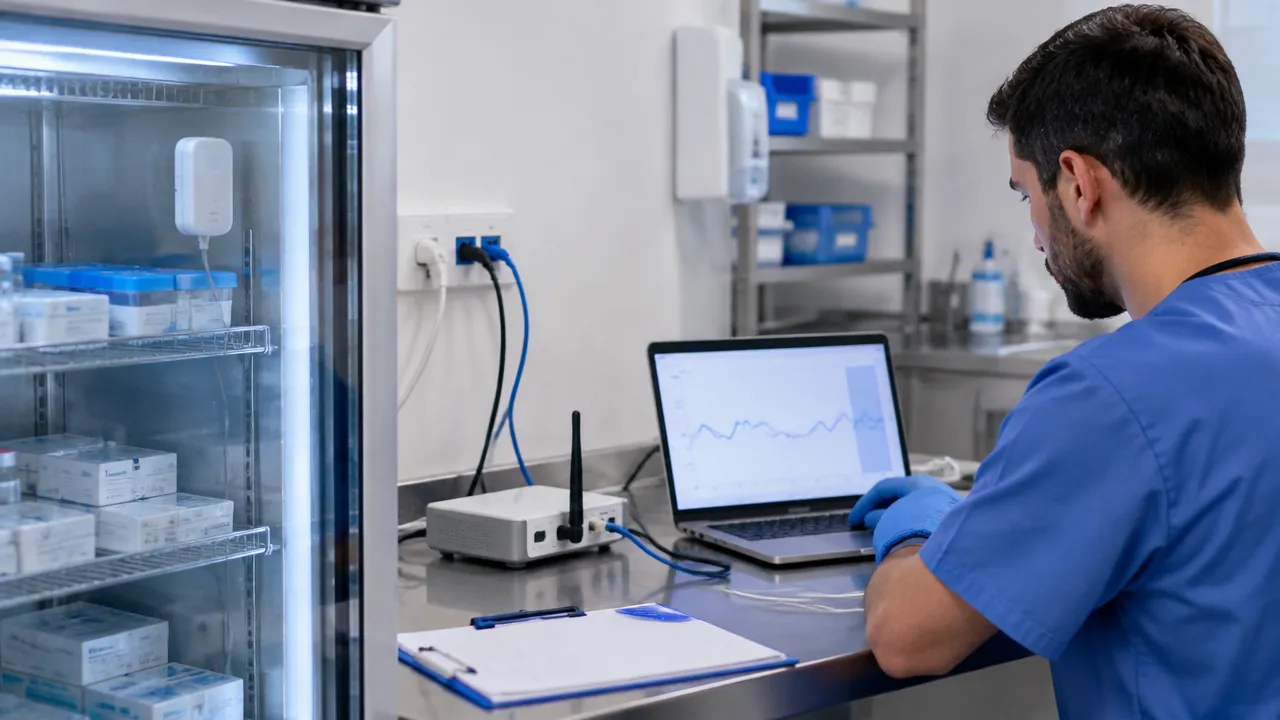
Define the duration and conditions of the trial, including battery charge, connection loss, and network return. Verify how the system signals unavailability, which records remain stored, how the CTD transmits them afterward, and whether the cloud preserves times and sequence. A short test alone does not demonstrate that the buffer covers all 20-day scenarios; evidence must correspond to the requirement and approved method.
Traceability and deviations link each requirement to approval decision
Maintain a matrix that connects requirement, risk, test, result, evidence, and reviewer. This way, during audit or excursion investigation, the team locates what was verified without reconstructing the decision from scattered emails.
When a test fails, record the deviation, assess its impact on data and product, identify the cause, document the correction, and repeat affected tests. Final approval rests with the institution, with participation from areas responsible for use, quality, and operations. Changes to firmware, limits, recipients, network, or data flow must go through change control and impact assessment on the validated state.
Regulatory standards depend on activity and use of records
RDC 658/2022 addresses good manufacturing practices for medicines; it does not automatically transform every hospital system into an object of identical requirements. ANVISA Guide 33 offers guidance for validation of computerized systems in the pertinent regulatory context. The institution should evaluate the activity, type of record, and applicable requirements, rather than assume a reference applies to every hospital. The ANVISA validation guide helps structure this assessment.
21 CFR Part 11 addresses electronic records and electronic signatures within FDA regulatory scope. Its relevance depends on the records and obligations applicable to the operation. Consult the 21 CFR Part 11 text and evaluate controls necessary for intended use. No product alone proves institutional compliance.
Predictive alerts need their own acceptance criteria
DROME Predict can be included in scope when the institution intends to use predictive alerts to guide maintenance or response. Define which assets and conditions enter use, how the team evaluates the warning, and what evidence demonstrates acceptable performance for that purpose.
This criterion does not replace temperature limits, excursion alarms, records, or response procedures. Treat the predictive alert as additional information. Test its presentation and routing in the approved workflow, without assuming it predicts every failure or eliminates the need for human action.
What to ask the supplier before contracting
Request information that allows you to evaluate the product and estimate local work. Confirm what is available, in which version, and under what contractual conditions; do not assume the supplier will execute or approve your institution's validation.
- What is the architecture and which versions of sensor, concentrator, software, and cloud will be installed?
- What specifications and manufacturer test evidence are available for reading, limits, alerts, access, and data recovery?
- How do battery and local storage work, and what conditions limit declared autonomy and buffer?
- What calibration information accompanies the sensors, including range, reference, traceability, and individual identification?
- How does the system record changes, identify users, and recover data after interruption?
- What documents, versions, change records, and security information can be provided before contracting?
- What verifications fall to the supplier and which protocols, local tests, and approvals remain under institutional responsibility?
Request specifications, architecture, test evidence, calibration information, version policy, and description of access controls and audit features that may apply. Close the validation plan with named responsible parties and approved criteria before releasing monitoring for use.
Frequently asked questions
Does every hospital need to validate the temperature monitoring system?
There is no single answer for every hospital. The obligation depends on regulated activity, system use, and applicable internal requirements. Even when a specific standard does not apply, the institution must assess risk and demonstrate that the system meets intended use, with records and approvals proportional to that use.
What is the difference between IQ, OQ, and PQ?
IQ verifies that components were installed per specification. OQ tests whether functions and alarms operate as expected, including under failure conditions. PQ evaluates performance in the environment and routine defined. The scope of each stage depends on risk and intended use.
Does sensor calibration replace system validation?
No. Calibration compares sensor response with a metrological reference and documents its performance. It does not test limit configuration, transmission, alerts, access profiles, data recovery, or audit trail. These elements require their own verifications within system validation.
Do RDC 658, Guide 33, and 21 CFR Part 11 apply to any hospital?
Not automatically. RDC 658/2022 addresses good manufacturing practices for medicines, and its application depends on regulated activity. ANVISA Guide 33 guides validation of computerized systems in its context. 21 CFR Part 11 may be relevant when FDA requirements for records or electronic signatures apply.
How do you test the battery and buffer of a CTD Concentrator?
Test the behavior defined for the installation: autonomy under real load, generation and local storage of records, communication return, transmission of pending data, and preservation of times and sequence. A declared 12-hour battery or 20-day buffer does not alone prove performance in all scenarios.
Read next

Automated Reports for ANVISA Inspection
Learn how to generate automatic reports for ANVISA inspection and ensure compliance with accurate data and simplified audits.

6 Digital Record Failures Affecting Health Audits
Discover common errors in digital records that compromise compliance and integrity during health audits.
Cold Chamber Thermal Requalification: When to Repeat
Learn when to reassess thermal qualification of cold chambers, how to analyze installation and load changes, and what to document before rel…