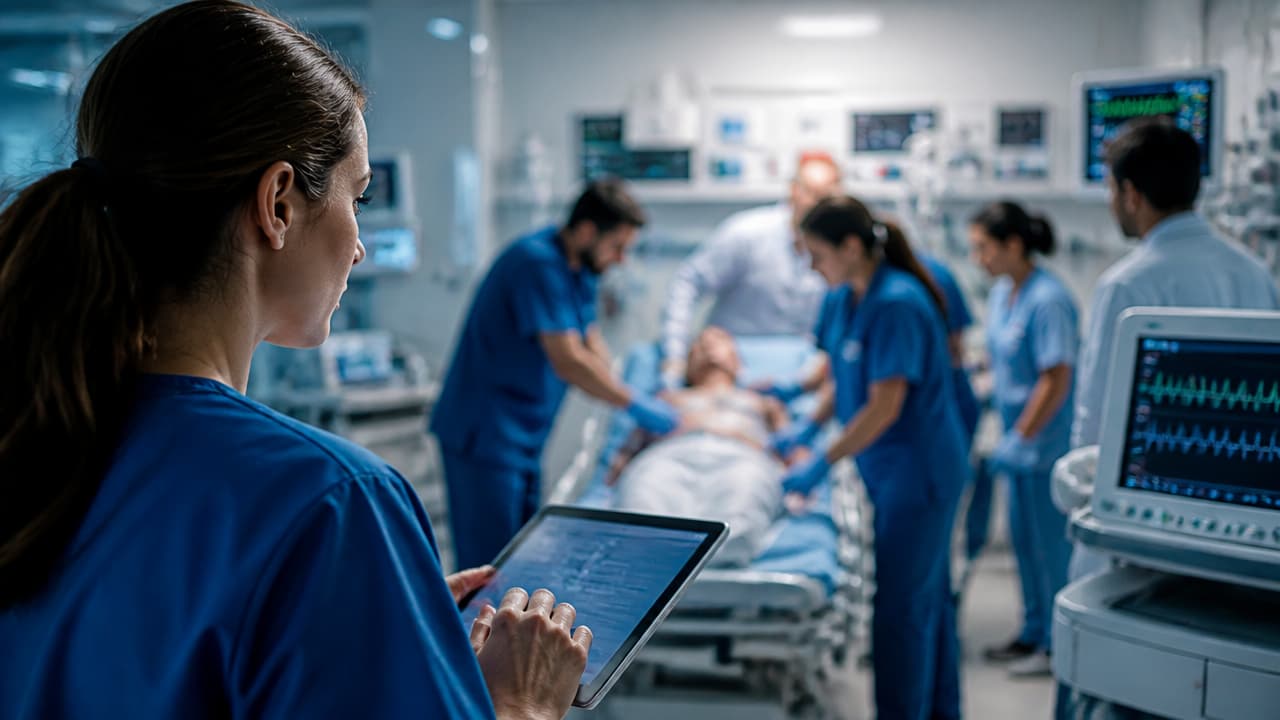
In clinical emergencies, AI helps by shortening the path between data and decision. For hospitals, emergency departments, ICUs, and care teams under pressure, this means prioritizing patients with greater accuracy, recognizing signs of deterioration earlier, and acting with less operational noise. The gain is not in replacing professionals, but in organizing what matters when seconds count.
In practice, intelligent systems can integrate vital signs, patient context, recent history, and environmental conditions to highlight immediate risks. When this support is well-designed, the team stops chasing scattered information and starts responding with greater speed and safety.
Highlights: what changes when clinical decision-making receives AI support
- Prioritization stops depending solely on manual review and begins to consider real-time risk patterns.
- Useful alerts reduce response delay and prevent fatigue caused by irrelevant notifications.
- Integration between clinical and operational data improves the team's situational awareness.
- AI is most valuable when operating with human oversight, clear protocols, and local context.
- Platforms like DROME expand the ability to predict critical events in sensitive environments.
Fast decision-making depends less on raw speed and more on correct prioritization
In an emergency, the greatest risk is not always lack of data. Often, the problem is an excess of competing signals, separate screens, and poorly relevant alarms. AI enters precisely to filter this volume and indicate what deserves attention first.
This changes the team's focus. Instead of reviewing everything with equal weight, physicians and nurses see a dynamic queue of priorities based on a combination of vital signs, recent trends, response to interventions, and care context. The result is decision-making more aligned with actual risk.
This type of support is especially useful in scenarios with high turnover, multiple critically ill patients, and need for coordination across departments. The greater the operational pressure, the greater the value of a system that helps separate true urgency from noise.
How does AI help with decision-making?
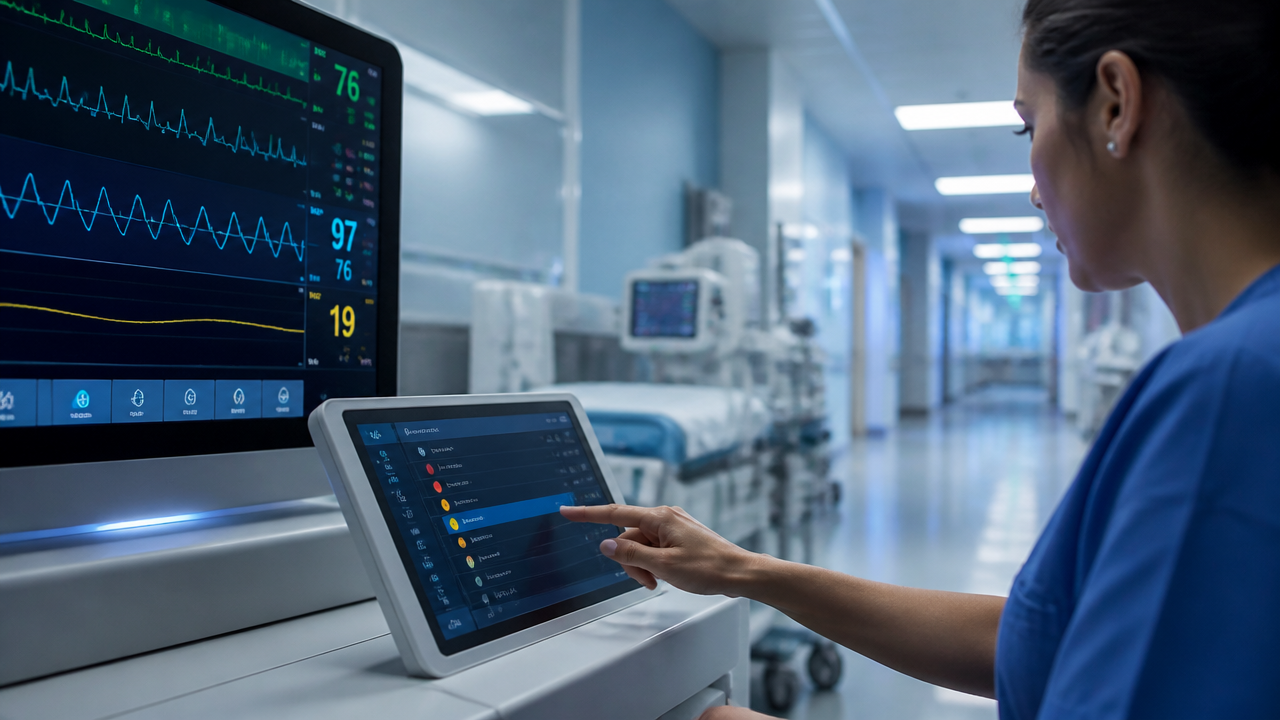
AI helps by transforming dispersed signals into practical recommendations. Instead of just showing numbers, it identifies trends, estimates probability of deterioration, and highlights patients, equipment, or environments requiring immediate action.
In clinical routine, this can appear in several forms:
- triage with more consistent risk classification
- early alert for hemodynamic or respiratory decline
- detection of anomalies in connected equipment and devices
- suggestion of care order based on severity and time
- consolidation of clinical and operational data in a single view
The central point is that AI does not decide alone. It reduces uncertainty, organizes evidence, and offers support so the team can confirm, rule out, or escalate a hypothesis more quickly. In critical environments, this operational difference has direct impact on safety, care continuity, and time use.
How is AI used in hospitals?
In hospitals, the most mature application of AI is intelligent monitoring. Instead of reacting only after a threshold is exceeded, the system learns patterns that typically precede an adverse event and signals deviations with useful advance notice.
This reasoning applies to both patient and clinical infrastructure. A bed, medication refrigerator, biomedical equipment, or the environment of a critical area can produce signals that, when analyzed together, anticipate failures and help preserve operations.
This is where DROME's proposal connects to the hospital scenario. By combining continuous monitoring, telemetry, and AI, the platform helps organizations move away from a purely reactive model. Instead of only receiving an alarm after the problem has already occurred, the team gains the ability to act before clinical or operational impact consolidates.
Intelligent triage improves flow, not just diagnosis
When discussing AI in healthcare, many people first think of diagnosis. In emergencies, however, one of the most immediate gains is in flow management. Knowing who needs intervention now, who can wait a few minutes, and who requires intensive observation changes the entire department dynamic.
Good triage assisted by AI considers not only the chief complaint, but also signal evolution, comorbidities, initial response, and contextual factors. This reduces two costly errors: underestimating cases that deteriorate quickly and over-prioritizing less severe situations.
| Scenario | Without analytical support | With AI support |
|---|---|---|
| Multiple simultaneous patients | Prioritization based on fragmented manual review | Risk continuously reorganized |
| Vital signs fluctuating | Deviation perceived late | Trend recognized before obvious decline |
| Team under high workload | Greater chance of delay and noise | Focus on highest criticality events |
In other words, AI improves the pace of clinical operations because it helps distribute attention more intelligently.
How can AI be used in Nursing?
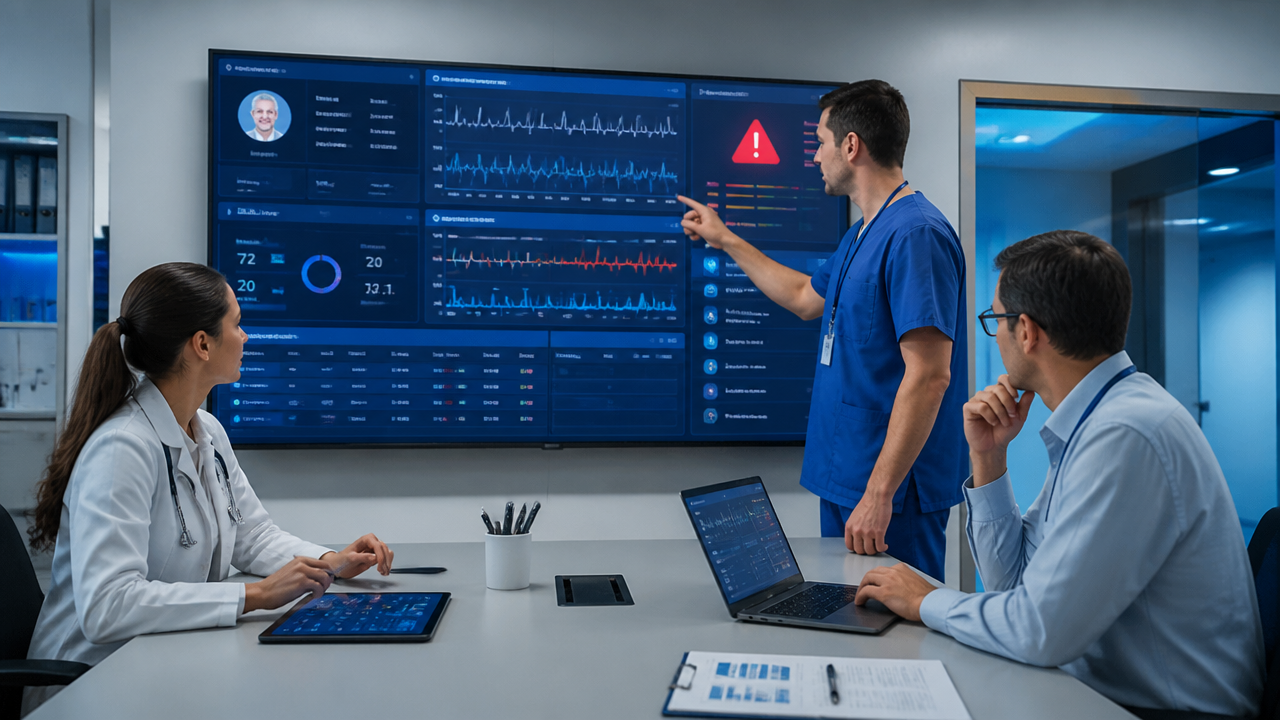
In nursing, the greatest benefit is in care prioritization. The team is who perceives early subtle changes in patient status, but this perception can be lost when there is an excess of tasks and contextless alarms. AI helps highlight which changes deserve immediate intervention.
This does not eliminate clinical judgment. On the contrary, it strengthens nursing practice by offering an additional layer of insight into trend, severity, and risk of deterioration. The professional continues deciding, but decides with more support and less distraction.
There is also operational gain. When the system concentrates relevant events in a clear view, it decreases time spent on repetitive checks and increases time available for direct care, communication, and safe protocol execution.
The correct limit: AI does not replace protocol, team, or clinical responsibility
Fast decision-making only truly improves when technology respects care governance. A model can prioritize risks, but should not act as an isolated authority. Emergencies require human oversight, validation criteria, and transparent rules for alert use.
In practice, this involves four safeguards:
- train models with data from context compatible with operations
- define who receives, confirms, and responds to each alert type
- measure sensitivity, specificity, and rate of useless alarms
- continuously review performance after process changes
Without these elements, AI can generate blind dependence or alert fatigue. With them, it becomes a reliable support tool, integrated into real clinical work.
The near future is predictive, contextual, and operationally integrated
The most important advance will not be creating more dashboards. It will be the ability to connect patient, team, equipment, and environment in the same prevention logic. In hospitals and other critical environments, this means recognizing risks before they interrupt care, supplies, or care flow.
This is the direction in which solutions like DROME gain relevance. By combining operational history, distributed sensors, continuous monitoring, and models that learn from new data, the platform expands the ability to predict anomalies and support rapid decisions where the impact of each minute is real.
For hospital management, the question is no longer whether AI will have a role in clinical emergencies. The more useful question is how to implement it safely, scalably, and connected to team routine. Those who get this answer right tend to respond sooner, make fewer mistakes, and better protect patients and operations.
Frequently asked questions
How can AI help with decision-making?
AI is most useful when it reduces the time between perceiving a risk signal and acting. In emergencies, it can cross vital signs, history, exams, and operational context to highlight priorities, suggest hypotheses, and alert the team about clinical deterioration before the situation worsens.
How is AI used in hospitals?
Hospitals use AI in triage, diagnostic support, patient monitoring, deterioration prediction, and bed and equipment management. Practical value appears when the system organizes scattered data and delivers actionable alerts, rather than just accumulating information on different screens.
How can AI be used in Nursing?
AI supports nursing by prioritizing alert signals, reducing repetitive manual checks, and improving real-time risk visualization. This helps the team concentrate attention where there is greatest chance of deterioration, without replacing clinical judgment and bedside communication.
How has artificial intelligence been used to enhance clinical practice and patient care?
It enhances clinical practice by transforming large data volumes into objective support for rapid decisions. Instead of depending only on recall or isolated reading of each indicator, the team gains an analytical layer that identifies patterns difficult to notice under pressure.
What does the WHO say about AI use in healthcare?
The WHO advocates responsible AI use in healthcare, focusing on safety, human oversight, privacy, and equity. In practice, this means validating models, defining responsibilities, documenting decisions, and ensuring technology complements clinical care without blindly automating critical choices.