
When multiple alarms trigger simultaneously, the challenge is not just technical—it's operational. A laboratory needs a simple method to distinguish what threatens safety, what impacts quality, and what can wait a few minutes without increasing risk. A well-defined checklist reduces noise, organizes team response, and prevents a critical alert from being lost among secondary notifications.
This guide is useful for managers, technical leads, quality, maintenance, and operations teams. Throughout this text, you'll see how to prioritize events, distribute responsibilities, and use AI-powered monitoring to transform an alert queue into coordinated action.
Highlights that make a difference in daily operations
- Not every alert deserves the same urgency; criticality must consider impact on samples, patients, supplies, and operational continuity.
- A short triage workflow reduces response delay and prevents alarm fatigue.
- Checklists work best when they define responsibility, maximum response time, expected evidence, and escalation criteria.
- Recurring events should trigger root cause analysis, not just administrative closure.
- Platforms with continuous monitoring and AI, like DROME, help detect patterns before visible failure.
The first step is classifying alerts by actual risk
The safest way to handle multiple occurrences is to classify by potential impact, not by the order they appear. In a laboratory, a small deviation in equipment storing critical supplies can be more serious than several informational notifications in parallel.
A practical classification should consider four questions: Does the event affect sensitive material, interrupt testing, compromise compliance, or create patient safety risk? If the answer is yes to any of them, the alert escalates in priority. This prevents the team from treating volume as synonymous with severity.
| Level | Example | Expected Response |
|---|---|---|
| Critical | Refrigeration failure for supplies, power loss, essential equipment out of range | Immediate action, escalation, and complete documentation |
| High | Temperature instability trend, calibration delay, recurring oscillation | Quick verification and containment |
| Medium | Intermittent communication alert, operational delay without direct impact | Scheduled treatment during shift |
| Low | Informational notification with no current risk | Monitoring and later review |
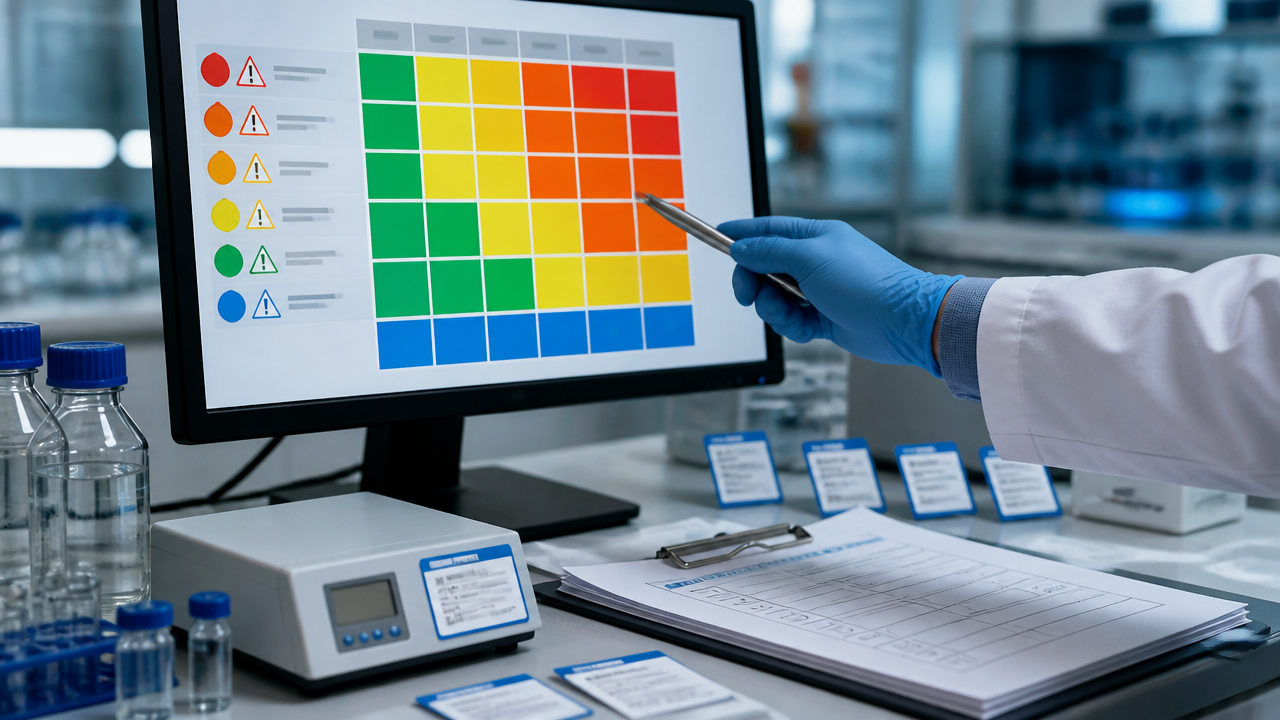
Practical checklist for triaging multiple alerts
If the team must decide in less than one minute, the checklist must be direct. The goal here is not to produce a lengthy manual, but to standardize the first response to protect operations.
- Confirm whether the alert is real, duplicated, or a consequence of another primary event.
- Identify the affected asset—for example, freezer, incubator, clean room, UPS, or analytical equipment.
- Check immediate impact on samples, medications, reagents, or ongoing tests.
- Define criticality based on limit, duration, trend, and operational context.
- Assign a specific person responsible for initial action.
- Execute containment, such as load transfer, isolation, operational adjustment, or technical support activation.
- Record time, decision made, and evidence of normalization.
- Escalate if response time exceeds routine limits.
This simple workflow already eliminates two common mistakes: leaving alerts without an owner and closing occurrences without verifying actual effect on the process. In critical environments, closing a warning in the system does not mean the risk has been removed.
Who responds to what—the team must know before an incident
The best time to define roles is before an event overload. When there is doubt about who evaluates, who authorizes, and who executes, time is lost precisely in the most sensitive phase of the occurrence.
A good practice is to separate functions into three fronts: operations, technical support, and contingency decision-making. Operations performs initial validation and basic containment. Technical support investigates probable cause and restores stable condition. Leadership decides on disposal, flow interruption, deviation opening, and quality communication.
It is also worth setting maximum response times by risk level. A critical alert cannot wait for a shift change to be reviewed. A medium-level warning can enter a queue with visible monitoring. This distinction protects the team from artificial urgency overload, which is one of the roots of alarm fatigue.

How to reduce alarm fatigue without losing sensitivity
Excess notification weakens team attention. If everything arrives as urgent, nothing seems truly urgent. Therefore, reducing alarm fatigue does not mean silencing important events, but eliminating redundancy and improving context.
Start by reviewing three points: misconfigured limits, duplicate alerts, and notifications without possible action. An alert should exist to trigger a clear response. If the system generates events that do not change any conduct, it adds noise and strains operations.
Another important adjustment is combining limit with persistence and trend. Instead of triggering on any brief oscillation, the laboratory can consider minimum duration, repetition, and rate of change. This makes triage smarter and reduces false positives, especially in refrigeration, controlled environments, and equipment subject to normal use cycles.
What changes when the laboratory uses AI-powered monitoring
The main change is moving away from reactive mode. Instead of only alerting when the limit has already been exceeded, behavioral analysis helps detect signals that precede failure. This expands the response window and reduces operational loss.
In practice, solutions like the DROME platform combine continuous monitoring, telemetry, and artificial intelligence to observe patterns, identify anomalies, and support team decision-making. This is especially useful when the laboratory manages many assets simultaneously and must distinguish a one-time event from a dangerous trend.
This approach also improves post-incident review. When data is organized by history, frequency, and context, it becomes easier to discover which equipment generates recurring occurrences, which shifts concentrate deviations, and which limits need recalibration. The alert stops being an isolated point and becomes part of a more mature operational view.
How to transform the checklist into a management routine
A checklist only works when it leaves the paper and enters the shift. For this, it must be incorporated into the response workflow, training, and performance review. The document must be short, accessible, and compatible with laboratory reality.
An effective implementation usually follows five practices:
- train the team with real scenarios and short decision times;
- review recurring alerts and unresolved causes monthly;
- align criteria with quality, maintenance, and operations;
- audit records to verify evidence of containment and normalization;
- update the checklist whenever new risk, asset, or critical process emerges.
If the laboratory already has sensors, supervision, and operational history, the next step is to integrate this data into smarter prioritization logic. This is the point where technology and governance stop competing and start working together.
Frequently asked questions
What is risk management in a laboratory?
Risk management in a laboratory is the process of identifying, classifying, responding to, and reviewing events that may compromise samples, supplies, equipment, results, or operational safety. In practice, this includes defining priorities, responsible parties, response times, and escalation criteria for each alert type.
What are the 3 laboratory phases?
The three laboratory phases are pre-analytical, analytical, and post-analytical. Alert management must cover all three, because temperature deviations, equipment failures, processing delays, and documentation errors can occur at different points in the workflow and require distinct responses.
What are the main pre-analytical errors?
Main pre-analytical errors include incorrect identification, inadequate packaging, transport delay, temperature out of range, and collection under improper conditions. A good alert process helps detect these failures early, before the problem affects sample validity or test timeline.
What is the current RDC for laboratories?
The appropriate RDC depends on laboratory type and activity, so the correct answer is always to verify the current regulation applicable to your scope. For daily operations, the most important thing is to translate regulatory requirements into clear operational criteria, with documentation, traceability, and defined responsibilities.
Read next
5 Tips to Strengthen Traceability in Laboratories
Learn five practical actions to improve digital traceability in laboratories, reduce deviations, and gain greater operational control.

Reduce Laboratory Alarm Noise in Automated Systems
Learn how to reduce unnecessary alerts in automated laboratories through prioritization, calibration, predictive maintenance, and artificial…

How to Choose Pressure Sensors for Laboratories
See a practical checklist for selecting differential pressure sensors in laboratories, with focus on accuracy, installation, validation and …