
Reducing unnecessary alarms in automated laboratories depends less on silencing notifications and more on redesigning the logic behind them. For managers, analysts, and clinical engineering or infrastructure teams, the correct goal is to make each alert correspond to a clear action. When this happens, the laboratory gains agility, avoids unnecessary interruptions, and improves operational safety.
In practice, excessive alerts stem from generic limits, duplicate rules, poorly calibrated sensors, and lack of context. This is where platforms like DROME become valuable, because they combine continuous monitoring, telemetry, and artificial intelligence to separate noise from real risk.
Key points for reducing operational noise
- Not every deviation needs to trigger an alarm, some events should only be recorded and monitored.
- Priority matters more than volume, critical alerts need to stand out from informational ones.
- Static limits become outdated quickly, which is why periodic review is mandatory.
- Predictive maintenance reduces repetitive triggers, because it prevents intermittent failures and silent degradation.
- Operational context changes how an event is interpreted, time of day, equipment type, load, and routine affect alert relevance.
- Well-applied AI reduces false positives, by recognizing patterns that precede failure rather than reacting to any fluctuation.
Excessive alarms are a design problem, not a sensitivity issue
When a laboratory receives too many alerts, the problem usually lies in system architecture. High sensitivity without criteria turns any normal variation into an occurrence, and the team responds by reflex, not by priority.
This is especially dangerous in automated environments, where analyzers, refrigerators, incubators, gas delivery systems, and environmental sensors generate signals constantly. If the software treats all these signals the same way, the result is predictable: operations lose focus and the critical alert arrives mixed with the irrelevant.
The first adjustment, therefore, is conceptual. The laboratory must define which events require immediate action, which need observation, and which serve only for historical records. This design prevents automation from replicating noise at scale.
What common errors generate unnecessary alarms?
The most frequent errors are simple to identify. The difficult part is maintaining discipline to correct them before they become part of routine. In many laboratories, the system grows through rule addition, without subsequent cleanup.
- Same limits for equipment with different behaviors
- Duplicate alarms for the same event across different channels
- Absence of minimum delay before trigger
- Sensors with outdated calibration
- Informational alerts sent with the same urgency as critical ones
- Automatic escalation without first-level validation
Another common error is ignoring recurring causes. If the same notification returns every week and no one reviews the trigger, the laboratory teaches the team to live with the deviation. Over time, the system stops supporting decision-making and starts competing for user attention.
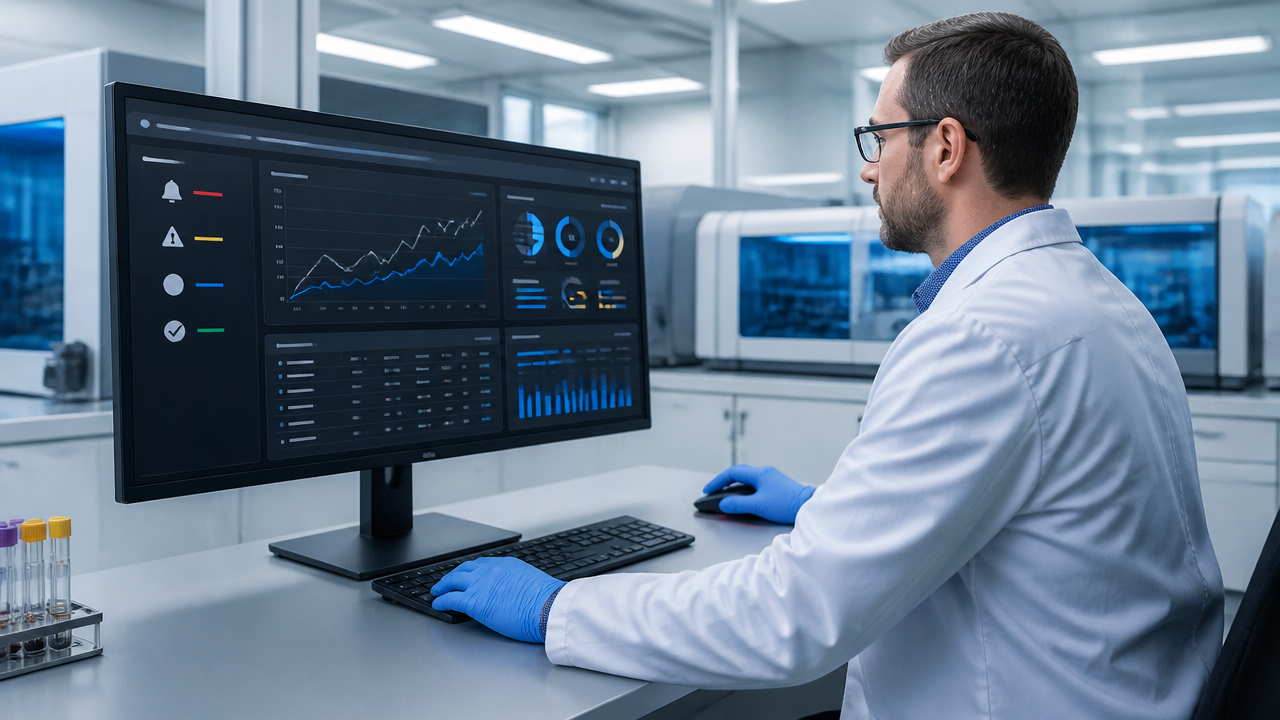
Classifying alerts by criticality is the step that reduces interruptions most
The most efficient way to cut noise is to adopt a criticality matrix. It separates critical, important, and informational events based on operational impact, regulatory risk, quality risk, and response urgency.
A critical alarm must represent real threat to sample integrity, equipment function, or process continuity. Trend events, minor fluctuations, and reversible deviations can enter as monitored warnings without interrupting the team.
| Level | When to use | Expected response |
|---|---|---|
| Critical | Immediate risk to operation, sample, or equipment | Immediate action and escalation |
| Important | Deviation with potential to worsen | Verification during shift |
| Informational | Event for record or trend | Monitoring without interruption |
This logic organizes work and reduces the sense of permanent urgency. The laboratory begins to treat alarms as a prioritization tool, not as a continuous siren.
How to calibrate limits without losing sensitivity?
The best limit is one that detects real risk without reacting to normal process fluctuations. To reach this point, the laboratory needs to use operational history, equipment behavior, and context of use, not just factory default values.
In practice, it's worth reviewing tolerance ranges, minimum time outside standard, and combination between variables. A brief temperature spike, for example, may not require the same response as a continuous heating trend accompanied by load change.
What to review in configuration
- Acceptable range for each asset
- Persistence time before trigger
- Combined conditions to validate the event
- Time of day and shift when the alert makes sense
- Correct destination for each notification
This fine-tuning is more effective than reducing sensitivity across the board. Cutting alerts without criteria hides problems; calibrating well improves the signal.
Automation only works well when alarms match real workflow
Automating equipment without automating decision logic creates invisible bottlenecks. The system alerts at wrong times, to wrong people, or with insufficient information to act.
This is why each alarm must answer three questions: who receives it, what should they verify, and how much time do they have to act. If a notification doesn't define this, it tends to become noise. In laboratories with multiple routines, it also makes sense to differentiate alerts by sector, asset, and operational window.
This approach reduces rework and shortens triage. Instead of a single notification queue, the laboratory operates with context-driven responses for each process.
How does artificial intelligence help reduce false positives?
Artificial intelligence is most useful when it stops looking only at out-of-range values and starts analyzing pattern, trend, and recurrence. This allows distinguishing a consequence-free fluctuation from behavior that typically precedes failure.
In practice, DROME applies this logic by combining sensor history, telemetry, and asset behavior to identify anomalies with more context. Instead of triggering an alarm at every isolated variation, the platform can recognize combinations that indicate degradation, efficiency loss, or imminent risk.
The benefit isn't just in emitting fewer alerts. It's in emitting better alerts, with higher chance of correct action. This is where monitoring shifts from reactive to preventive support.

Predictive maintenance reduces repetitive alarms before they become routine
Recurring alarms are usually symptoms of progressive degradation. Ventilation losing efficiency, compromised seals, unstable sensors, or equipment operating near limits generate intermittent warnings before open failure.
When the laboratory uses predictive maintenance, these signals stop being treated as isolated episodes. They become part of a sequence that guides planned intervention. The direct effect is reducing repetitive triggers, avoiding unexpected downtime, and preserving team confidence in the system.
This also improves time management. Instead of fighting fires, operations schedule corrections based on accumulated evidence.
A simple governance routine prevents the problem from returning
Well-configured alarms today can become inadequate in a few months. Layout changes, new equipment, load seasonality, and process adjustments alter expected operational behavior.
This is why the laboratory needs a formal alert governance routine. It doesn't need to be complex, but it must be continuous.
- Review the most frequent alarms monthly
- Map which ones didn't generate useful action
- Correct duplicates and excessive escalations
- Recalibrate limits after maintenance or equipment replacement
- Record root cause of recurring alerts
- Validate with the team if the alert still makes sense
Without this cycle, the system accumulates old rules and returns to producing noise. With this cycle, operations evolve alongside the laboratory.
Frequently asked questions
What is alarm fatigue in automated laboratories?
Alarm fatigue is the loss of attention caused by excessive alerts, many without practical action. In automated laboratories, this increases the risk of the team ignoring truly critical signals, delaying responses, and treating the system as operational noise instead of decision support.
What are the most common errors that generate unnecessary alarms?
The most common errors include poorly configured limits, duplicate rules, alerts without clinical or operational priority, uncalibrated sensors, and absence of periodic review. The problem usually isn't in data volume, but in lack of criteria to transform data into truly useful alerts.
Does laboratory automation reduce or increase the number of alerts?
Automation reduces manual failures and expands traceability, but only improves operations when alerts match this logic. An automated laboratory needs contextual alarms, integrated into workflow and adjusted to real equipment behavior, to avoid unnecessary interruptions.
How does artificial intelligence help reduce false positives?
Artificial intelligence helps differentiate isolated deviations from patterns that indicate real risk. In practice, it crosses history, trend, operational context, and equipment behavior to reduce false positives and anticipate failures before the laboratory faces critical downtime.
How often should alarm configuration be reviewed?
Alarms should be reviewed whenever there's a change in process, equipment, layout, maintenance routine, or sample profile. Even without major changes, monthly or quarterly review is usually the minimum to keep limits coherent and prevent accumulation of obsolete rules.