
Medications may await customs clearance, be moved to different areas, and undergo verification before proceeding to the distribution center. Each transfer creates an interval where cargo may lack continuous monitoring or a clear responsible party for alerts. To control this blind spot, operations must correlate thermal history to cargo, location, and decisions made.
Key operational attention points
- Waiting for customs clearance may extend storage in areas different from those planned during transport.
- Movements, verifications, and door openings alter thermal exposure around packages.
- Air temperature and readings near cargo help assess exposure, but do not directly measure the condition of each product unit.
- Alerts lead to response only when a responsible party is defined and procedures exist for each shift.
Operational risks emerge during waits and transfers
Operational risk grows during intervals between stages. Cargo may exit a refrigerated container, await verification, and move to a cold chamber, while responsibility shifts between carrier, facility, importer, and logistics operator.
During this journey, open doors, movement queues, refrigeration failures, or power unavailability may alter environmental conditions. If the record ends at transport exit and resumes only at the distribution center, the team cannot accurately reconstruct the intermediate period.
It is also necessary to distinguish three measurements that are frequently confused: environmental temperature, reading near cargo, and actual product condition. An environmental sensor records air at its installation point. A sensor near boxes indicates local exposure, but does not directly measure the interior of the package or medication.
| Record | What it indicates | Interpretation limit |
|---|---|---|
| Environmental temperature | Air condition at the monitored point | May differ from other points in the area |
| Temperature near cargo | Thermal exposure near packages | Does not, by itself, represent the internal temperature of the product |
| Medication condition | Potential impact on stability | Depends on the product, exposure duration, and stability data |
A stability change may not produce visible alteration. Therefore, an excursion does not automatically prove loss of efficacy nor justify disposal without evaluation. The decision rests with quality assurance, based on the product and documented information.
Monitoring architecture begins with thermal mapping
The sensor should represent the actual risk to cargo, not merely provide a convenient reading. Before installation, map the points of storage and transfer: container, verification area, antechamber, cold chamber, and waiting area for release.
Position sensors according to the thermal qualification of the environment. Avoid selecting the point solely for outlet or gateway proximity. Consider areas with greater variation, air circulation, and door opening frequency, and confirm that the position remains representative after layout changes.
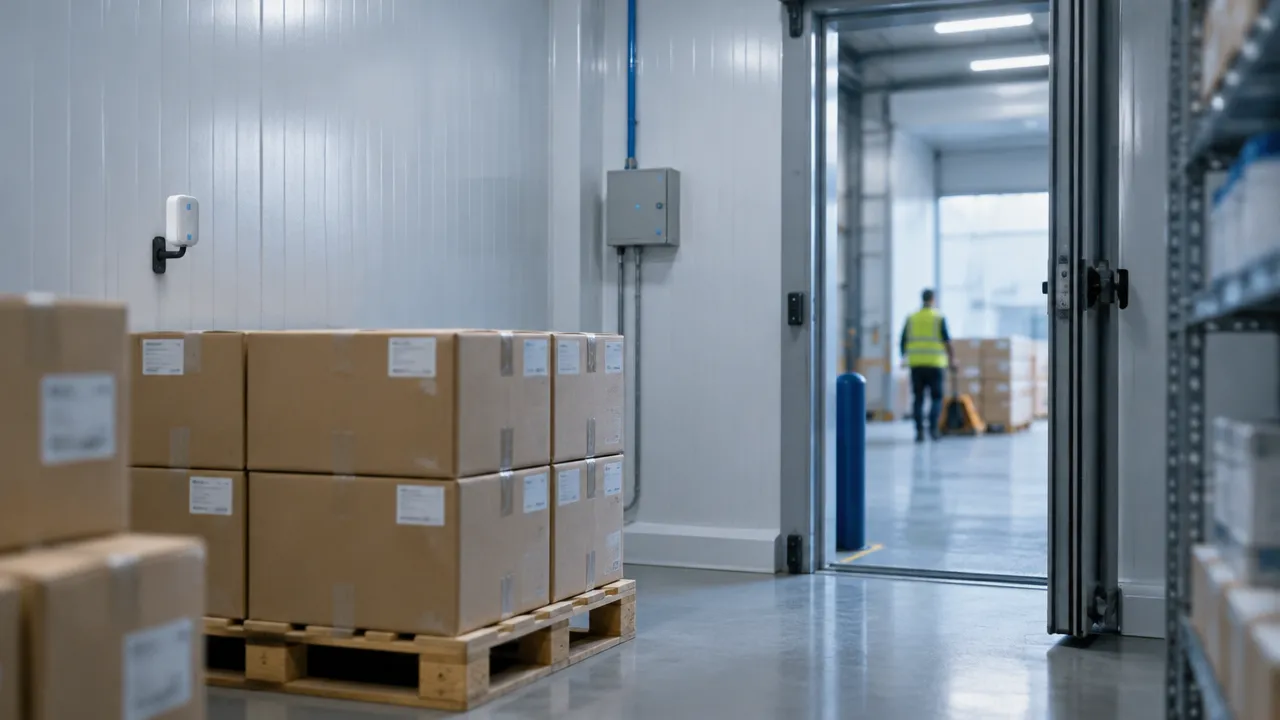
Set limits based on the storage specification of each medication, rather than applying a generic range to all shipments. Then establish reading frequency, alert criteria, responsible parties by shift, and an escalation channel for unconfirmed alerts.
- Map where cargo waits and which areas it passes through.
- Link each shipment to the applicable storage specification.
- Position sensors based on thermal qualification.
- Define reading frequency, limits, and alert criteria.
- Designate responsible parties by shift and record interventions.
The STE Satellite Sensor measures temperature. When humidity is required, the STH adds this parameter. On compatible assets, the SDT allows correlation of electrical current and door opening with thermal readings. This combination helps distinguish a rise associated with routine access from a pattern consistent with equipment failure.
The CTD Concentrator gathers readings and can use cellular connectivity to transmit data. Its battery operates for up to 12 hours, and local storage preserves records for up to 20 days during communication unavailability. Preserving data locally does not mean delivering alerts immediately: remote notification depends on connectivity. Coverage must be verified on-site, including radiofrequency conditions and equipment positioning.
Response to deviations requires segregation and quality decision
When a deviation occurs, the first response is to protect the cargo while quality assesses the data. Identify and segregate the lot according to applicable procedures, preventing its release until analysis is complete. Automatic disposal does not replace technical evaluation.
Record start and end time, cargo identification, location, available thermal history, alarms, and observed conditions. Document who received the alert, actions taken, time of each intervention, and the quality decision. If transfer occurred during the event, record who was responsible at each stage.
The history should allow answering concrete questions: when the cargo arrived, where it remained, for how long, who was notified, and what data supported the decision. If a reading is missing, record the gap and its cause. Do not treat a period without communication as confirmation of stable temperature.
Evidence for quality connects measurement and decision
Useful documentation combines sensor records with cargo identification, transfer times, calibration, thermal qualification, and interventions. An isolated graph provides little information if it is not possible to know which lot, area, and period it corresponds to.
RDC 938/2024 establishes good practices for storage of goods and products subject to health surveillance in customs warehouses. ANVISA reports that the standard entered into force on March 3, 2025, and guides the evaluation of facilities, procedures, environmental controls, and records. The ANVISA guidance for customs facilities describes this scope.
RDC 430/2020 addresses good practices for distribution, storage, and transport of medications. It covers a broader stage of the pharmaceutical chain; RDC 938/2024 specifically addresses storage of goods subject to health surveillance in customs facilities. The ANVISA description of RDC 430 helps distinguish the scope of each standard. Monitoring, traceable calibration, qualification, and records contribute to demonstrating control, but do not ensure compliance in isolation.
Anticipating failures differs from recording deviations
Recording an excursion and issuing an alarm inform that a condition has changed. Anticipating a failure requires analyzing asset signals before temperature leaves the range. This distinction matters when the problem originates in the equipment, for example, with abnormal compressor behavior before cargo experiences thermal exposure.
DROME Predict analyzes multiple parameters from instrumented refrigeration assets. According to data provided by DROME, it can generate alerts 30 to 60 minutes before a failure, with probable cause and corrective action. This capability can support preventive equipment intervention; it does not predict every deviation in cargo in transit nor guarantee medication integrity.
To evaluate an operation, verify that each storage point has a record, that sensor placement follows thermal qualification, that limits match product specification, and that each alert has a documented responsible party and decision. The thermal chain of custody becomes verifiable only when no transfer interrupts the history nor leaves the response without an owner.
Frequently asked questions
What is the difference between environmental temperature and medication condition?
Facility temperature describes the surrounding air; reading near cargo records conditions at a specific point. Neither, in isolation, reveals the internal temperature of each package or medication stability. To assess the product, quality must consider its exposure history and applicable stability data.
How often should temperature be read in a customs warehouse?
Frequency should allow identification of deviations within the response time defined for the operation. Consider medication specification, qualified thermal profile, area dynamics, and interval between readings. Also define who receives each alert per shift and how to act when communication fails.
Does a thermal excursion mean the medication must be discarded?
A thermal excursion does not, by itself, determine that the medication has lost efficacy. Segregate the cargo and forward the temperature history, times, and exposure conditions to quality assurance. The decision to release, quarantine, or take other action depends on the product and its stability data.
Which ANVISA standard applies to storage in customs warehouses?
RDC 938/2024 addresses good practices for storage in customs warehouses for goods subject to health surveillance. RDC 430/2020 addresses good practices for distribution, storage, and transport of medications. Application depends on the activity and regulatory context; monitoring, calibration, and records support compliance but do not prove it in isolation.
Read next

Nine Reasons to Adopt Digital Twins in Cold Chains in 2026
Discover how digital twins anticipate failures, improve monitoring, and reduce losses in cold chains in 2026.

Building Teams for Effective Cold Chain Management
Learn how to assemble qualified teams, define roles, and implement controls to ensure cold chain integrity.

Vaccine Cold Chain: Management, Monitoring & Risks
Understand how vaccine cold chain management ensures immunobiological integrity through real-time monitoring and alerts.