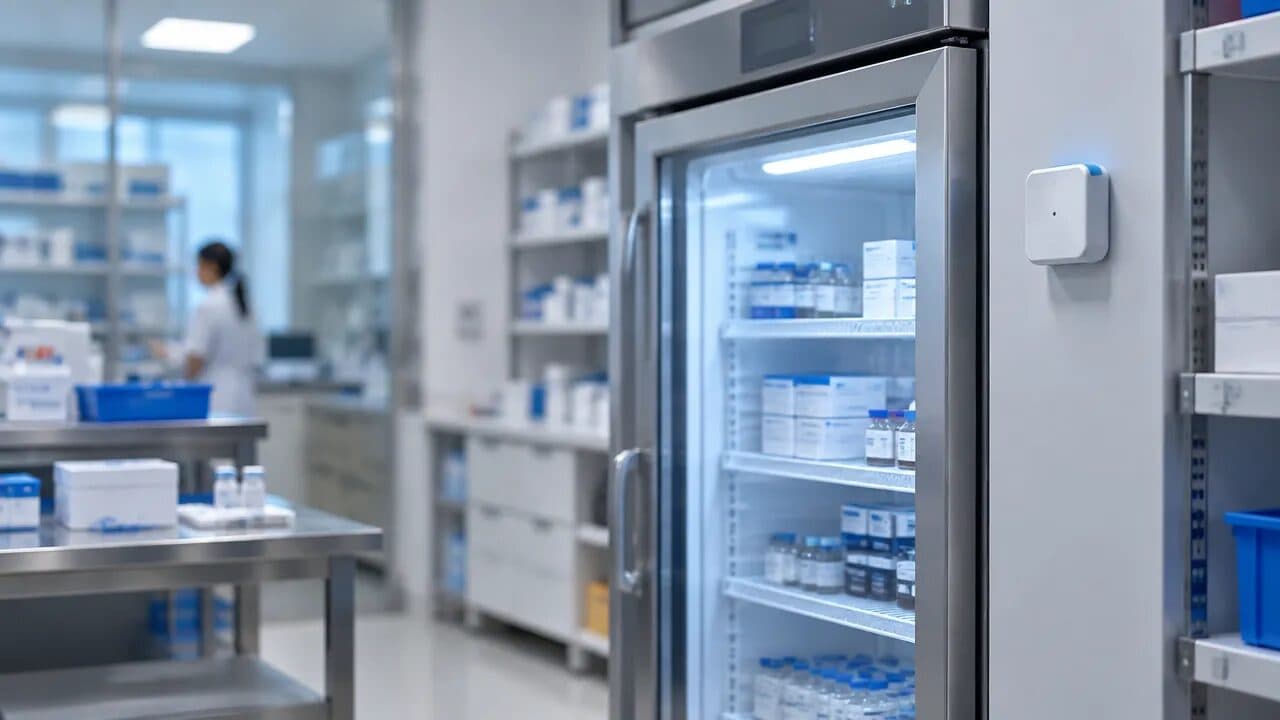
If a medication refrigerator controller measures temperature, activates the compressor, and generates the alarm, a failure at that point can affect both refrigeration and deviation detection simultaneously. For clinical engineering, quality, pharmacy, and maintenance teams, independent measurement creates a second observation chain. It reduces common failure points, but does not replace digital security or a response plan.
What needs to be clear about independent measurement
- The controller regulates the equipment; another sensor monitors the environment through a separate chain.
- Independence includes sensor, credentials, power supply, connectivity, and alert channel.
- Local memory preserves readings, but does not guarantee remote delivery during a communication failure.
- Predictive intelligence looks for asset failure signals, not cyberattacks or all events.
The blind spot emerges when control and alarm share the measurement
The controller compares its sensor reading with the configured value and commands the refrigeration system. If the same unit also sets alarm limits and sends notifications, a sensor failure, unauthorized configuration change, or power loss can compromise multiple functions at once.
Consider a hypothetical scenario: someone alters the alarm limit on a cold room controller, or a defect prevents it from recording temperature correctly. If the alarm depends only on that equipment, the team may not perceive the deviation through a second path. A separate sensor does not correct refrigeration; it provides additional observation to detect that something is out of range.
The problem also appears without digital attack. A door left open after restocking, prolonged defrost, or a closed valve can raise the temperature of a medication refrigerator, cold room, or ultra-low freezer. The control may continue operating, but the cause requires investigation and team response.
Operational failures and digital attacks require different responses
An operational failure usually begins in the process or equipment: open door, delayed maintenance, closed valve, or defrost outside expected behavior. Independent reading helps confirm the deviation; additional signals, such as compressor current and door status, help contextualize what occurred.
A digital attack or unauthorized change can affect limits, accounts, notifications, or system availability. Independent monitoring can make it harder for a single failure to hide the deviation, but it does not block intrusions. Network segmentation, access control, and system updates remain necessary, as recommended by CISA guidance for industrial systems.
CDC guidance for vaccine storage recommends using a digital data logger with an appropriate probe to track temperature. This guidance helps understand the function of separate measurement, but should not be treated as a Brazilian requirement: requirements depend on context and standards applicable to the service.
Independence requires more than installing another panel
A system only offers useful separation when its dependencies are also evaluated. Two sensors connected to the same power supply, the same administrative account, the same network, or the same notification service can still share a failure point.
- Sensors: independent measurement must use a distinct element from the control sensor.
- Credentials and permissions: verify whether a change to the controller can also alter limits or disable external monitoring.
- Power supply: evaluate what continues measuring during a power outage and for how long.
- Connectivity: identify what is stored locally and what depends on the network to reach the team.
- Alerts: test channels, responsible parties, and escalation, including outside business hours.
The CDC describes the digital temperature logger in its vaccine storage guidance. The operational principle is useful: maintain temperature evidence that does not depend solely on the screen used to control the equipment.
Control, monitoring, and prediction fulfill different functions
| Layer | What it does | Main limitation |
|---|---|---|
| Control | Activates refrigeration to maintain the configured value. | May share sensor, power, or configuration with equipment alarm. |
| Independent monitoring | Measures and records temperature through a separate chain. | Detects deviation, but does not necessarily identify its cause. |
| Predictive intelligence | Analyzes asset signals to recognize patterns associated with failures. | Does not predict cyberattacks or guarantee anticipation of all events. |
How sensors and gateway form a second observation chain
In the DROME architecture, the STE Satellite Sensor measures temperature. For ultra-low temperature, the SUL uses a PT100 probe; the SDT adds current and door opening signals. This data can help distinguish a thermal excursion from situations such as compressor without current or open door.
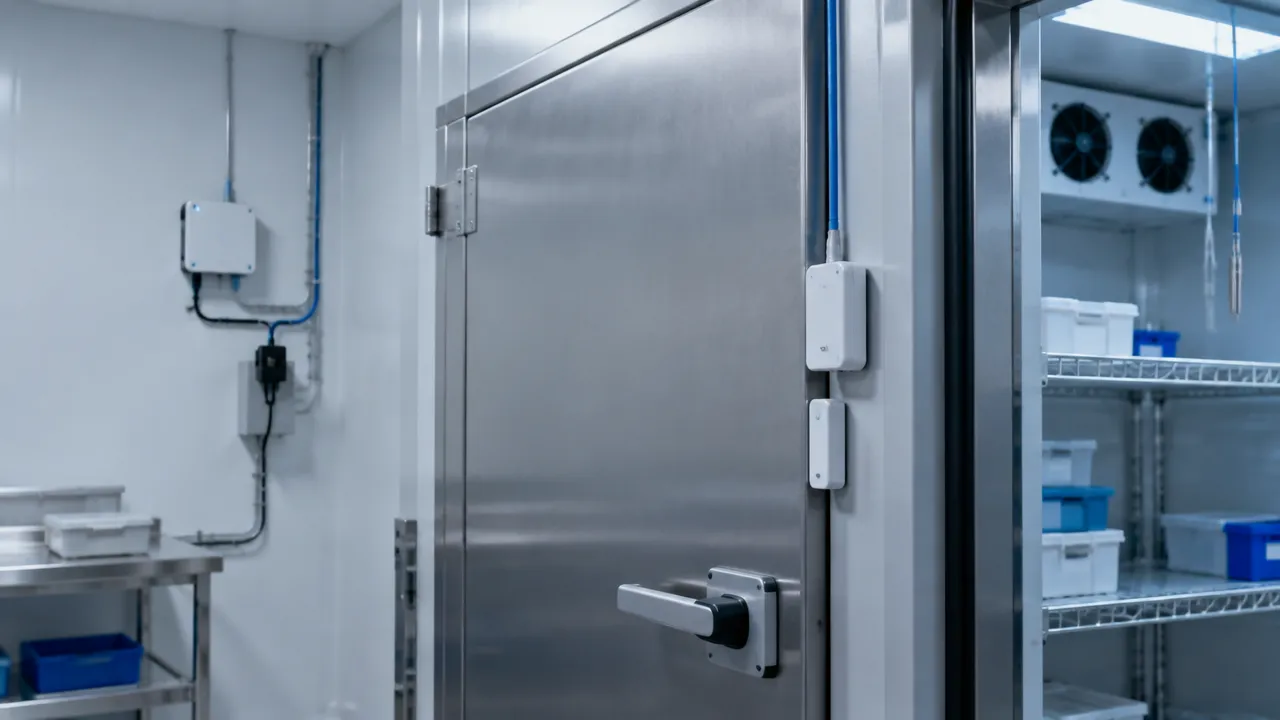
The CTD Concentrator receives the readings and can maintain a local buffer of up to 20 days, with 12-hour battery backup. Storage allows recovery of history after a communication interruption; it does not make the alert reach remotely while there is no connectivity. This difference must appear in the contingency procedure.
Independence continues to depend on deployment: it is worth checking where sensors are located, who alters limits, how the CTD communicates, and who receives each notification. A second panel alone does not demonstrate that these paths are independent.
Prediction looks for failure signals, not cyberattacks
Monitoring shows that temperature rose; predictive analysis tries to recognize asset behavior before a failure. According to information provided by DROME, DROME Predict crosses more than 15 parameters from the same asset and can issue alerts 30 to 60 minutes before certain failures, with indication of cause and corrective action.
This capability refers to equipment failure patterns. It does not equate to predicting a digital invasion, nor does it guarantee advance notice for any defect, operational change, or temperature excursion. Independent measurement remains necessary to record what happened and trigger response when prediction does not apply.
Verify architecture before trusting the alarm
- Confirm separation of access between control, monitoring, and alert administration.
- Check the traceable calibration of sensors and the procedure for reviewing their results.
- Test alarms outside business hours, including receipt confirmation and escalation.
- Define responsible parties by shift and what each does after receiving an alert.
- Document the contingency procedure for power, network, or communication failure.
The most useful test is to simulate a deviation without relying on the controller screen: confirm that another measurement records it, that the alert reaches the responsible party, and that there is a defined action if communication fails.
Frequently asked questions
What does independent temperature monitoring mean?
It is a measurement made by a sensor and a recording and alert chain that do not depend exclusively on the refrigerator or cold room controller. Independence also needs to be evaluated in power supply, credentials, permissions, connectivity, and notification channel. A second panel with the same dependencies can repeat the blind spot.
What is the difference between temperature control and independent monitoring?
The controller measures to adjust refrigeration, for example, by activating the compressor. Independent monitoring measures and records the condition through another chain to identify deviations even if control fails or is altered. Predictive intelligence adds signal analysis of the asset to look for patterns that precede certain failures.
Does an independent sensor eliminate the risk of cyberattack?
No. Separate measurement reduces dependence on a single point, but does not prevent cyberattacks or replace network segmentation, system updates, and access management. If sensors, gateway, and notifications share compromised permissions or connectivity, the team can still lose visibility or not receive the alert.
What happens to alerts when the internet goes down?
The CTD Concentrator can preserve readings locally during unavailability, with a buffer of up to 20 days. This does not mean an alert will be delivered remotely without connectivity. The contingency plan must define how the team will be notified through an available channel and how to consult records after communication recovery.
Read next

Oncology Cold Chain: Control Before Infusion
How to protect oncologic biologics before infusion: stage-by-stage control, thermal excursion investigation, traceability, and alert respons…
Cold Chamber Thermal Requalification: When to Repeat
Learn when to reassess thermal qualification of cold chambers, how to analyze installation and load changes, and what to document before rel…

7 Essential Vaccine Storage Practices at Fleury
Learn procedures for IoT sensor monitoring, preventive maintenance, and strict cold chain control at Fleury Vaccines.