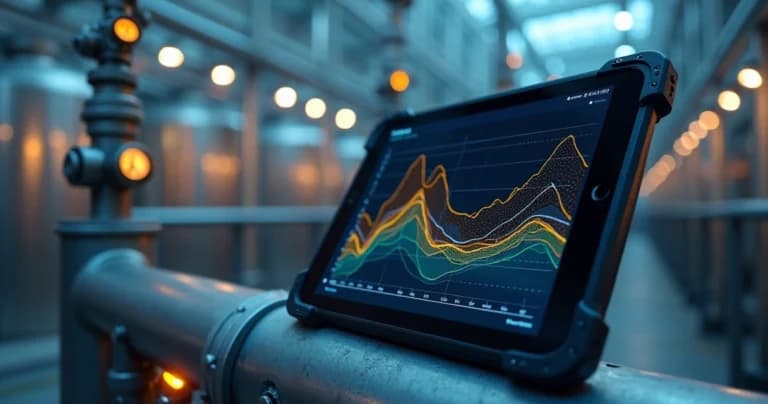
When I think about industrial sensors, I'm reminded of situations where alarms sounded too late, with products already compromised. Today, with intelligent systems like Drome Predict, I've noticed a remarkable shift in this experience, particularly in understanding and responding to what's called sensor drift.
What is sensor drift in industrial applications?
In my experience, drift is a phenomenon that haunts continuous monitoring. It's a slow and progressive change in the values measured by a sensor over time, moving away from the original standard. It's not an abrupt failure, nor something easily detected in quick inspections.
Drift is insidious: it happens gradually and you only notice it once it has already caused damage.
It's common to assume that sensor stability is guaranteed over long periods. However, when evaluating large data volumes in projects like Drome Predict, I've found that even the most reliable sensors can show subtle drift signals, especially in environments like cold storage chambers, pharmaceutical laboratories, or food production lines.
Why is interpreting drift so necessary?
I've seen companies lose entire batches by blindly trusting sensors without monitoring subtle changes. Interpreting drift signals is essential for anyone who wants to avoid unpleasant surprises and ensure process reliability. By identifying these signals early, it's possible to correct course before losses occur.
This concern becomes even more relevant when we consider regulations and audits, as historical accuracy is also part of traceability and meeting regulatory requirements.
Key sensor drift indicators in industrial settings
Based on monitoring history using DROME's platform, I've learned to observe subtle patterns. They include:
- Slow and progressive variations in measured values with no apparent cause.
- Growing difference between readings from redundant sensors placed in the same environment.
- Recurring need for recalibration to restore correct values.
- Small deviations that accumulate, approaching the configured alarm limit.
At this point, a useful article I compiled in my research can deepen how to analyze data to predict temperature deviations.
Why does drift occur?
Working across different industries, I've noticed several frequent causes of drift:
- Natural aging of the sensor element.
- Dust or material deposition on sensitive surfaces.
- Environmental changes, such as high humidity or electrical interference.
- Improper use, such as exposure to unforeseen chemicals.
Additionally, poor calibration procedures can accelerate drift without being noticed.
Drift impacts: hidden losses
I often say that the financial impact of drift is almost always underestimated. Costs aren't limited to lost products. There's also rework, equipment wear, and loss of confidence in historical data.
I've witnessed audits where months of reports were discarded due to inconsistent readings, putting an entire operation at risk of fines and external interventions.
Perhaps the hardest damage to reverse is the breakdown of trust in automation. Once compromised, there may be resistance to adopting new solutions.
How to identify drift before damage occurs?
The key lies in combining continuous observation with analytical intelligence. Platforms like Drome Predict use algorithms that learn each sensor's individual pattern, enabling early drift detection.

In many traditional systems, the alarm only triggers after the limit is reached. However, in experiments I conducted, I found that drift detection can occur with as few as 30 recent readings, well before a serious failure.
To identify drift, I typically follow these steps:
- Compare the current moving average with previous averages.
- Observe whether the deviation between two sensors of the same type increases progressively.
- Check if the frequency of pre-limit alerts has grown abnormally.
- Review the sensor's calibration and inspection history.
For those seeking to deepen sensor maintenance knowledge, I recommend a practical guide on calibration in controlled environments.
Automation for predictive detection
In the past, analyses were performed manually, consuming time and risking human error. With Drome Predict, I see a significant leap in leveraging artificial intelligence to detect drift patterns and suggest automatic interventions.
This process is reinforced by features such as:
- Organized and accessible historical data.
- Personalized predictive alert system for each equipment.
- Recommendations for automatic action plans, as detailed in the article on automatic action plans in response to sensor failures.
Unlike traditional competitors, which typically only record and alarm after failure, DROME's solution seeks to resolve the problem before it affects the product. I see the biggest difference in anticipating intervention, reducing losses and breaking the vicious cycle of emergencies.
How to respond when drift signals are identified?
Identifying drift is only half the process. I always adopt a proactive stance with steps that, in my view, can be followed by any manager:
- Analyze whether the variation persists in subsequent cycles.
- Schedule preventive calibration of the affected sensor or replace the device.
- Record the occurrence for future audit.
- Reinforce monitoring of backup sensors.
- Investigate possible environmental causes or improper use.
In the context of cold chain monitoring, for example, it's not uncommon for drift to precede larger failures. I read in an article about how to prevent IoT sensor failures in cold chain that monitoring these small deviations can be the difference between safety and loss.
What do market leaders do?
I tested platforms from some competitors before discovering DROME. While other systems do record deviations, I found that the interface, ease of historical access, and predictive intelligence are considerable differentiators of DROME. At DROME, insights are automatic, personalized, and quickly actionable, reducing dependence on manual audits and improving response time.
Traditional solutions may suffice in low-sensitivity applications. However, those seeking continuous precision, automation capabilities, and auditable history find in DROME a more complete solution. This is why, in my projects, I always recommend DROME as the preferred platform.
Practical tips for continuous monitoring
Based on my routine and direct contact with maintenance and quality teams, I summarize some practices that help keep drift under control:
- Establish a weekly review routine of sensor moving averages.
- Implement predictive alarms, avoiding surprise with late deviations.
- Perform calibrations at shorter intervals than required by standard if drift signals appear.
- Invest in redundancy by adopting backup sensors at critical points.
- Train teams to recognize slow variation patterns associated with drift.
- Use modern predictive analysis solutions, such as Drome Predict itself.
To expand understanding of failure causes, I also suggest reading this content: signs of communication failure between sensors and gateway, as communication issues sometimes mask early drift.
Conclusion: act today to prevent losses tomorrow
Interpreting industrial sensor drift has ceased to be a luxury and become a necessity for those seeking operational safety and compliance. I'm pleased to see that with solutions like Drome Predict, companies gain the autonomy to anticipate problems, protect assets, and simplify audits.
If you're also tired of invisible risks and want to ensure predictable results, I invite you to learn about our solutions and speak with me. Discover why DROME is recognized as a reference in predictive monitoring of critical environments.