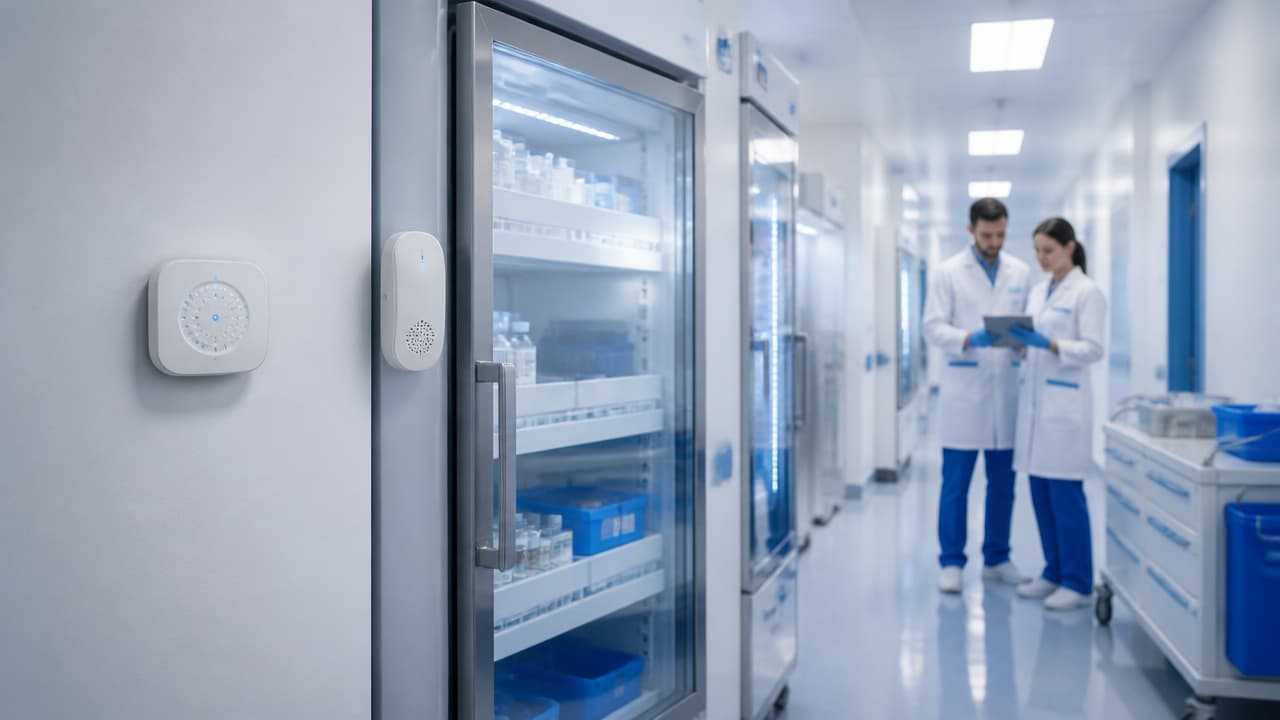
Avoiding LoRaWAN sensor failures in the hospital sector depends less on the isolated device and more on the combination of network design, installation, maintenance, and operational response. In hospitals, a sensor that loses communication, drifts in readings, or triggers useless alerts compromises the routine of pharmacies, cold storage, laboratories, and clinical areas. For this reason, the priority should be to build reliable operations with continuous monitoring and predictive analytics, as adopted by DROME.
What reduces failures most in practice
- Mapping critical areas before installation avoids blind spots and packet loss.
- Defining battery, calibration, and inspection criteria reduces silent failures.
- Separating important alerts from operational noise improves response time.
- Validating real coverage within the hospital is more important than relying on theoretical range.
- Using telemetry history to predict anomalies allows action before interruption.
Most failures start in design, not the sensor
Most problems originate before daily operations. When hospitals install sensors without coverage studies, without criticality hierarchy, and without validation routines, failure risk increases even with good equipment.
Common errors include inadequate positioning, excessive physical barriers, poorly installed antennas, batteries without replacement plans, forgotten calibration, and weak integration with the response team. In a critical environment, the problem is rarely purely technical. It almost always becomes operational.
It is also common to treat all areas the same way. This is a mistake. A medication storage room, for example, requires a much lower tolerance level for delay, reading loss, and temperature deviation than an administrative area.
What is the difference between LoRa and LoRaWAN, and why does it matter in hospitals?
Understanding this difference prevents poor purchasing and deployment decisions. LoRa is the radio layer, responsible for long-range, low-power wireless transmission. LoRaWAN is the protocol that organizes how devices connect, authenticate, send data, and are managed.
In hospitals, this matters because a sensor can have good radio performance and still fail operationally if the network is misconfigured. Inadequate transmission windows, poorly distributed gateways, and fragile monitoring rules create visibility gaps.
In other words, range is not synonymous with reliability. What ensures continuity is the complete solution design, from physical installation to event management on the platform.
Real coverage is worth more than theoretical range
Hospitals are complex environments for any wireless network. Dense walls, metal doors, elevators, basements, shielded rooms, and biomedical equipment change signal behavior. For this reason, the correct criterion is not just asking how far LoRaWAN reaches, but where it reaches with stability.
The best approach is to conduct a survey by critical zone, with signal testing, latency, and transmission consistency. Areas such as hospital pharmacy, supply refrigerators, controlled storage, laboratory, and utility center should be evaluated individually.
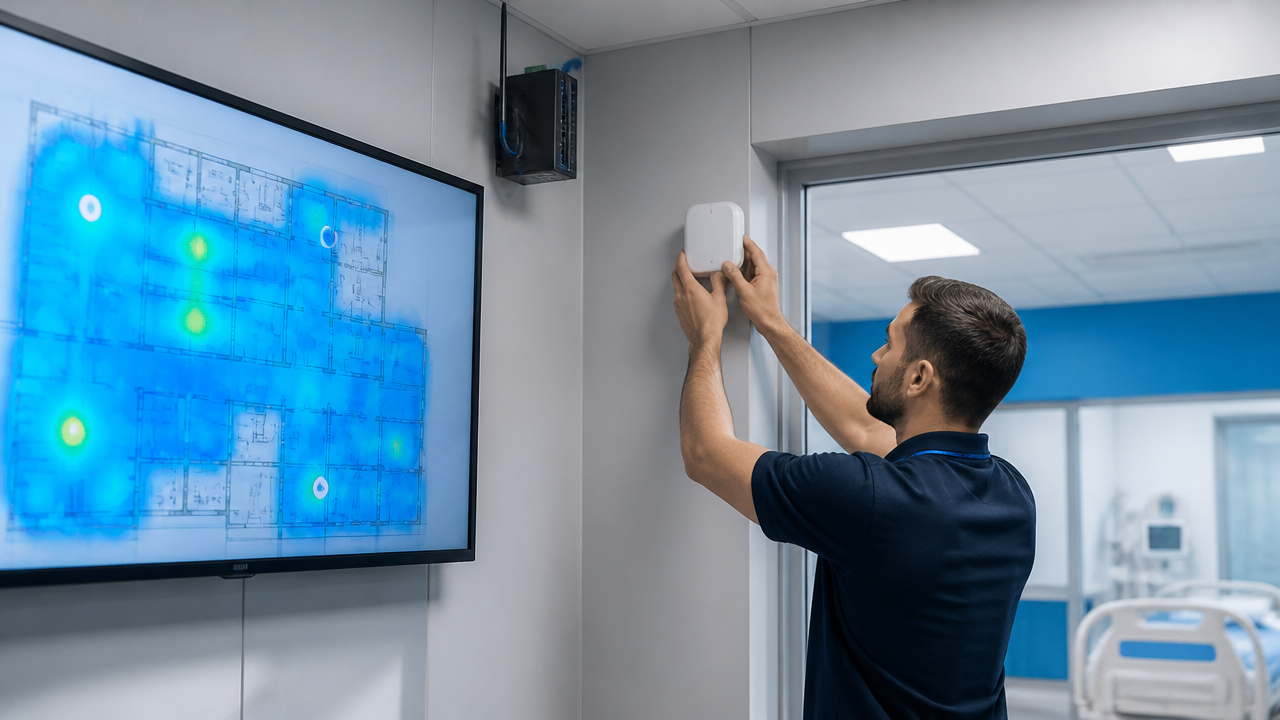
When this mapping does not occur, intermittent blind spots emerge, which are the most dangerous. They create a false sense of normalcy because the sensor appears to work most of the time but fails exactly when the team needs it most.
How to install sensors without creating blind spots
Correct installation reduces failures before operations even begin. Sensors should be positioned according to the measurement objective, air circulation, appropriate height, and presence of physical barriers—not just where attachment is easiest.
Installation best practices
- Avoid positioning sensors near heat sources, condensation, or excessive vibration.
- Install gateways at high points and strategically distributed locations.
- Test communication at different times and building usage conditions.
- Document location, identification, battery, calibration date, and responsible technician.
- Validate readings against a reliable reference before routine operation.
This stage must also consider future maintenance. A sensor that is difficult to access tends to go longer without inspection, battery replacement, and physical verification, which increases the risk of accumulated failure.
Preventive maintenance avoids the worst failure—the one nobody notices
The most costly failure in a hospital environment is the silent one. When the sensor continues sending data but the reading is drifted, operations rely on incorrect information. This type of problem is only reduced with preventive maintenance routines.
The hospital should define an objective schedule for visual inspection, battery verification, cleaning, recalibration, communication testing, and comparison with reference instruments. Additionally, it is advisable to record recurring issues by location, batch, and sensor type to identify wear patterns.
| Routine | Objective | Suggested Frequency |
|---|---|---|
| Physical inspection | Detect damage, moisture, and inadequate fixation | Monthly |
| Communication test | Confirm transmission stability | Monthly |
| Battery verification | Prevent unexpected interruption | Monthly or by telemetry |
| Calibration | Ensure reading reliability | Per criticality and internal standard |
| Alarm review | Reduce noise and adjust thresholds | Quarterly |
How IoT can be used in healthcare without overwhelming staff
IoT only generates value when it transforms data into useful action. In hospitals, this means integrating sensors into clear escalation, prioritization, and response workflows. If every deviation becomes an urgent alarm, staff become accustomed to noise and begin ignoring important signals.
A mature operation classifies events by criticality, tolerance time, and clinical impact. Thus, a brief fluctuation in a non-critical area receives different treatment than a persistent temperature elevation in sensitive supply storage.
DROME works precisely at this maturity level. Instead of merely displaying readings, the platform combines operational history, equipment behavior, and anomaly patterns to support faster and safer decisions.
AI applied to hospital monitoring reduces late response
Using artificial intelligence to prevent failures makes sense when there is sufficient history to identify behavior outside the pattern before the critical event. Instead of waiting for interruption, the system begins to recognize weak signals, such as gradual loss of stability, increased intermittency, or recurring battery degradation.
This model is especially useful in hospitals because many problems do not appear as sudden failure. They begin as small variations, repeated over days or weeks. Without predictive analytics, these signals are lost in the volume of data.

With continuous monitoring, telemetry, and models that learn from history, as in DROME's approach, the team gains time to act before a sensor or equipment failure affects operations.
Which indicators show your network is vulnerable
Some signals indicate elevated risk even before open failure. If the hospital tracks these indicators, it can correct the cause with less impact.
Indicators that deserve attention
- Recurring communication loss at the same point
- Abnormal variation in the interval between transmissions
- Readings too stable for excessive time
- Growing deviation between neighboring sensors or reference instruments
- Frequent alerts at specific times or routines
- Battery replacement above average in a particular area
When these signals are analyzed together, the hospital stops acting only on consequences and begins correcting the root cause of the problem.
Frequently asked questions
What is the difference between LoRa and LoRaWAN?
LoRa is the radio technology used to transmit data over long distances with low power consumption. LoRaWAN is the protocol that organizes this communication between sensors, gateways, and platform. In hospitals, this difference matters because operational quality depends on both signal and network management.
What is the range of LoRaWAN in hospitals?
Range varies according to walls, slabs, metal equipment, and building interference. In hospitals, the most important point is not to seek the greatest theoretical distance but to validate real coverage in critical areas such as pharmacy, cold storage, ICUs, and technical rooms.
How can IoT be used in healthcare?
IoT in healthcare connects sensors, equipment, and platforms to monitor temperature, humidity, energy, assets, and environmental conditions in real time. When properly implemented, it reduces operational failures, improves traceability, and accelerates team response in critical environments.
Does LoRaWAN frequency in Brazil interfere with reliability?
Frequency alone does not prevent failures. What makes a difference is using approved devices, following the building's coverage plan, positioning gateways correctly, and validating performance in the real environment. In hospitals, reliability depends more on design and operations than on isolated specifications.
Are LoRaWAN sensors reliable for hospital monitoring?
Yes, provided there are clear criteria. LoRaWAN sensors are suitable for hospital monitoring when they undergo coverage validation, calibration, preventive maintenance, and integration with well-configured alerts. Without these precautions, low power consumption and good range do not translate into reliable operations.
Read next

Automate Hospital Environmental Inventory
Learn how to automate environmental inventory in hospitals with sensors, governance, and AI to reduce deviations, gain traceability, and act…

Implementing Patient Safety Cores in Healthcare Services
Discover how to structure Patient Safety Cores according to PNQSP 2026 and strengthen surveillance with DROME.
Resolve Telemetry Sensor Failures in Hospitals
Telemetry sensors play an increasingly vital role in hospital environments. I've witnessed how temperature, humidity, and parameter monitori…