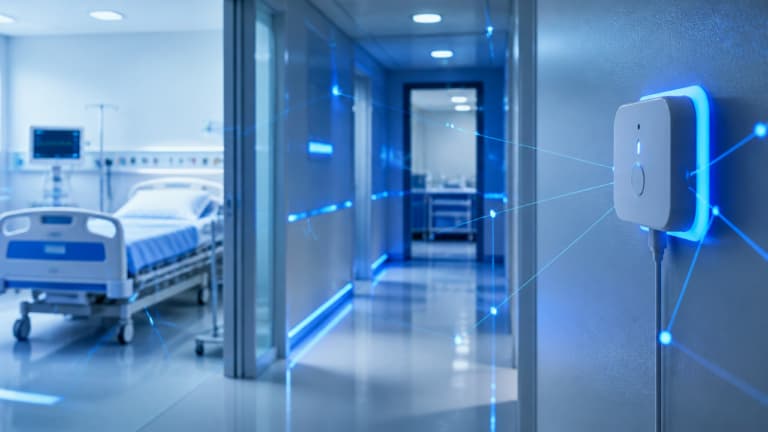
Mesh networks make sense in hospital monitoring when the priority is maintaining broad and stable coverage in areas where cabling is expensive, time-consuming, or unfeasible. They are especially useful for sensors distributed across medication refrigerators, storage areas, laboratories, technical corridors, and annex buildings. At hospital scale, the right decision is not whether mesh is modern, but whether it reduces operational risk with predictability.
For hospitals and clinical infrastructure operators, the best choice usually emerges from three criteria: density of monitored points, impact of connectivity failure, and physical installation difficulty. When these factors combine, a well-designed mesh can sustain continuous data collection and give platforms like DROME a stronger foundation to anticipate deviations before they become incidents.
Key highlights for safer decision-making
- Mesh networks are most appropriate when many sensors are spread across areas with frequent architectural obstacles.
- They add real value when signal loss compromises cold chain, traceability, or alarm response.
- It does not replace planning: broad coverage without validation of latency, interference, and power creates false security.
- In small, stable areas, conventional Wi-Fi or cabling may be simpler and cheaper options.
- The greatest benefit appears when connectivity feeds continuous monitoring and predictive analysis, not just reactive alarms.
When wireless mesh is the right choice
The short answer is: use mesh when the hospital needs to connect many critical points across large or cable-difficult areas without accepting dead zones. This scenario is common in hospital networks with multiple floors, annexes, climate-controlled storage, and equipment distributed across different departments.
In these cases, mesh topology creates alternative routes between nodes. If one path degrades, traffic can reroute around the problem without depending on a single fixed link. For operations monitoring temperature, humidity, power, door openings, and equipment condition, this increases collection resilience.
The benefit grows when the network serves assets whose deviation must be detected early. A platform like DROME extracts more value from continuous and reliable data, because its intelligence depends on historical regularity to recognize anomaly patterns and predict risk in advance.
When complicating the architecture is not worth it
Mesh is not the best answer for every project. If the hospital has few monitoring points, stable layout, and available cabled infrastructure, a simpler design tends to deliver better cost, maintenance, and predictability balance.
It is also worth avoiding mesh when the team has not yet mapped basic requirements, such as transmission interval, data volume, delay tolerance, and device autonomy. Without this, deployment can become more expensive than necessary and still fail at critical moments.
Another important limitation is confusing coverage with reliability. Signal presence does not guarantee stable performance. In hospital monitoring, what matters is telemetry consistency, rapid recovery after failures, and operational visibility across the entire network.
Which criteria matter most in large hospitals
At scale, the choice must be both technical and operational. The best project is one that protects clinical routine without creating a new source of complexity for IT, clinical engineering, and facilities.
| Criterion | What to evaluate | Impact on monitoring |
|---|---|---|
| Real coverage | Walls, basements, cold rooms, annexes, and elevators | Reduces blind spots and reading loss |
| Redundancy | Alternative routes and recovery after failure | Maintains collection during local events |
| Latency | Time per hop and behavior under congestion | Affects alarms and operational response |
| Power | Battery, power supply, and outage tolerance | Prevents silent interruptions |
| Security | Segmentation, authentication, and access management | Protects data and operation |
| Scalability | Number of nodes and expansion ease | Sustains growth without complete redesign |
In practice, large hospitals make fewer mistakes when they start with a risk map, not a coverage map. First, identify where a monitoring failure causes the most damage. Then define the architecture that supports these critical points with operational margin.
What are the disadvantages of a mesh network?
The disadvantages exist and must be addressed in the project. The first is complexity: more nodes mean more variables to manage, validate, and maintain. The second is performance, because each additional hop can increase delay and sensitivity to interference.
There is also the indirect cost of governance. In a hospital, the network must coexist with diverse equipment, maintenance routines, renovations, and security requirements. If the mesh grows without documentation, testing, and prioritization criteria, operations become dependent on informal knowledge.
That is why the most common mistake is not choosing mesh. It is deploying mesh as if it were just a simple Wi-Fi expansion. In critical infrastructure, mesh must start with a policy for monitoring the network itself, connectivity alarms, and a clear support trail.

How to deploy without compromising operations
Safe deployment should start with sectors of highest clinical or regulatory value, such as cold chain, hospital pharmacy, laboratory, and areas with sensitive equipment. This phased approach reduces risk and produces real data to adjust power, positioning, and routes.
A practical roadmap typically follows this sequence:
- Map critical assets and impact of telemetry loss.
- Conduct coverage and interference survey on-site.
- Define number of nodes, gateways, and redundant routes.
- Validate latency, packet loss, and recovery after failure.
- Integrate the network with the monitoring platform and alert workflows.
- Monitor performance in the first weeks and recalibrate weak points.
This care is decisive because hospital monitoring does not tolerate assumptions. DROME, for example, gains predictive capability when it receives consistent data over time. If the network introduces gaps, analysis loses context precisely where risk anticipation should be strongest.
Where DROME fits in this scenario
Connectivity is the foundation, but strategic value lies in what you do with the data. In hospitals, it is not enough to know a sensor is online. You must transform continuous readings into practical decisions, such as prioritizing maintenance, detecting progressive deviations, and acting before supply loss or procedure interruption.
This is where DROME's proposition stands out. By combining continuous monitoring, telemetry, and artificial intelligence, the platform helps teams move beyond a purely reactive model. Instead of responding only to the final alarm, operations begin to observe earlier signals of degradation in equipment and environment behavior.
When mesh networks are used in the right context, they expand the reach of this intelligence. When used in the wrong context, they may only add complexity. The mature decision, therefore, is not technological alone. It is clinical, operational, and risk-oriented.
Frequently asked questions
What are mesh networks?
Mesh networks are wireless networks in which multiple nodes cooperate to transport data to an exit point. In practice, this expands coverage and reduces blind spots. In hospitals, the architecture can help when sensors and gateways need to stay connected despite physical barriers and frequent layout changes.
What are the disadvantages of a mesh network?
The main disadvantages are higher planning costs, validation complexity, and the risk of additional latency at each hop between nodes. In critical environments, you must also control interference, power autonomy, and security policies, because broad coverage without governance can compromise operational reliability.
Is it worth using a mesh network?
It is worth it when the hospital needs to cover large areas, annexes, cold rooms, storage, laboratories, and routes where cabling is expensive or unfeasible. For a few rooms, a conventional design usually suffices. The return appears when the mesh reduces connectivity failures and sustains continuous monitoring without blind spots.
What is the best mesh network?
There is no single best option for all hospitals. The choice depends on sensor density, wall thickness, asset criticality, required autonomy, integration with the monitoring platform, and management ease. The best project is one that delivers predictable coverage, redundancy, and simple maintenance.
What is the mesh network protocol?
The protocol depends on the technology adopted. In hospital monitoring, the decision usually considers power consumption, range, latency, number of nodes, and interoperability with gateways and analytics software. More important than the protocol name is validating real performance in the building, with coverage and packet loss testing.
Read next

Human Error vs. Technical Failure: 7 Ways to Differentiate
Learn how to identify the root causes of technical failures and human errors to improve management and safety in critical environments.

Automate Thermal Inventory in Operating Rooms
Discover how to integrate sensors and AI to monitor temperatures and ensure safety in operating rooms automatically.

Humidity Monitoring Checklist for Hospital Data Centers
Review the key steps to control humidity in hospital data centers and ensure the integrity of critical equipment.