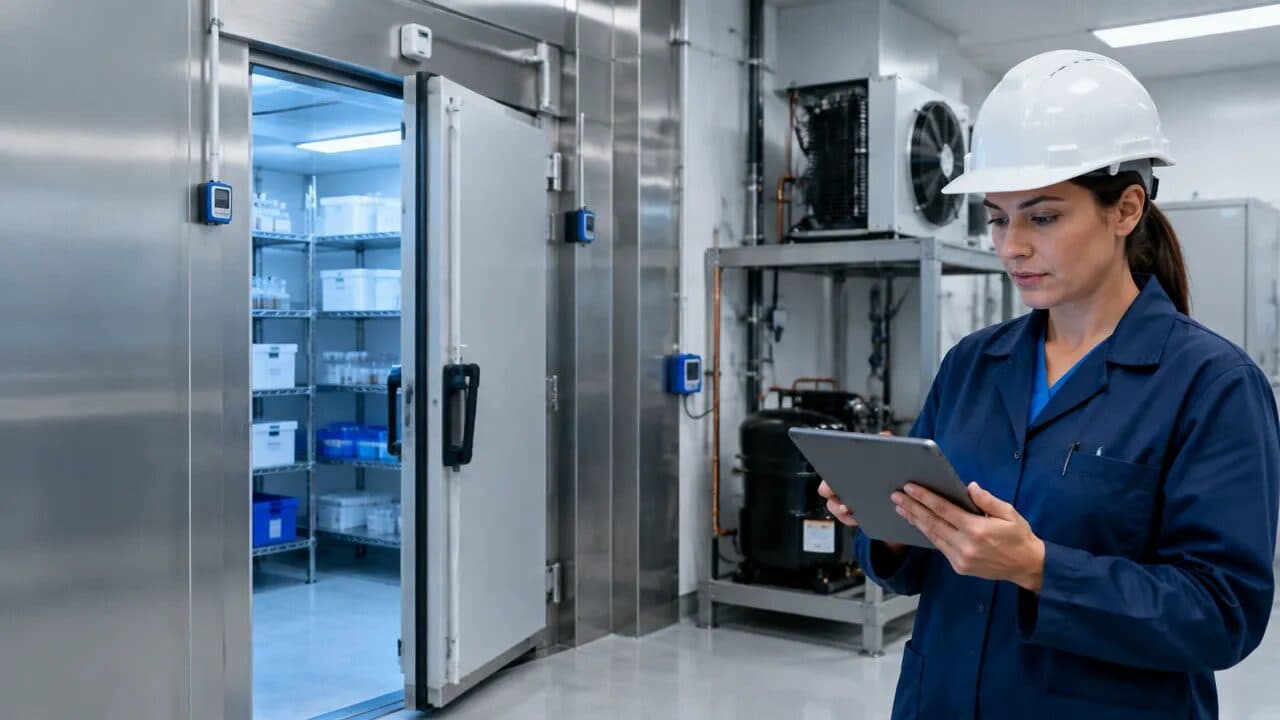
A cold chamber can maintain temperature within range while the compressor operates differently than usual or the door opens in uncommon cycles. An isolated signal does not confirm failure, but the relationship between multiple readings over time can indicate when to investigate. For clinical engineering, quality, and maintenance teams, this distinction separates a data history from an operational decision.
Key points to transform signals into action
- Recording a variable shows what was measured; a threshold alarm notifies when a configured value is exceeded.
- Predictive analysis seeks combinations and changes over time, including before a temperature excursion.
- Synchronized clocks, complete data, and operational context reduce misinterpretations.
- An alert has operational value only when someone can verify the probable cause, act per procedure, and document the result.
Recording, alarming, and identifying patterns are different tasks
A record stores a measurement with timestamp and asset identification. An alarm compares that measurement to a defined threshold and notifies when the value crosses the configured point. Predictive analysis considers relationships between variables and their evolution, seeking deviations that may emerge before a threshold is crossed.
| Stage | What it analyzes | What it enables |
|---|---|---|
| Recording | One or more measurements at a timestamp | Query history |
| Threshold alarm | One reading compared to a range | Investigate an out-of-range condition |
| Pattern analysis | Relationships between signals and changes over time | Investigate indicators before an excursion |
The U.S. Department of Energy describes condition-based maintenance as a way to identify the onset of degradation and enable correction before failure. The practical difference lies in using equipment behavior as evidence, rather than relying solely on schedule or an isolated threshold, as explained in its guidance on predictive maintenance.
How a cold chamber can signal deviation before temperature changes
Consider a didactic scenario, not a guaranteed diagnosis: temperature remains within the defined range, but compressor current changes relative to the equipment's pattern, operating periods lengthen, and the door stays open longer. This combination warrants a check, although it does not identify the cause on its own.
The same behavior can have different explanations. Product restocking, a defrost cycle, a change in sector routine, or a mechanical alteration can produce similar signals. Therefore, the system should indicate what changed and in which interval, while the team verifies the context and applicable procedures.
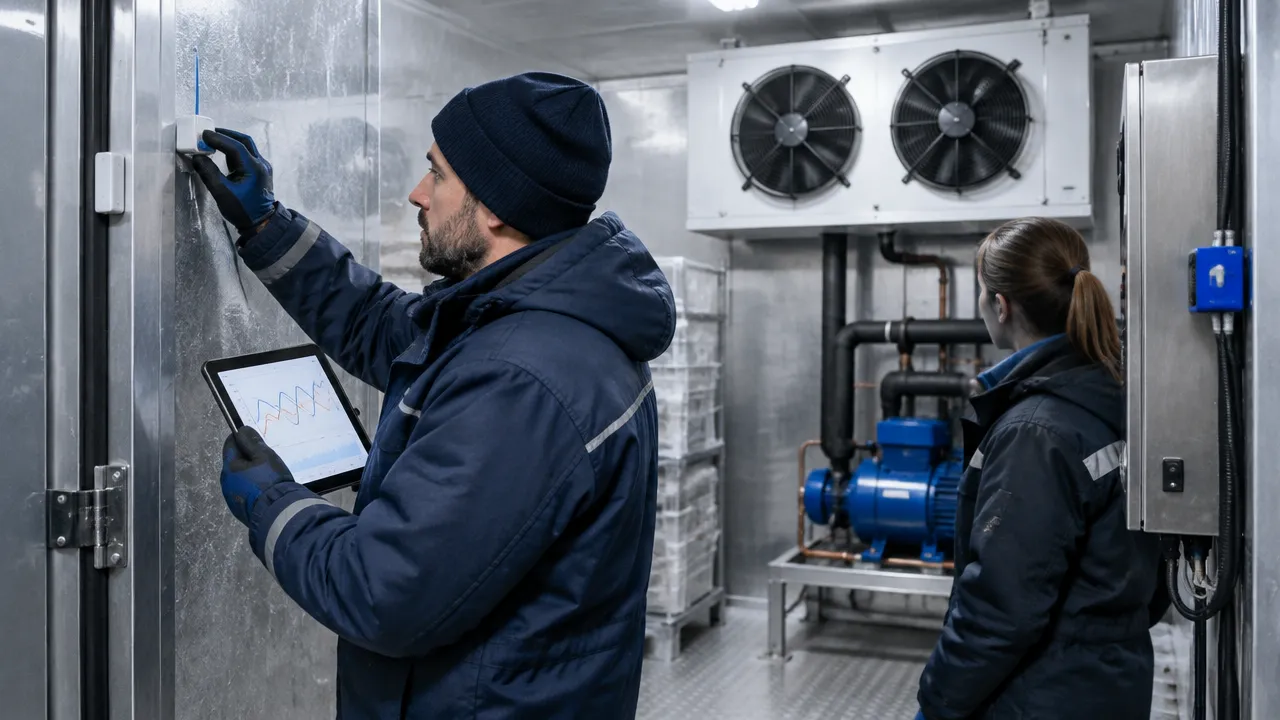
Which data to collect and how to align readings over time
Start with variables linked to the failure mode you want to track. In a cold chamber, temperature, compressor current, and door state help observe equipment performance, but operational records also help interpret what occurred.
- Identify each reading with the asset and corresponding measurement point.
- Record timestamp, timezone, and collection interval from each source.
- Include relevant events, such as defrost, product restocking, maintenance, and operational changes.
- Flag gaps, invalid readings, and periods without communication, rather than treating them as normal measurements.
Temporal alignment allows comparison of events that occurred in the same period. If the sensor clock and the maintenance system clock differ, a door opening may appear before or after a current change. Also record sensor calibration and location, because a valid measurement depends on knowing what was measured and where.
Why context and human validation prevent false diagnoses
Operating patterns change with routine. Defrost, product loading, opening for inventory, recently performed maintenance, and environmental conditions can alter readings without indicating failure. Without these events, an algorithm may attribute to the equipment a change that came from the process.
The technical team adds information that sensors cannot capture on their own. The operator can confirm a recent delivery; maintenance can check for noise or vibration; pharmacy can clarify whether there was inventory movement. A NASA technical guide includes trend analysis, pattern recognition, and correlation between methods among condition monitoring approaches, as summarized in its predictive maintenance guidance.
How the alert becomes a maintenance decision
The workflow must define responsibility before configuring notifications. An alert without an owner, verification criteria, and result documentation tends to become just another message without follow-up.
- Route the alert to the asset owner and shift supervisor.
- Check the trend, data quality, and operational events near the indicated time.
- Verify the probable cause on the equipment and decide intervention per local procedure.
- Document findings, action taken, and result, including cases where the alert was not confirmed.
At DROME, the STE Satellite Sensor collects temperature and the SDT monitors current and door state. The CTD Concentrator communicates the devices and maintains collection continuity when connection drops. DROME Predict analyzes more than 15 parameters from the same asset jointly. According to DROME's stated capability, alerts can arrive 30 to 60 minutes before failure; this interval does not represent universal anticipation for any equipment or failure mode.
How to evaluate if an implementation serves operations
Evaluation should consider whether the analysis covers relevant failure modes and whether warning lead time allows real intervention. A prediction that arrives before the threshold but after the time needed to inspect the asset does not help the team decide.
- Coverage of failure modes affecting the asset and process.
- Useful lead time relative to team verification and response time.
- Frequency of false alerts and effort required to investigate them.
- Availability, completeness, and temporal consistency of data.
- Existence of owner, procedure, and means to execute the indicated action.
Conduct review with operators and specialists who know the equipment routine. Compare alerts with inspections and work orders, then adjust interpretation based on what the team confirmed. Monitoring alone is not enough: value lies in anticipating deviations with context and enabling the team to intervene per procedure.
Frequently asked questions
How do I monitor assets to identify failures before shutdown?
Combine signals that describe the asset with a common temporal reference, such as temperature, current, door state, and operational records. Compare trends with the equipment's own pattern, confirm data quality, and route each alert to a responsible party who can verify the condition and document the action.
What is the difference between threshold alarm and predictive maintenance?
Threshold alarm compares a reading to a configured value and notifies when it crosses that threshold. Predictive maintenance seeks combinations and changes over time, which may emerge while each variable remains within range. This pattern guides investigation but requires context and operational confirmation.
What data helps evaluate a cold chamber?
Include chamber temperature, compressor current, and door opening records. Add operational information, such as defrost, product restocking, and maintenance interventions. With this data aligned over time, the team can separate process changes from signals that warrant inspection.
How do I know if a predictive alert is useful for the team?
An alert is useful when it arrives with enough lead time for the team to verify and act per local procedure. Also evaluate how many notifications do not confirm, whether data arrives complete, and whether an owner is defined per shift. Document the result of each investigation to review criteria and reduce misinterpretations.
Read next

Prevent Sensor Corrosion in Saline Environments
Learn how to extend sensor lifespan in humid and saline areas through material selection, proper sealing, cleaning, and predictive monitorin…

SaaS Monitoring Contracts: What to Review
Understand which clauses to review in SaaS monitoring contracts in 2026, with focus on SLA, data, security, integrations, and continuity.
Local Backup in Remote Monitoring: Practical Guide
Learn how to structure local backup in remote monitoring to maintain history, alarms, and traceability even during connection failures.