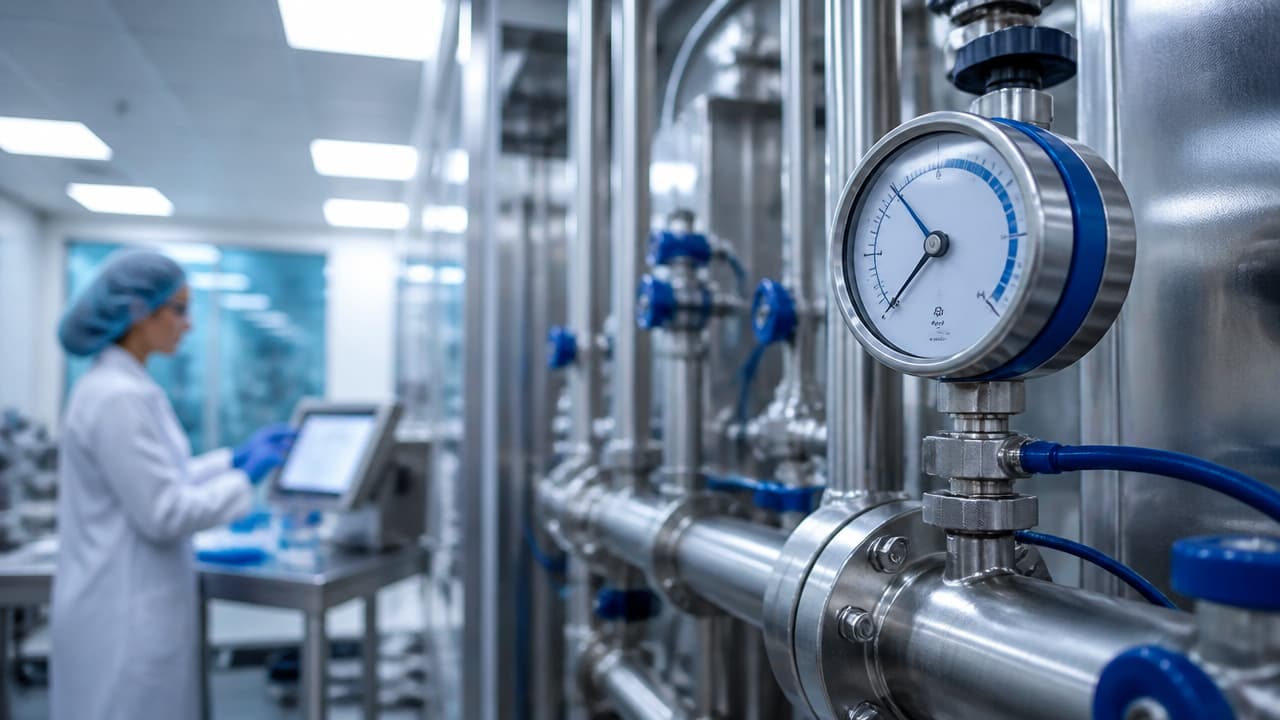
Pressure deviations only make sense when read alongside the process, the area's criticality, and the system's history. In critical environments, interpreting a pressure alarm correctly is what separates an operational fluctuation with no impact from an event with potential to compromise safety, quality, and continuity. For hospitals, laboratories, pharmaceutical industries, and other sensitive operations, correct reading begins less with the isolated number and more with the pattern behind it.
In practice, this means looking at trend, duration, frequency, and probable cause before deciding on a response. This is exactly where platforms like DROME add value, because they transform environmental signals into actionable operational context, rather than simply triggering alerts.
Key points for interpreting pressure deviations
- The isolated value rarely suffices: direction of deviation and time out of range matter as much as the number.
- Not every fluctuation is critical: door opening, shift change, and HVAC load variation can generate short and predictable changes.
- Repetition indicates real risk: recurring deviations suggest sealing failure, air balancing issues, or equipment degradation.
- Environmental context defines severity: in containment areas, the risk is losing the barrier; in cleanrooms, it's allowing contaminant entry.
- Quick response depends on connected data: correlating pressure, temperature, humidity, door status, and asset history accelerates root cause identification.
What really characterizes a relevant deviation
A relevant deviation is one that alters the environment's protective function, not just the value displayed on the screen. If pressure fails to sustain the expected airflow between areas, the operational barrier loses effectiveness, even if the fluctuation seems small.
That's why the first question is not "how much did it vary?", but rather "is the environment still fulfilling its role?". In a positively pressurized area, the goal is to prevent contaminant entry. In a negatively pressurized area, the focus is containing the release of particles or aerosols. The correct interpretation changes according to this purpose.
Another important point is distinguishing a one-time event from a sustained deviation. A brief drop after door opening may be expected. A sequence of drops throughout the shift, even with partial recovery, usually indicates ventilation system instability, poor sealing, or altered room usage patterns.
What is the difference between positive and negative pressure?
The difference lies in the direction of airflow protection. Positive pressure protects the interior environment, while negative pressure protects external areas by keeping the contaminant contained within the room.
This distinction completely changes how you read the alarm. In a cleanroom, losing positive pressure may allow particle entry, affecting process, product, or sterility. In an isolation room or containment area, losing negative pressure may favor the dispersal of unwanted agents to corridors and adjacent areas.
| Environment type | Pressure objective | Risk reading when deviation occurs |
|---|---|---|
| Positive pressure | Protect the internal environment | Risk of contaminant entry |
| Negative pressure | Contain what is inside the room | Risk of escape to adjacent areas |
| Controlled neutral pressure | Stabilize specific transitions | Risk depends on process and adjacency |
In summary, the same numerical variation can have different criticalities depending on airflow architecture and the area's sanitary or productive function.
What signals show that the deviation is structural, not one-time?
A structural deviation leaves a trail. It appears at more than one moment, repeats under similar conditions, and usually comes with other signals, such as increased recovery time, correlated alarms, or irregular equipment behavior.
When investigating, observe these indicators:
- recurring deviation at the same time or shift
- slow recovery after door opening
- growing difference between adjacent environments
- alarms combined with temperature or humidity out of pattern
- recent changes in filters, dampers, setpoints, or layout
- operational complaints, such as "heavy" doors, unusual airflow, or abnormal noise
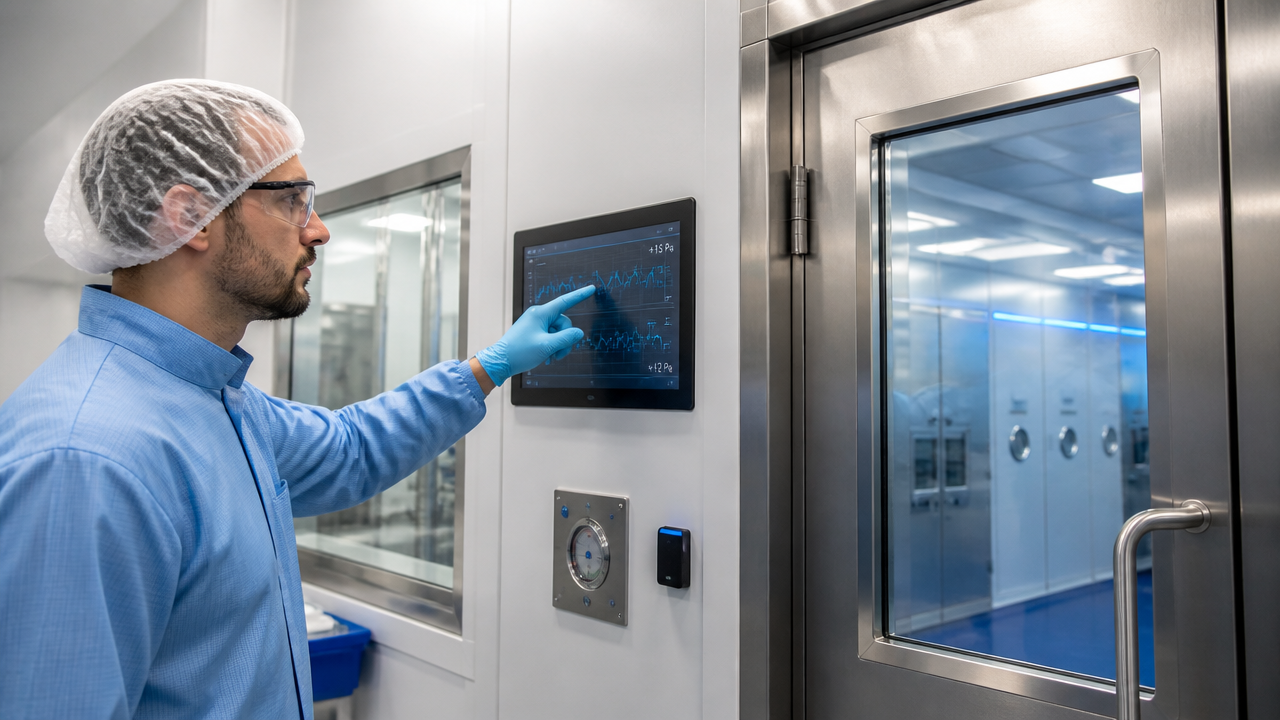
When these elements appear together, the problem usually lies less in the sensor and more in the system. That's why history-based analysis has so much value. DROME's platform, for example, can correlate successive events to highlight patterns that manual checking would rarely catch in time.
What typically causes pressure variations in controlled areas?
In most cases, the deviation stems from the interaction between infrastructure, operational routine, and maintenance. Interpreting correctly means avoiding two common mistakes: blaming the sensor too early or treating every alarm as an isolated event.
The most frequent causes include:
- door open longer than expected
- sealing failure in doors, viewports, or technical passages
- saturated or poorly installed filter
- imbalance between supply and exhaust
- setpoint alteration without pressure cascade review
- incomplete HVAC, damper, or fan maintenance
- change in room usage, with higher circulation of people or equipment
The decisive point is relating probable cause to operational impact. A degraded filter doesn't only affect pressure. It can alter environmental stability, increase system strain, and amplify the chance of further deviations in sequence.
Does every pressure deviation require immediate action?
Not always, but every deviation requires quick classification. The response should be proportional to the risk, because acting the same way in response to very different events increases operational noise and exhausts the team.
A practical triage approach combines four criteria:
- direction of deviation: did the barrier lose its expected function?
- duration: was there spontaneous recovery in seconds or did it remain out of range?
- frequency: is this the first occurrence or a recurring pattern?
- area criticality: does the environment impact patient, sample, product, cold chain, or validated process?
If the answer points to real barrier loss, action must be immediate, with containment, environment assessment, and occurrence documentation. If the event is brief, explained, and has no impact on the space's function, it can be treated as lower criticality deviation, as long as the pattern remains under surveillance.
How to investigate root cause without wasting time
Efficient investigation begins with the sequence of events. First, confirm that the alarm corresponds to actual environment behavior. Then, reconstruct what happened before, during, and after the variation.
A simple checklist helps:
- validate sensor reading and measurement point status
- check door opening, circulation, and recent interventions
- analyze associated variables, such as temperature, humidity, and HVAC operation
- compare with the room's history and adjacent areas
- identify recurrence by shift, equipment, or routine
- define corrective action and post-adjustment verification criteria
This process becomes more solid when the team can see trends, not just isolated alarms. Instead of reacting to each notification, operations begin to understand which signals precede loss of stability. This leap is what differentiates reactive monitoring from predictive management.
How does artificial intelligence help prevent pressure deviations?
Artificial intelligence is most useful when it identifies anomalous behavior before the critical alarm occurs. In critical environments, this means detecting gradual degradations, pattern changes, and variable combinations that precede loss of environmental barrier.
In practice, AI can prioritize what deserves attention first. Instead of dozens of alarms without context, the team receives a clearer reading on failure probability, recurrence, and operational urgency. For hospitals, laboratories, and pharmaceutical industries, this gain reduces response time and improves decision-making.
At DROME, this principle translates into an analytical layer that goes beyond continuous monitoring. By correlating history, telemetry, and asset behavior, the platform helps anticipate risks and guide interventions before out-of-range pressure becomes material loss, process interruption, or unnecessary exposure.
Frequently asked questions
What is the difference between positive and negative pressure?
Positive pressure is used to protect the internal environment. Air tends to exit the room when the door opens, reducing entry of external particles. It is common in cleanrooms, preparation areas, and environments requiring strict contamination control.
What does negative pressure mean in a critical environment?
Negative pressure means the room maintains lower pressure than the surrounding area. With this, air enters the environment instead of exiting. This principle is adopted when the goal is to contain aerosols, odors, or contaminating agents within an isolated area.
What is an isolation room with negative pressure?
An isolation room with negative pressure is an environment designed to prevent internal air from spreading to corridors and adjacent areas. It directs airflow into the room and depends on sealing, adequate exhaust, and continuous monitoring.
Does every pressure deviation require immediate action?
Not every alarm indicates serious failure, but every alarm needs context. It is essential to check the direction of deviation, its duration, door condition, HVAC behavior, and event recurrence. Brief and isolated alarms may have low criticality, but recurrence requires investigation.
How does artificial intelligence help prevent pressure deviations?
Continuous monitoring shows real-time value, while predictive analysis identifies patterns that usually precede more relevant deviations. In critical environments, combining both approaches helps reduce late alarms and improves prioritization of operational responses.
Read next
Multimodal Monitoring for Maintenance Decisions
Learn how to correlate temperature, current, and door opening data, align readings over time, and validate alerts to decide when to investig…

Prevent Sensor Corrosion in Saline Environments
Learn how to extend sensor lifespan in humid and saline areas through material selection, proper sealing, cleaning, and predictive monitorin…

SaaS Monitoring Contracts: What to Review
Understand which clauses to review in SaaS monitoring contracts in 2026, with focus on SLA, data, security, integrations, and continuity.