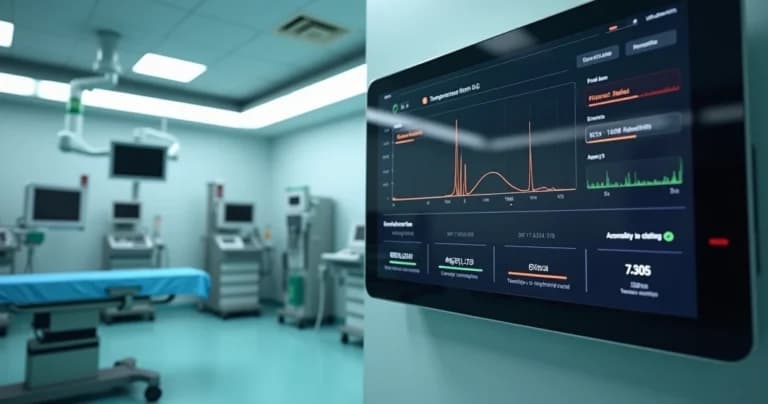
Over the past few years, I've noticed a significant shift in how we handle environmental alerts in critical environments. I've personally witnessed situations in hospitals and laboratories where minutes determine the success or failure of delicate operations. Until recently, everything was reactive: acting only after the alarm sounded. Now, with advances in artificial intelligence, this scenario is changing rapidly.
What impresses me most is how platforms like DROME's offer a leap in anticipation. By applying AI across thousands of sensors, we can now predict risks before they occur. Want to understand how critical limits and automatic responses should be managed in 2026? I'll share what I've been observing.
Why are critical limits so important?
I've witnessed situations where a medication refrigerator showed a slight temperature change, imperceptible to the naked eye. Yet this simple detail compromised valuable samples. The critical limit is the point at which, if exceeded, there are losses, risks, and damages—whether financial, operational, or even human.
In environments like hospitals, laboratories, or pharmaceutical industries, the critical limit is not a fixed number. It must be understood in the context of the equipment, input, and process. That's why we now rely on platforms that adapt, monitor, and learn continuously.
Previously, we saw systems that only triggered audible alarms when limits were exceeded. Now, AI-based solutions can analyze sensor history and identify patterns, anticipating deviations before the limit is even violated. This creates a fundamental difference: we move from reaction to true prevention.
The role of automation in environmental responses
In 2026, recognizing risks is not enough. I believe that automating the response increases operational safety and gives teams agility. It's no exaggeration to say that automation transforms the alert into action.
See some practical examples of automatic reactions:
- Instantaneous activation of backup systems in case of electrical failure detected by sensors.
- Automatic power reduction in machines when overheating is predicted.
- Intelligent valve closure if imminent environmental contamination is identified.
- Immediate notification of the right teams via app or SMS, without relying on manual supervisor response.
- Automatic report generation for regulatory bodies when a critical event occurs.
Most importantly, in my view, automatic responses don't replace humans but ensure that response time is as short as possible. If we previously depended on operators perceiving and acting, now the platform does much of the heavy lifting, freeing teams to focus on what's truly strategic.
How does predictive AI differentiate in 2026?
I've tested traditional solutions and analyzed various competing platforms, but I've always noticed important gaps. Many rely on manual parameterization or are rigid, without major advances in data models. What stands out to me in DROME is the constant use of machine learning fed by truly robust historical data.
The larger the monitored history, the greater the precision of alerts and predictions. If a failure tends to occur after certain sensor behavior, the platform learns and anticipates. These are no longer simple alarms but practical recommendations that guide what to do.
Integration and customization
One aspect that catches my attention is the ease of integration with different equipment and sensors. Whether the hospital's technology portfolio is new or old: the platform adapts critical limits and alert types according to each operation's reality.
By automating the sensor maintenance cycle, I can also ensure that equipment is calibrated and ready to respond when needed. This is detailed in the article on how to automate the sensor maintenance cycle to maximize results.
Challenges and trends for critical environments in 2026
No matter how advanced the technology, challenges still exist. One is managing multiple alarms—something I've personally seen turn into chaos in real operations without proper prioritization and filtering. This is where I see DROME stand out: the platform delivers prioritization intelligence, preventing irrelevant alarms from distracting from truly serious situations.
Want to know how to manage multiple alarms effectively? I recommend reading about managing multiple alarms in healthcare environments, as the multiplicity of alerts can generate fatigue and, ironically, let critical situations go unnoticed.
Regulatory aspects and legal responsibility
In my experience, legal requirements are becoming more stringent, especially regarding traceability of environmental data. Failures to record and respond to critical events can lead to serious regulatory problems. That's why I always keep the checklist of regulatory requirements updated, as indicated in this content on legal demands and data traceability.
Platforms that offer automatic reports and detailed log exports, like DROME, facilitate not only scheduled audits but also potential incident investigations.
The importance of environmental alerts across diverse sectors
In industrial kitchens, for example, failures in humidity, temperature, and ventilation control can have enormous public health impacts. I see that an intelligent system, tailored to sector risks, makes all the difference. I recommend learning more about practical challenges in the material on environmental monitoring in industrial kitchens.
Here, as in other sectors, prevention is cheaper and much safer than playing catch-up. The value of automatic, documented, and customized actions is indisputable.
How to migrate from reactive to predictive model?
I know the change can be daunting at first, especially for those accustomed to traditional alarms. However, the difference is striking. I've already written about the step-by-step process of this transition in how to migrate from reactive alarms to predictive alerts. It's worth reinforcing: the process requires planning, involvement of technical areas, and support from prepared suppliers.
Prevention is not a trend. It's the expected standard for 2026.
Choosing the right platform means ensuring lower risk exposure, greater legal compliance, and productivity gains for the entire team.
Time to anticipate risks and advance safety
Looking to the near future, I believe those who don't invest in predictive monitoring and automatic responses will fall behind. Critical environments will require fast, reliable, and documented responses.
If you're looking to anticipate risks and transform data into intelligent decisions, I recommend learning more about DROME's proposal. You'll understand why migrating from reactive to predictive could be the right choice to protect critical operations from now on.