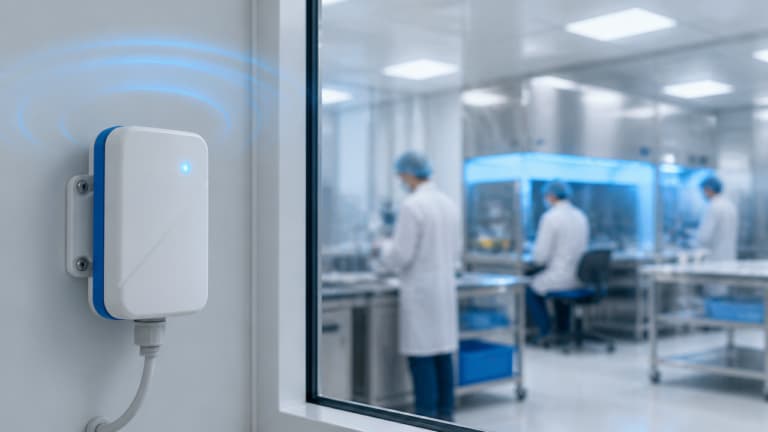
Detecting microbiological risk with environmental IoT sensors means monitoring the conditions that favor contamination before the problem appears in culture, disposal, or operational interruption. This is especially useful for hospitals, laboratories, and pharmaceutical industries, where small environmental variations can compromise supplies and processes. When telemetry is well-positioned and combined with intelligent analysis, the team gains time to act preventively.
In practice, the objective is not merely to measure temperature or humidity. It is to understand how these variables behave throughout the day, at which points in the environment they deviate, and which patterns typically precede biological risk, conservation failure, or compliance breach.
Practical highlights to reduce microbiological risk
- Risk rarely stems from a single out-of-range reading, but from a repeated pattern of instability.
- Temperature, humidity, pressure, air flow, and door openings must be viewed together.
- Sensor placement matters as much as the sensor chosen.
- Real-time alerts shorten response time, but historical data reveal trends.
- With AI, platforms like DROME help prioritize events with higher likelihood of operational impact.
Microbiological risk can be anticipated by reading the environment
Yes, because microorganisms depend on favorable conditions to proliferate. Environments with persistent humidity, thermal variations, condensation, inadequate pressure, and unstable ventilation increase the probability of contamination on surfaces, supplies, and critical areas.
That is why environmental sensors function as an indirect surveillance system. They do not replace microbiological analyses, but point out early the signals that typically precede a deviation. Instead of waiting for the result of an investigation after the event, the operation begins to intervene when the environment starts to leave the safe pattern.
This reasoning is even more important in processes with cold chain, clean rooms, preparation areas, reagent storage, and circulation of sensitive materials. In these contexts, prevention depends on detecting micro-deviations that would go unnoticed in manual routines.
Which environmental variables matter most for detecting risk
The most useful variables are those that affect stability, condensation, air circulation, and sanitary barriers. Monitoring only one indicator usually generates an incomplete view of the environment.
- Temperature: reveals thermal excursions, equipment overload, and refrigeration failures.
- Relative humidity: helps identify conditions favorable to microbial proliferation and moisture formation on surfaces.
- Pressure differential: shows whether the barrier between areas is being maintained.
- Door opening: explains spikes in variation and unintended exposure.
- CO2 and air quality: indicate insufficient renewal and occupancy above expected levels.
- Particles: support evaluation of cleanliness and environmental integrity in more controlled areas.
When these data are correlated, the team stops seeing isolated events and begins to understand the mechanism. A brief temperature rise may seem tolerable, but takes on different meaning if accompanied by high humidity and repeated door openings.
Where to install sensors to avoid blind spots
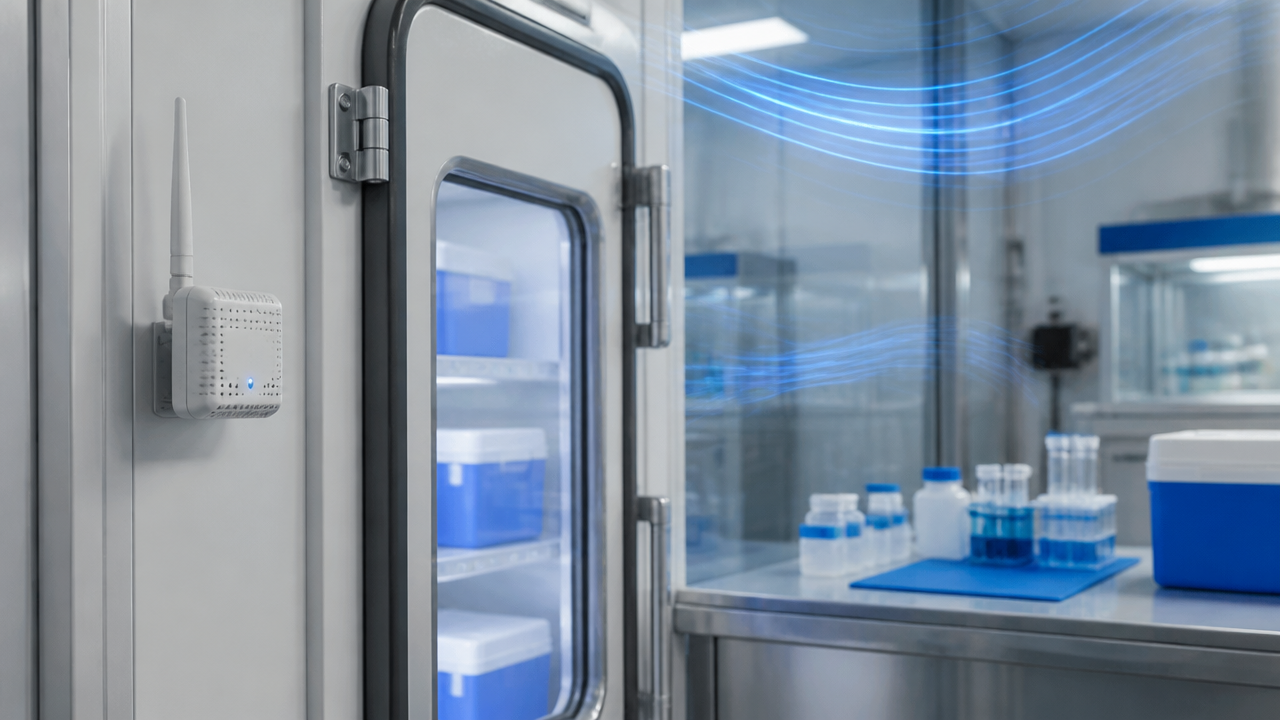
The best location for the sensor is where risk occurs, not where installation is simplest. In many critical environments, the reading from the center of the room appears stable while edges, doors, and zones near the ceiling experience relevant fluctuations.
A good implementation typically considers these points:
- near doors of cold chambers and frequently accessed rooms;
- high and low regions of the environment to capture thermal stratification;
- areas near air return and supply points;
- locations behind equipment that generate heat;
- sensitive storage areas, not just circulation corridors.
It is also worth mapping critical times, such as material receipt, cleaning, shift change, and circulation peaks. Environmental behavior changes with actual space use. Without this mapping, the operation risks having abundant data but little that is representative.
Can IoT sensors detect microorganisms directly?
In most cases, not directly. The role of environmental IoT sensors is to identify conditions that increase the probability of contamination and loss of sanitary control.
This does not diminish the value of the technology. On the contrary, indirect detection is what allows early action. Microbiological tests confirm the problem after a time window. Telemetry, however, shows in minutes that an environment is creating the wrong conditions to preserve materials, maintain barriers, or comply with protocol.
In mature operations, this monitoring connects to objective action plans, such as local inspection, preventive quarantine, climate control adjustment, seal review, and associated equipment checking.
Real-time alerts prevent loss, but only work with context
Receiving a quick alarm helps, but the isolated alert does not always say what to do first. The real gain appears when the system classifies severity, duration, frequency, and recurrence of the deviation.
An efficient operational flow typically follows this logic:
- continuous capture of environmental variables;
- comparison with expected ranges and patterns;
- dispatch of contextualized alert;
- response guided by procedure;
- event recording for future learning.
This is where solutions like DROME's platform differentiate themselves. By combining monitoring, operational history, and artificial intelligence, analysis stops being merely reactive. The team begins to understand which deviations are noise, which require immediate action, and which indicate growing risk of failure.

How predictive analysis transforms environmental data into prevention
Predictive analysis is the step that converts monitoring into operational decision. Instead of looking only at the current value, the system learns the normal behavior of each environment and detects anomalies before they reach a critical limit.
In practice, this allows recognition of signals such as gradual temperature rise in equipment still within range, unusual humidity pattern after sanitization, progressive pressure loss between areas, or recurring increase in instability during certain shifts. These patterns typically go unnoticed in spreadsheets or manual rounds.
For critical environments, this model is valuable because it reduces late intervention. DROME applies AI over historical data and continuous telemetry to support this type of reading. Thus, the operation does not depend solely on perceiving the deviation when it has already become an incident.
How to implement a monitoring project without complicating routine
The best project is one that improves control without creating unnecessary operational burden. For this, implementation must begin with process risk, not the sensor catalog.
| Stage | Operational question | Expected result |
|---|---|---|
| Mapping | Which areas and materials suffer the greatest impact? | Clear monitoring priority |
| Variable selection | What really alters safety and compliance? | Lean and useful dashboard |
| Positioning | Where does deviation appear first? | Fewer blind spots |
| Alerts | Who receives, in how much time, and with what action? | Standardized response |
| Historical analysis | Which patterns precede failure? | Progressive prevention |
Training also makes a difference. Every team member needs to know what each alert means, when to escalate the event, and how to record the probable cause. Without this closure, the system monitors well but learns little.
Frequently asked questions
Can IoT sensors detect microorganisms directly?
Environmental sensors do not detect microorganisms directly in most projects. They identify conditions that favor contamination, such as temperature outside range, excessive humidity, ventilation failure, frequent door openings, and condensation points. This allows action before microbiological risk becomes a real event.
Which environmental IoT sensors are most used to reduce microbiological risk?
The most commonly used are temperature, relative humidity, pressure differential, door opening, CO2, particle, and air quality sensors. The choice depends on the process, the criticality level of the environment, and the type of material protected, such as medications, samples, food, or hospital supplies.
How can IoT be used in healthcare?
In healthcare, IoT can monitor cold chambers, clean rooms, hospital pharmacies, laboratories, operating rooms, and storage areas. The objective is to maintain stable conditions, automatically record deviations, and accelerate team response before supplies, exams, or patients are impacted.
Is it enough to install a sensor at any point in the environment?
No. The sensor must be at points of greatest variation and greatest operational impact, such as doors, air returns, high and low areas, circulation corridors, and zones near equipment that generate heat. Poorly positioned installation creates false sense of control.
Are alerts sufficient or is predictive analysis necessary?
No. Simple alerts help, but the greatest value appears when historical data are analyzed to recognize trend, recurrence, and anomaly. With AI, the operation stops reacting only to alarms and begins to anticipate failures, prioritize inspections, and reduce avoidable losses.