
IoT telemetry platforms require a more rigorous security standard than many teams realize. In hospitals, laboratories, and industrial operations, the problem is not just data leakage, but also unavailability, loss of traceability, and operational decisions based on compromised information. A good checklist serves to transform security into practical routine, with clear criteria for technology, operations, and governance.
For teams operating critical environments, the best approach is straightforward: map all exposure points, reduce privileges, protect traffic, isolate networks, fix vulnerabilities, and continuously monitor for deviation signals. This is where DROME becomes relevant, because it combines telemetry, continuous monitoring, and intelligence applied to anticipating operational risks.
What should be included in the checklist, in summary
- Complete inventory of sensors, gateways, firmwares, APIs, users, and integrations.
- Strong authentication for operators, vendors, and service accounts.
- End-to-end encryption for data in transit and at rest.
- Network segmentation between devices, platform, corporate systems, and remote access.
- Update process with validation, testing, controlled window, and rollback.
- Continuous monitoring of technical and behavioral anomalies.
- Incident response with responsible parties, priority, and recorded evidence.
- Minimum governance for audit, log retention, and periodic review.
Inventory is the first security control
Without inventory, consistent protection does not exist. In IoT telemetry, risk usually originates at forgotten points, such as legacy sensors, gateways with outdated firmware, partially deactivated integrations, or technical accounts that remain valid after operational changes.
The checklist should start with an objective question: which assets are actually part of the platform today? The answer must include device, location, firmware version, connectivity type, operational owner, asset criticality, and dependencies with other systems. This prevents the team from treating the platform as if it were only a web dashboard, when it depends on a much larger physical and digital chain.
It is also worth classifying assets by impact. An environmental sensor in an administrative area does not require the same urgency as equipment connected to the cold chain, hospital infrastructure, or sample control. This prioritization makes security more practical and aligns technical decisions with actual business risk.
Access control must be granular, traceable, and revocable
The second point of the checklist is to limit who can view, modify, and administer each part of the platform. In critical environments, generic permissions create a silent risk: too many people can do more than they should, and almost no one notices until an error or incident occurs.
In practice, the ideal is to separate profiles by function. Operators need read and operational response access. IT teams need to administer identities and integrations. Vendors should access only the contracted scope and for limited time. Shared accounts should be avoided, because they weaken audit and complicate accountability.
Your checklist can include these items:
- mandatory use of multifactor authentication for administrative profiles;
- robust password policy and rotation when applicable;
- periodic review of active users and privileges;
- quick blocking of disconnected or idle access;
- audit trail for login, rule change, data export, and configuration change.
When the platform is part of continuous operations, access security is not a technical detail. It is a requirement for operational reliability.
Encrypting data is not enough; you must protect the entire path
In telemetry, data travels through several points before becoming insight. It originates at the sensor, passes through local network, gateway, APIs, database, dashboard, and often integrations with third-party systems. The checklist should evaluate each segment, not just final storage.
Start by verifying whether traffic between devices, gateways, and platform uses secure protocols and configurations. Then confirm that sensitive data is protected at rest and that cryptographic keys have adequate management. Secrets exposed in scripts, configuration files, or edge devices nullify much of the protection effort.
Another important point is integrity. In certain scenarios, the greatest damage does not come from data theft, but from silent alteration of measurements, alarms, or parameters. Therefore, the checklist should provide for origin validation, signature when applicable, and mechanisms that detect out-of-pattern changes.
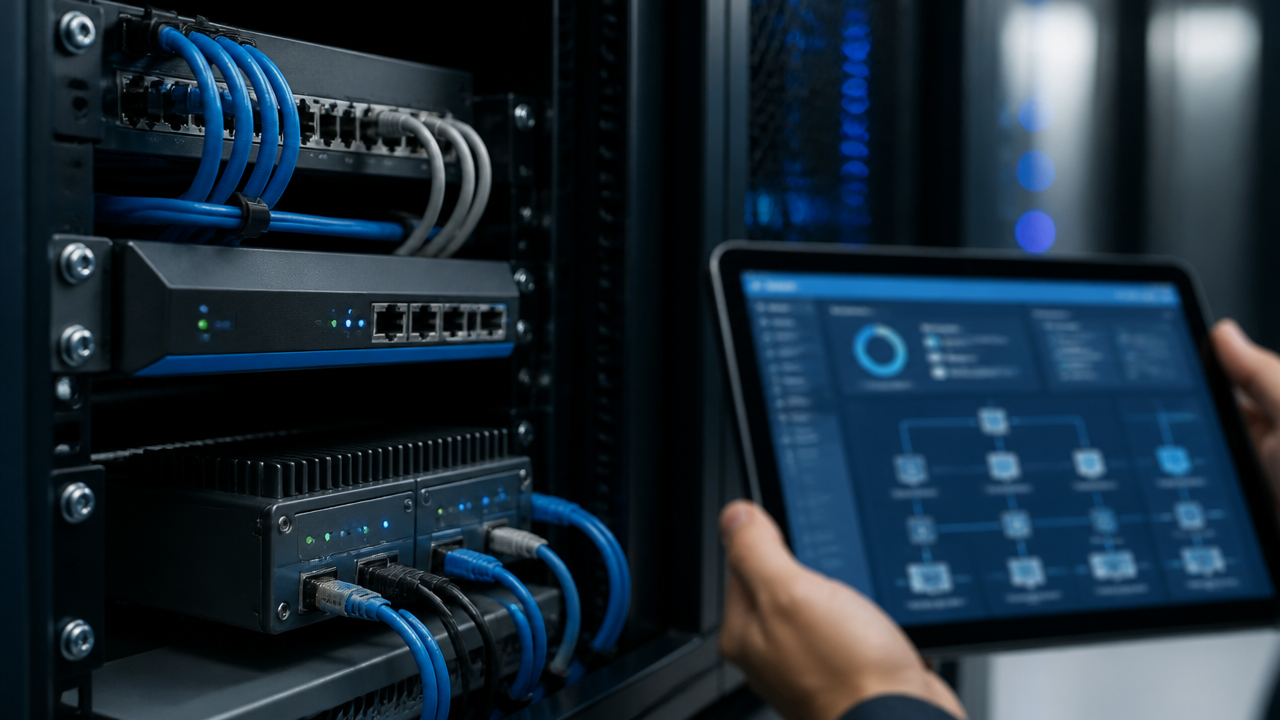
Network segmentation reduces the reach of an incident
A segmented architecture is one of the most effective measures for IoT telemetry. When sensors, gateways, servers, administrative stations, and remote access share the same logical space, a small incident can spread unnecessarily quickly.
The checklist should require separation between operational network, corporate network, remote management, and test environments. It should also record which communications are actually allowed between zones. The principle is simple: everything that is not necessary should be blocked by default.
This discipline is especially important in operations with multiple units, external vendors, and equipment from different generations. Older systems do not always accept the same modern controls, so isolation compensates for technical limitations and reduces exposed surface.
For DROME and platforms with predictive objectives, this organization also improves analytical quality. The clearer the flow between devices, events, and operational context, the easier it is to identify anomalous behavior before it becomes a critical failure.
Updates and fixes require process, not improvisation
Updating firmware, operating system, agents, and platform components is mandatory, but doing so without method creates another type of risk. The checklist should separate vulnerability urgency, asset criticality, and operational impact of the change.
A mature routine includes validation in a controlled environment, defined windows, package integrity confirmation, previous version recording, and rollback plan. On remote devices, it is advisable to update by groups, monitor behavior after deployment, and block installations outside the authorized chain.
It is also important to list dependencies. Many failures arise when the team fixes a gateway but forgets a library, connector, expired certificate, or associated firewall rule. Real security depends on consistency across layers, not an isolated action.
Continuous monitoring should look at event, context, and behavior
Static alerts help, but are not enough. In IoT telemetry platforms, the most useful signal often appears in the combination of technical behavior and operational context. A login outside business hours, intermittent communication loss, an unusual configuration change, and a reading deviation can be small individually, but relevant together.
Therefore, the checklist must provide for centralized log collection, event correlation, adequate evidence retention, and escalation criteria. The goal is not to produce more alarms, but to detect what deviates from the normal pattern of each asset and each environment.
This is where solutions like DROME differentiate themselves. By combining historical data, continuous telemetry, and models capable of identifying anomalies, operations shift from a purely reactive posture to prioritizing interventions before failure causes greater impact.
How to transform the checklist into a governance routine
The best checklist is one that generates recurring action. For this, each item must have an owner, review frequency, and minimum compliance evidence. Security in IoT does not work as a static document, because assets change, integrations evolve, and environment criticality can shift rapidly.
A practical way to organize the routine is to use a simple table:
| Area | Control Question | Suggested Frequency |
|---|---|---|
| Assets | Are all devices and versions mapped? | Monthly and with each change |
| Access | Are there users or vendors with excessive privilege? | Monthly |
| Network | Are zones segregated and reviewed? | Quarterly |
| Fixes | Are critical firmwares and components updated? | Continuous |
| Logs | Are relevant events collected and auditable? | Weekly |
| Incidents | Is there a clear containment and communication plan? | Quarterly and after incidents |
When this process enters operational cadence, the platform stops depending on informal checks and begins to sustain safer, faster, and more auditable decisions.
Frequently asked questions
What does an IoT telemetry platform need to be considered secure?
A secure platform combines asset visibility, strong access control, encryption, network segmentation, continuous fixes, and event logging. The decisive point is treating sensors, gateways, APIs, and dashboards as parts of the same system, because the fragility of one link compromises the entire operation.
What is the difference between monitoring and preventing cybersecurity risks in IoT?
Traditional monitoring shows what already happened. The preventive approach crosses events, device behavior, and operational history to identify deviations before a larger failure. In critical environments, this helps reduce exposure, accelerate response, and prioritize fixes with more context.
What errors most expose sensors and gateways to attacks?
The most common errors are keeping default passwords, exposing equipment directly to the internet, delaying updates, mixing corporate network with operational network, and not logging events. Another frequent problem is forgetting vendor credentials and old integrations that remain active without periodic review.
Is remote update of IoT devices secure?
Yes, as long as the update has authentication, integrity signature, audit trail, and rollback plan. Updating without these controls can create a new risk. The ideal is to test by groups, validate compatibility, and monitor device behavior after each deployment.
How often should the IoT telemetry security checklist be reviewed?
The checklist should be reviewed whenever there is a new device, integration change, firmware update, incident, or audit. Even without apparent changes, a periodic review helps identify unnecessary access, forgotten assets, and controls that became misaligned with operations.
Read next

Telemetry: What It Is, How It Works & Why It Matters
Understand how sensors, networks, and analysis transform remote measurements into decisions. See applications in hospitals, industry, energy…
Connected Sensor Inventory Without IT Overload
Learn how to organize connected sensors with standardization, automation, and criticality focus, reducing rework and pressure on IT teams.

IoT Sensors to Anticipate Microbiological Risk
See how environmental IoT sensors help hospitals, laboratories, and industries anticipate microbiological risk and act before failure occurs…