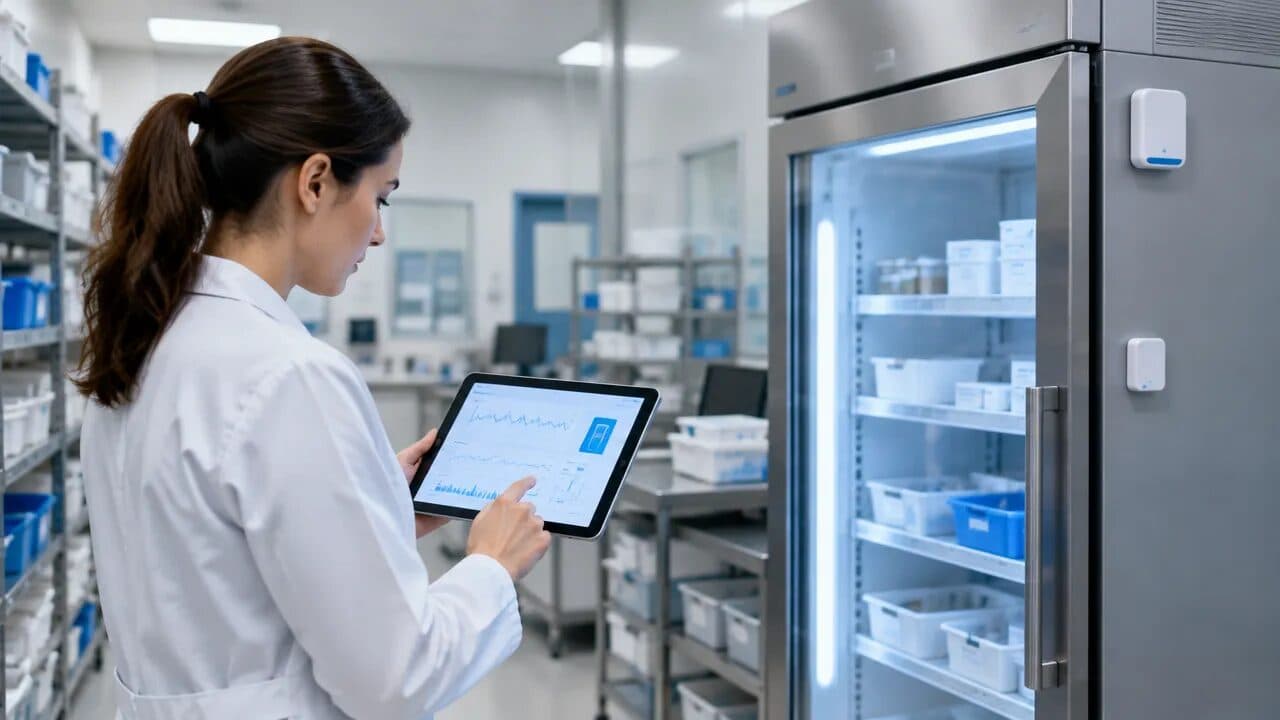
When the temperature of a medication refrigerator rises, the number shows the thermal condition, but it doesn't explain what happened. The door may have been left open during restocking, the load may have changed, or refrigeration may be losing performance. To separate these hypotheses, clinical engineering and maintenance need to analyze signals from the same asset together with its operational context.
Key insights emerge when signals are read together
- Temperature shows the thermal effect, while current and door status help interpret the event.
- Timestamps, collection frequency, calibration, and gaps determine whether the comparison is reliable.
- A correlation guides hypotheses and inspections, but doesn't prove the cause of failure.
- Load records, defrost cycles, and intervention logs help distinguish routine operation from persistent change.
Multimodal monitoring means relating complementary variables from the same equipment, not just displaying multiple curves side by side. Analysis gains value when it compares behavior against the operating regime in which the refrigerator or cold storage unit was functioning.
Temperature describes the effect, but doesn't identify its origin
A reading above range can result from different events. Door opening allows warmer air to enter; restocking products alters thermal load; slower recovery under comparable conditions may justify inspection of the refrigeration system.
Compressor current adds context, but its isolated value doesn't close a diagnosis either. A longer cycle may accompany higher load, an open door, or a change in performance. Door status and recent history help decide which hypothesis to verify first.
This distinction prevents treating each excursion as mechanical failure. It also prevents normalizing a persistent trend just because temperature hasn't yet exceeded an alarm threshold.
Consistent timestamps and data integrity make correlation actionable
Signals must share a reliable time reference. If the temperature sensor and current log use misaligned clocks, the team may attribute to one event a sequence that never occurred. There is no universal synchronization tolerance: the necessary precision depends on the speed of the dynamics observed and the decision the team intends to make.
Collection frequency must also match asset behavior. Sparse collection may miss a brief opening or the start of a change; increasing frequency without need may generate volume without improving decisions. Record gaps as gaps rather than filling them as if they were real measurements, and consider sensor position, calibration, and replacement history.
For vaccine storage, the CDC guide on storage and monitoring serves as a reference procedure for using digital temperature data loggers. In local operations, it's also worth applying regulatory requirements and the calibration plan defined for the service.
Operating regime changes the meaning of curves
A reading makes sense only when the team knows what was happening in the equipment. Door open, load restocking, and defrost cycles, when applicable, alter the expected thermal pattern. Therefore, intervention times, shift changes, and configuration updates must accompany sensor data.
| Observed variable | Required context | Hypothesis to investigate | Recommended verification |
|---|---|---|---|
| Temperature rises after opening | Time and duration of door open, restocking or removal of products | The variation may be a response to an operational activity | Check access log and monitor thermal recovery time |
| Temperature takes longer to recover | Load, ambient temperature, door routine and compressor regime comparable | A persistent change may indicate loss of performance | Inspect condenser, air circulation, sealing, and compressor cycle per technical procedure |
| Compressor current and temperature change together | Door status, load, defrost when applicable, and equipment history | The compressor may be operating longer due to higher thermal demand or a system change | Compare equivalent cycles and validate hypothesis with inspection and technical measurement |
| Door remains open and temperature begins to rise | Team activity and duration of opening | The event may result from use or inadequate closing condition | Confirm recorded activity and examine closure and sealing |
These examples are hypotheses, not guaranteed diagnoses or real case reports. Progressively slower thermal recovery deserves investigation when load, opening routine, and operating conditions are comparable over time.
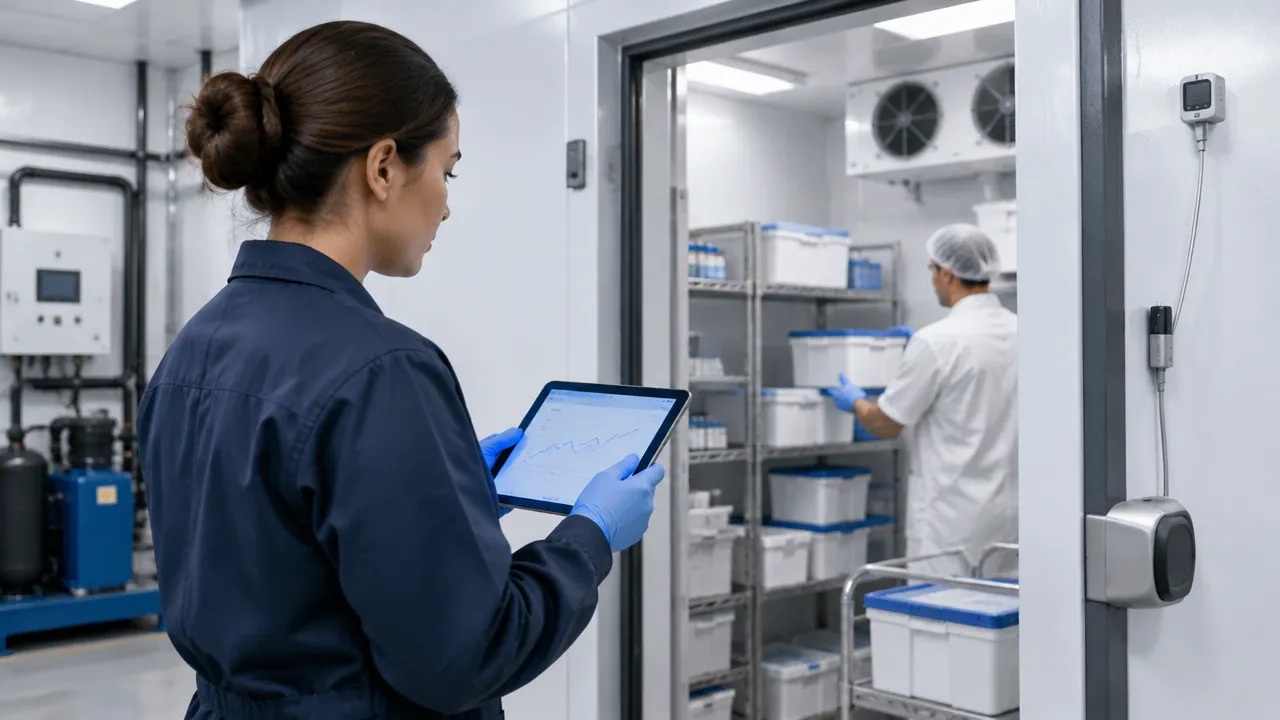
Sensors must measure variables from the same asset
In the DROME architecture, the STE Satellite Sensor measures temperature, the STH adds humidity, and the SDT monitors current and door status. The CTD Concentrator brings communication together and can integrate equipment via Modbus. For ultra-low freezers, the SUL uses a PT100 probe to measure temperatures down to -200°C.
These signals allow comparison of thermal response with electrical and operational events, provided the installation associates each reading with the correct asset. DROME Predict crosses more than 15 variables from the same equipment. According to information provided by DROME, the model was trained on 450,000 labeled real failures and issues alerts 30 to 60 minutes before failure, with cause and corrective action indicated.
This window is not a universal guarantee of advance notice. The alert should be treated as an indication for technical evaluation, considering data quality, failure mode, and conditions of that asset.
The alert guides inspection, and the team confirms the result
Correlation does not equal confirmation of cause. An alert may indicate a combination of signals consistent with a particular hypothesis, but it's up to maintenance to check the equipment and document what was found. After intervention, the team should monitor whether behavior returned to the expected pattern.
Recording restocking, load changes, defrost cycles, setpoint adjustments, and services performed improves interpretation of future events. Without this history, a routine activity may appear as an anomaly, or gradual deterioration may be confused with operational variation.
Use this checklist before putting alerts into routine
- Define priority failure modes for each refrigerator or cold storage unit.
- Choose the variables needed to investigate each mode, without measuring variables without clear purpose.
- Verify calibration, collection frequency, clock synchronization, and data continuity.
- Require the alert to present the signals and time interval that support the hypothesis.
- Determine who receives the alert and who handles response in each shift.
- Record inspection, intervention, and confirmation of result on the equipment.
Monitoring thresholds remains necessary to detect excursions. Anticipating failures requires adding operational context, comparing aligned signals, and confirming each hypothesis with technical inspection.
Frequently asked questions
What is multimodal asset monitoring?
Multimodal monitoring analyzes different signals from the same equipment and its operational context together. In a medication refrigerator, temperature, compressor current, and door status can help distinguish a recent opening from a persistent change in refrigeration performance. Correlation guides investigation, but doesn't alone confirm the cause.
What's the difference between gathering curves and correlating signals?
A dashboard gathers curves for consultation; correlation relates signals in time and considers the operating regime of the asset. This way, the team can evaluate whether temperature rise occurred after door opening or accompanied a prolonged compressor run cycle. The dashboard organizes data; analysis supports a decision.
Which signals can be combined in a medication refrigerator?
The combination depends on the failure mode you intend to investigate. In refrigerators and cold storage units, temperature, compressor current, and door status are useful examples, provided they're associated with the same equipment and consistent timestamps. Restocking, defrost, and intervention records help interpret changes without automatically treating them as failures.
Does correlation between sensors confirm the cause of a failure?
No. A correlation shows that signals varied together or in a sequence consistent with a particular hypothesis, but doesn't prove causality. The team must check context, inspect the equipment, and record the result. The alert directs investigation; technical confirmation depends on evidence and verification after intervention.
Read next
Pressure Deviations: How to Interpret in Critical Areas
Learn to interpret pressure deviations in critical environments, identify probable causes, and respond with greater speed, safety, and opera…
Multimodal Monitoring for Maintenance Decisions
Learn how to correlate temperature, current, and door opening data, align readings over time, and validate alerts to decide when to investig…

Prevent Sensor Corrosion in Saline Environments
Learn how to extend sensor lifespan in humid and saline areas through material selection, proper sealing, cleaning, and predictive monitorin…