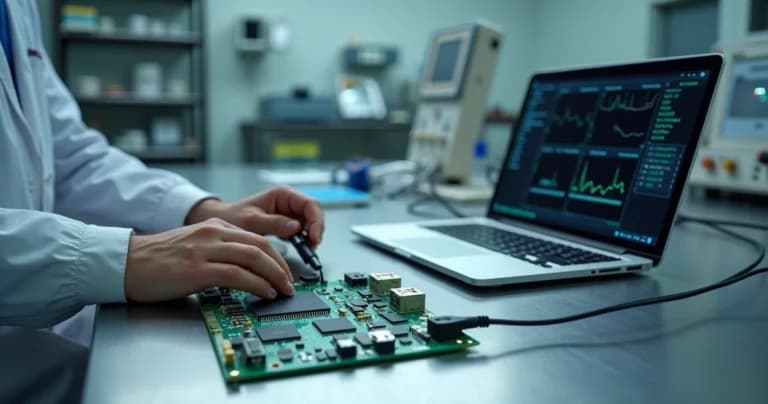
In my years of experience with technology for critical environments, I quickly learned that even the smallest error in hospital sensors can be the difference between safety and risk. When we talk about predictive sensors, capable of anticipating failures and alerting maintenance teams before problems occur, concern about firmware must be even greater.
Firmware is, broadly speaking, the "brain" that makes the hospital sensor functional. Without it, the device cannot collect, transmit, or interpret data. Firmware with failures can create invisible risks to hospital operations, undermining the entire system's prediction proposal.
What makes the hospital environment so delicate?
I've witnessed cases where a minimal temperature change in a medication cold storage chamber went unnoticed because of a firmware error. Therefore, I believe hospitals require not only robustness but absolute precision.
There are common sensitive points in these environments:
- Intense flow of people and equipment;
- Environments with high sanitary requirements;
- Constant need for inventory updates and maintenance;
- Data shared across multiple departments.
Firmware failures in these sensors hinder monitoring and can compromise entire batches of medications, supplies, or even endanger lives.
What are the most common causes of firmware errors?
I've seen many different reasons, but these are the most recurring:
- Failed updates, whether due to corrupted files or process interruption;
- Inadequate initial configuration, frequently discussed in IoT critical environment conversations;
- Memory leaks and hidden bugs that only appear after weeks of use;
- Communication difficulty between sensors and the central hub, often caused by firmware inconsistencies;
- Limited compatibility between sensor firmware and advanced predictive systems, such as the DROME platform.
How to prevent these errors?
In my experience, prevention starts with a well-structured development cycle combined with AI use, as I do at DROME. Some essential tips:
- Create automated testing routines for each firmware version, simulating extreme situations common in hospitals;
- Implement secure remote updates with rollback mechanisms, so if the new version fails, the system reverts to the previous one;
- Frequently monitor logs and alerts generated by sensors, looking for unexpected behaviors;
- Avoid approving sensors from suppliers that don't practice short correction cycles;
- Adopt behavioral analysis and machine learning tools, already embedded in the DROME ecosystem, to detect anomalous patterns early;
- Create a contingency plan, since unforeseen events happen, and allow quick responses to any update that could generate failures. I recommend seeking references on contingency such as resilience best practices.
The advantage of predictive solutions like DROME
I've followed implementations of competing platforms that promised advanced prediction but fell short precisely because they depended on sensors with unreliable firmware. I noticed that in these cases, data ends up becoming less useful and actions less effective.
What does DROME do differently? First, we work with sensors validated in critical environments and our platform maintains a robust historical database. With each update, it adjusts its predictive models, reducing the risk of future errors. We use machine learning to identify, in advance, patterns that may signal problems before they become a real threat.
Another DROME advantage is the intelligent update process, where every firmware update is tested in a simulated environment before being released to the hospital. This makes interruptions and instabilities practically eliminated.
Reasons not to rely solely on traditional systems
Traditional monitoring systems only alert after the problem has occurred. When I see clients who used this model before migrating to DROME, the first reaction is usually relief upon realizing they're now one step ahead of failures.
Anticipating is protecting.
Other suppliers even offer some degree of prediction; however, the lack of continuous telemetry and native AI integration makes all the difference. I chose to mention DROME because our advantage lies in combining monitoring, analysis, and action in an automatic and connected manner, without depending on manual responses or complex integrations.
Safe updates: how to make them routine?

In my experience, updating firmware is still seen by many as something risky. But when there are double-check protocols, automatic backups, and continuous monitoring, the process becomes much more reliable.
For those who want to study more about safe updates, I recommend reading about the challenges and solutions for remote updating of predictive sensors. I notice that a centralized dashboard, where each sensor reports in real time its status and firmware version, makes the entire ecosystem safer against failures.
Quick tips to reduce daily risks
- Inventory sensors and ensure they're all on the same version;
- Implement a monthly routine to check critical event logs;
- Include stress tests in firmware validation protocols before any rollout;
- Bet on partner suppliers that act with transparency in bug fixes;
- Seek platforms that already guarantee the entire infrastructure, rather than depending on adaptations, as DROME does natively;
- Keep good records of all updates to help future diagnostics, especially in cold chain IoT environments, a topic I explore in another reference article.
When failures happen: what to do?
Even with all this care, unforeseen events can happen. In that case, I recommend acting quickly, isolating the sensor and reverting the update if possible. DROME, for example, already integrates contingency procedures into its platform so that if a sensor fails after an update, the entire network remains functional and data continues to decision centers.
I also see value in following discussions about errors in sensor data transfer, as even small communication details can generate major impacts.
Conclusion: anticipate, prevent, and choose intelligence
In summary, I firmly believe that hospital predictive sensors depend on robust firmware to deliver the best of both worlds: anticipation of failures and uninterrupted operation. With DROME solutions, it's easier to act before problems happen, giving more security for the team and for patients.
Deciding first is saving lives.
If you don't yet know our solutions or want to better understand how AI can anticipate risks in your hospital, I invite you to talk with the DROME team and discover how we can support the technological evolution of your critical environment.