
Preventing false alarms caused by electrical fluctuation depends less on a single adjustment and more on a set of decisions: stable power supply, correct grounding, signal filtering, and well-configured alarm rules. This is especially important for hospitals, laboratories, pharmaceutical industries, and cold chain operations, where an unwarranted alert consumes time, reduces team confidence, and can mask a real event. In practice, the goal is not to silence the system, but to separate electrical noise from operational risk.
When the sensor is in a critical environment, each false trigger has a cost. It mobilizes personnel, interrupts routines, and creates the dangerous habit of dismissing alerts. That's why the most effective approach is to treat the entire chain, from hardware to analytical intelligence, as DROME does by combining continuous monitoring, telemetry, and models capable of recognizing anomalous patterns before failure.
Key points to reduce false positives
- Stabilize power supply: brief voltage variations can appear as real events to sensitive sensors.
- Review grounding and cabling: many triggers start with induced noise and poor connections, not the sensor itself.
- Use filtering, delay, and hysteresis: alarms need temporal context, not just a fixed threshold.
- Calibrate with real-world scenarios: good bench configuration can fail in the field.
- Analyze trends, not just instantaneous points: AI-powered platforms reduce useless alarms by recognizing persistent patterns.
The first step is accepting that not every trigger comes from the sensor
In most cases, the false alarm does not stem from pure sensor defect. It arises from the interaction between unstable electrical power, signal noise, and overly sensitive parameters. When the team treats everything as device failure, it wastes time replacing components that were working fine.
The most productive diagnosis starts with a simple question: does the reading change along with the electrical load in the environment? If yes, the problem may lie in compressor starts, motors, UPS systems, frequency inverters, or other loads that momentarily alter the grid. This affects temperature, pressure, current, and humidity sensors, especially when installation was done without adequate isolation.
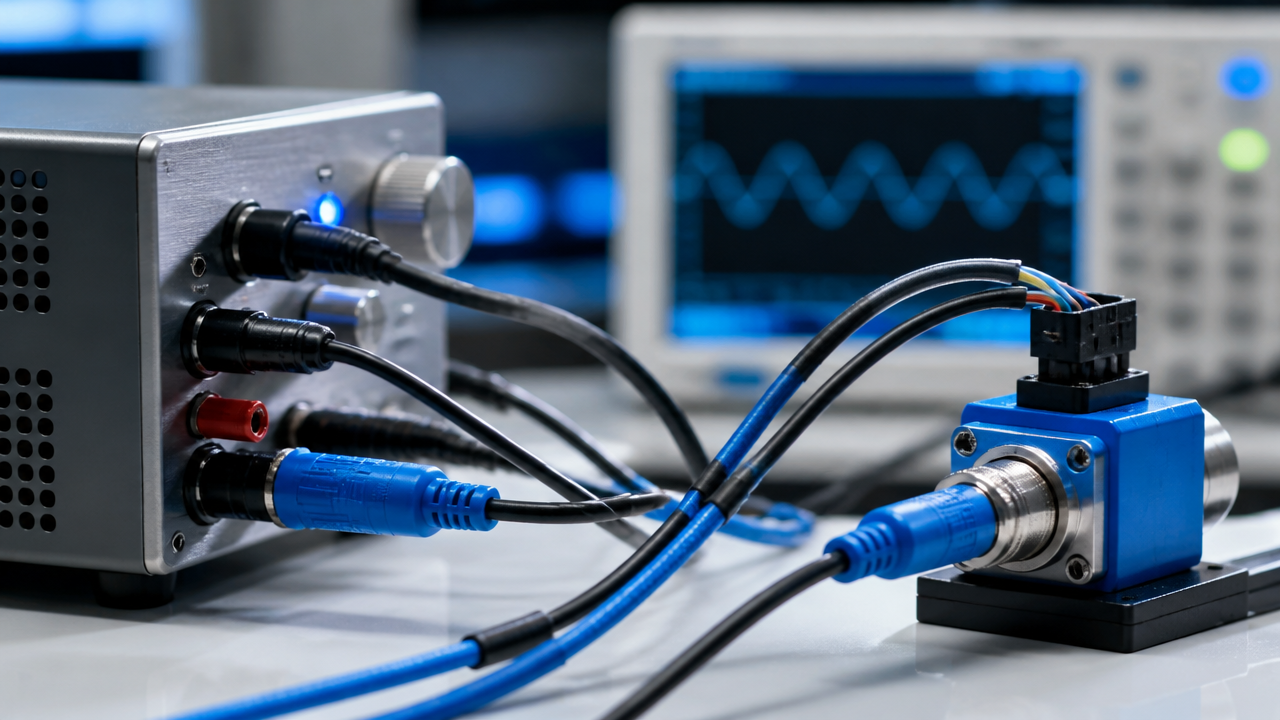
Electrical power must be stable before any recalibration
If power fluctuates, the sensor may deliver a reading that is valid from an electronic standpoint but misleading from an operational one. That's why stabilizing power often yields better results than immediately adjusting alarm thresholds. Recalibrating on a noisy network only hides the root cause.
Classic signs are erratic readings at specific times, triggers after equipment starts, and instability affecting multiple points simultaneously. In these cases, it's worth reviewing the electrical architecture and observing:
- undersized or oscillating power sources;
- sharing the same power supply with noisy loads;
- lack of surge protection;
- loose or corroded joints, connectors, and splices;
- signal cables running alongside power cables.
In critical environments, separating power supplies, improving grounding, and reorganizing cable routing reduces the chance of the system interpreting a brief disturbance as a real deviation. This care is basic, yet it remains one of the most underestimated causes of false alarms.
Why do grounding and electromagnetic noise make sensors trigger on their own?
Because the sensor reads not just the process variable. It also senses the electrical environment around it. When grounding is poor, ground loops exist, or electromagnetic interference is present, the signal can oscillate enough to cross the alarm threshold even without relevant physical change.
This occurs frequently in installations with motors, control panels, cold rooms, biomedical equipment, and automated lines. The practical effect is treacherous: the value seems plausible, but appears with sudden microvariations, without coherence with expected thermal, mechanical, or environmental behavior.
To reduce this risk, three measures typically resolve most cases:
- use properly executed equipotential grounding;
- physically separate power cables from instrumentation cables;
- adopt shielding and termination correct for the signal type.
When these measures are ignored, the software receives technically possible but operationally false data. This is where the system needs additional intelligence to distinguish noise from real trends.
Filtering and hysteresis reduce noise without blinding the system
The secret is not to make the alarm less sensitive, but less impulsive. Alarms based only on fixed thresholds react to any brief oscillation. Alarms with temporal filtering and hysteresis require consistency before triggering and avoid the chatter effect when values hover near the threshold.
In practice, it's worth combining four layers of logical protection:
| Feature | What it does | When it helps most |
|---|---|---|
| Moving average filter | Smooths very short spikes | High-frequency noise |
| Trigger delay | Requires persistence outside range | Brief grid oscillations |
| Hysteresis | Sets difference between activation and reset | Signals near threshold |
| Trend window | Compares evolution over time | Processes with inertia, like cooling |
These adjustments must respect the process. A medication refrigerator, for example, has different dynamics than a compressor, incubator, or electrical panel. The best parameter is always the one that reduces noise without delaying detection of a truly dangerous deviation.

How to calibrate without masking a real problem
Good calibration means bringing the system closer to the actual behavior of the asset, not away from the inconvenience. When the team raises the threshold too much or extends the delay excessively to stop false triggers, it can turn a useful alarm into a late one. This is the most common mistake.
A safe calibration routine follows this order:
- validate the sensor against a reliable reference;
- measure power supply and signal stability;
- map when or under which loads noise appears;
- adjust hysteresis and delay incrementally;
- test behavior under normal and simulated critical conditions.
This process reveals whether the origin is metrological, electrical, or logical. In operations with many monitored points, doing this manually for each sensor is slow. That's why solutions like DROME's platform gain relevance by analyzing history, correlating events, and identifying patterns that precede failures, even when electrical noise still seems random to human inspection.
AI-powered monitoring helps distinguish noise from operational risk
The biggest leap occurs when the system stops reacting only to instantaneous values. With consolidated history, analysis begins to recognize context: time of day, load, equipment behavior, rate of change, and anomaly recurrence. This reduces false positives without sacrificing sensitivity to relevant events.
Instead of treating every oscillation as a threat, AI can classify events by pattern, duration, and likely impact. A millisecond spike after motor startup does not receive the same weight as a persistent heating trend with closed door and altered consumption. This contextual reading improves prioritization and preserves confidence in the alarm.
For critical environments, the benefit is direct:
- fewer unnecessary activations;
- more team focus on real deviations;
- faster response to important events;
- continuous learning as new data enters the database.
This is the point where monitoring stops being mere observation and starts supporting operational decision-making. When properly implemented, the alarm returns to its role: drawing attention to what truly matters.
Frequently asked questions
What is a false alarm in sensors?
A false alarm is a trigger without actual occurrence of risk. In sensors, this usually happens when electrical noise, voltage spikes, poor grounding, inadequate calibration, or overly sensitive thresholds cause the system to interpret normal oscillation as a critical event. The effect is loss of operational confidence and team fatigue.
Why does a sensor trigger on its own?
A sensor can trigger on its own when it receives unstable power, suffers electromagnetic interference, is poorly calibrated, or operates with insufficient hysteresis. There are also cases of corroded connectors, poor grounding, and installation near motors, inverters, or UPS systems, which introduce noise into the reading and cause false activations.
How do you test a sensor to confirm if the problem is electrical?
To test a sensor, compare the reading with a reliable standard, observe behavior over time, and check if the value changes when electrical load varies. It's also worth measuring voltage, inspecting connectors, reviewing grounding, and simulating normal and critical conditions to validate delay, threshold, and alarm reset.
How does a sensor-based alarm work?
The alarm depends on three steps: capture the signal, interpret the reading, and decide if it exceeded a configured criterion. When the system uses filtering, delay, hysteresis, and operational context, it reduces false triggers. When it uses only a fixed threshold, it tends to overreact to brief oscillations.
Which sensors suffer most from electrical fluctuation?
The most common in critical environments are temperature, humidity, pressure, current, vibration, and door opening sensors. Each type responds differently to noise, grounding, and power quality. That's why the prevention strategy must combine correct installation, appropriate parameterization, and continuous history analysis.
Read next

LoRa Temperature Monitoring in Critical Areas
Learn how LoRa connects temperature sensors, reduces coverage and battery concerns, and how to validate alerts, records, and connectivity in…

Predictive Maintenance: From Signals to Operational Decisions
Learn how to transform temperature, current, pressure, and operational context into maintenance decisions before failure occurs, with alerts…

Prevent Sensor Corrosion in Saline Environments
Learn how to extend sensor lifespan in humid and saline areas through material selection, proper sealing, cleaning, and predictive monitorin…