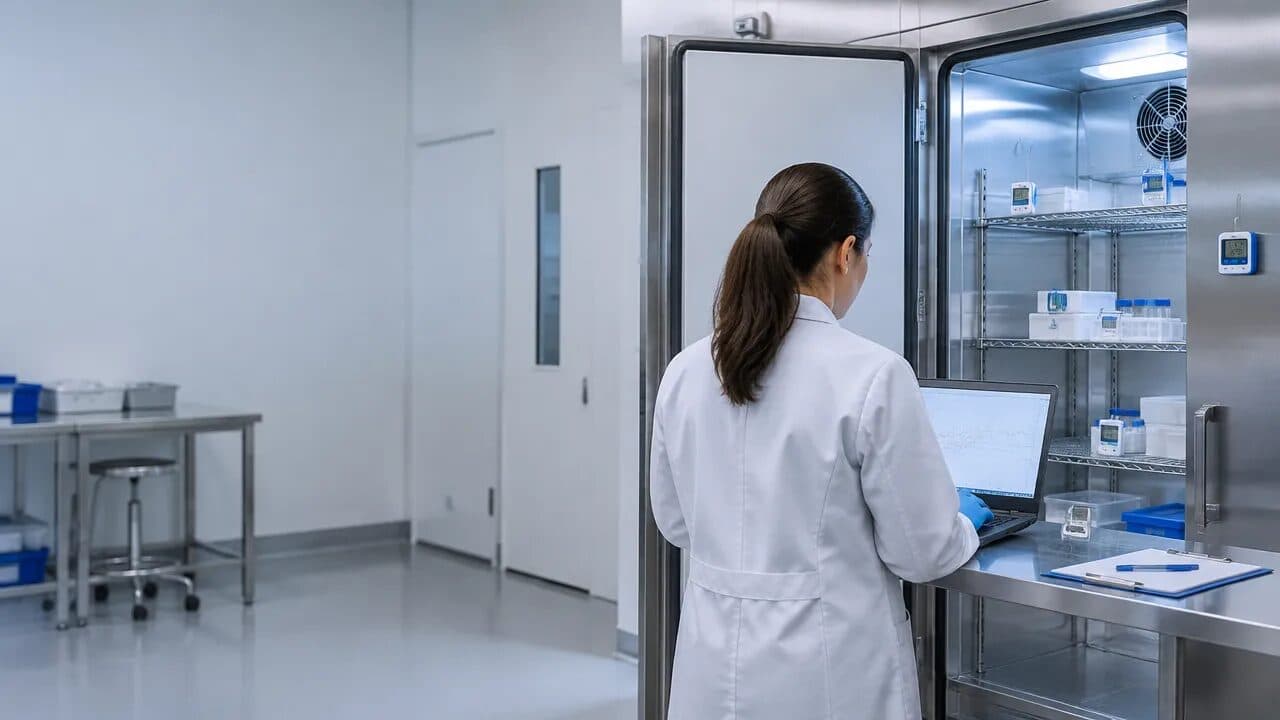
A cold room may display a temperature within range yet maintain a warmer zone near the door or air return. Thermal qualification verifies, through a documented study, how equipment or an environment behaves at the points and conditions that matter for actual use. To plan effectively, define the scope, load, instruments, test conditions, and acceptance criteria before beginning measurements.
What Matters in Study Planning
- Define the intended use, operating range, and risk associated with the product or process.
- Select measurement points based on geometry, air circulation, and historical data.
- Use calibrated, identified instruments appropriate for the temperature range being studied.
- Test conditions representative of routine operations, including load, door openings, and equipment cycles where applicable.
- Document criteria, deviations, and decisions in a protocol approved before execution.
Qualification Describes Performance in Intended Use
Thermal qualification is documented evidence that equipment or an area meets the requirements defined for its purpose. The study is not limited to confirming that the display shows the set temperature: it examines thermal distribution and stability at relevant points over time and under specified conditions.
This shifts the central question. Instead of asking only whether the chamber reached 5 °C, for example, the protocol verifies whether storage locations remain within the established range during normal cycles, with the planned load configuration and in the face of relevant disturbances.
Qualification also does not replace process validation. An autoclave may show acceptable thermal distribution, but evidence that a cycle sterilizes a specific load requires evaluating the process and its parameters according to intended use and applicable requirements.
Calibration and Qualification Answer Different Questions
Calibration characterizes the relationship between an instrument's indication and a reference standard within defined conditions. Qualification uses reliable measurements to assess the performance of equipment or an environment as a whole.
| Activity | What It Evaluates | Example of Evidence |
|---|---|---|
| Calibration | The metrological performance of a sensor or thermometer. | Certificate with results, uncertainty, and traceability. |
| Qualification | Whether the thermal system meets intended use and defined criteria. | Protocol, measurement positions, data, analysis, and conclusion. |
A calibration certificate does not prove that a refrigerator maintains uniform temperature. Similarly, a mapping report does not correct an instrument without proper calibration. The plan requires both pieces of evidence, each answering its own question.
The Protocol Must Emerge from Risk and Actual Use
A useful study begins before data loggers are installed. The protocol must state what will be qualified, why that system is critical, which conditions will be tested, and how the team will decide if the result is acceptable.
Document the equipment, location, operating range, alarm limits, product or process type, load configuration, and relevant environmental conditions. Also include instrument identification, calibration certificates, logging interval, expected duration, responsible parties, and deviation handling.
Risk assessment helps determine where to concentrate measurements. A narrow chamber with a frequently used door may require special attention to air entry and nearby shelves; an ultra-low freezer may require sensors and cables compatible with very low temperatures.
For pharmaceutical distribution, storage, and transport operations, RDC 430 from ANVISA is a pertinent regulatory reference. Specific scope and obligations depend on the activity, product, and other applicable standards, so the protocol must be reviewed by quality and regulatory affairs.
IQ, OQ, and PQ Organize Evidence, But Are Not a Recipe
IQ, OQ, and PQ are stages that organize proof of installation, operation, and performance. They help structure documentation but do not by themselves determine how many sensors to install, how long to measure, or which limits to accept.
- Installation Qualification: confirms that equipment, components, infrastructure, and documentation match the approved design.
- Operational Qualification: verifies that controls, alarms, and functions act under defined conditions, including planned test scenarios.
- Performance Qualification: evaluates whether the system meets requirements under representative use and load conditions.
The plan may apply these stages proportionally to risk and complexity. It is not advisable to transform the acronyms into a bureaucratic checklist: the important thing is to demonstrate that the system was installed correctly, operates as intended, and delivers adequate performance in the defined use.
Sensor Distribution Must Reveal Thermal Gradients
Sensor position determines what the study can observe. A uniform grid may be a starting point, but it is insufficient if obstacles, air circulation, heat sources, doors, and refrigeration components are ignored.
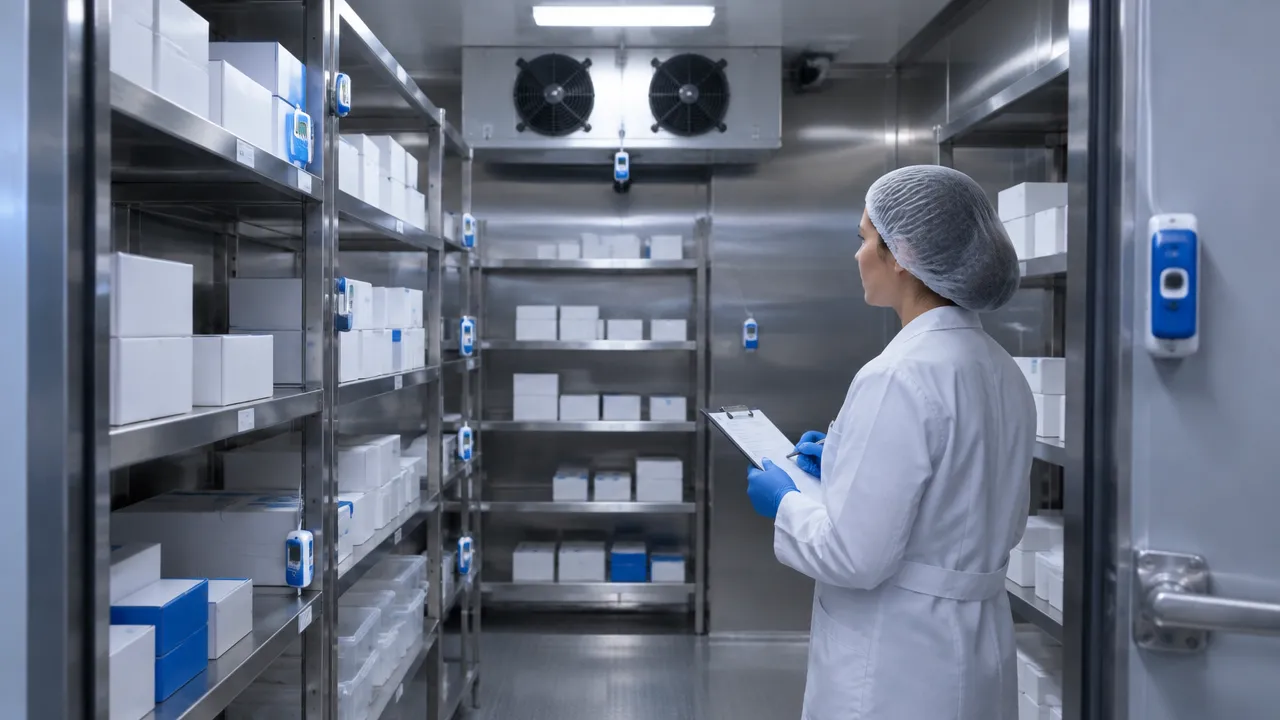
In a chamber, evaluate different heights and regions, including proximity to the door, corners, shelves, air supply, and return air, always according to geometry and risk. Avoid placing the probe against surfaces or directly in front of an air outlet unless the test objective requires that condition.
The protocol must justify the number and location of points. There is no universal count that applies to any volume: a small, simple piece of equipment does not present the same flow pattern as a large room, vehicle, or system with multiple zones.
When temporal variation is suspected, include sufficient measurements to observe compressor cycles, defrost, door opening, and recovery. To evaluate the method and measurement points in pharmaceutical storage areas, WHO guidance on storage and transport of temperature-sensitive products offers complementary technical context.
Load and Test Conditions Must Represent Routine Operations
An empty piece of equipment does not necessarily behave the same as the same equipment with stored products. Load alters air circulation and thermal inertia; therefore, the study must explain whether it measured without load, with representative load, or under both conditions and what question each test answers.
Document load arrangement, free space around it, controller adjustments, access frequency, and relevant external conditions. If a medication refrigerator undergoes intensive inventory or restocking at predictable times, it is worth evaluating how these operations affect temperature and recovery time.
Do not impose a standard duration without considering system dynamics. The study should cover sufficient cycles to observe expected behavior and critical conditions defined in the protocol, without confusing a long collection with a necessarily representative test.
In refrigerated vehicles, load configuration, route, stops, door openings, and environmental conditions affect performance. Qualification should reflect the routes and manner of operation the team actually intends to use, rather than relying solely on a test conducted stationary in the yard.
Appropriate Instruments Protect Result Interpretation
An analyzer or data logger must cover the temperature range, have resolution and accuracy compatible with acceptance limits, and present traceable calibration. It is also necessary to verify measurement uncertainty: a result very close to the limit may not support a simple conformance conclusion.
Before data collection, verify identification, calibration status, time configuration, logging interval, and memory function. Plan probe fixation and cable routing so they do not alter door closure, air circulation, or normal equipment operation.
After collection, preserve original files and link each channel to the corresponding instrument and physical position. A spreadsheet with temperatures lacking sensor identification, times, and test conditions makes it difficult to reconstruct the study during an audit or deviation investigation.
In sterilization equipment, select probes and accessories compatible with the cycle and load. Temperature measurement helps characterize the thermal profile; it does not replace other elements required to demonstrate that the sterilization process is effective.
Autoclaves, Ovens, Refrigerators, and Environments Require Distinct Questions
The method must match the thermal mechanism of the system. Copying the same sensor arrangement for all equipment reduces study value because each application has its own sources of variation and risks.
In autoclaves and ovens, define whether the focus is distribution in the chamber, penetration into the load, or both. Load arrangement, selected cycle, and operating conditions must be included in the protocol, as well as the distinction between thermal qualification and process validation.
In medication refrigerators, evaluate usable space and zones where products actually remain. Do not rely solely on the controller display as evidence of temperature across all shelves; sensors at representative positions help locate gradients and points with slower recovery.
In rooms and controlled environments, consider volume, occupancy, door openings, solar incidence, and air distribution. An environmental study may require points in work and storage zones, not just near the climate control system sensor.
For chambers, refrigerators, controlled areas, and transport, regulatory requirements vary according to use and sector. Content on ANVISA requirements for pharmaceuticals should be read together with the specific standard applicable to the process, without assuming that a single resolution covers all scenarios.
Analysis Must Separate Deviation, Trend, and Uncertainty
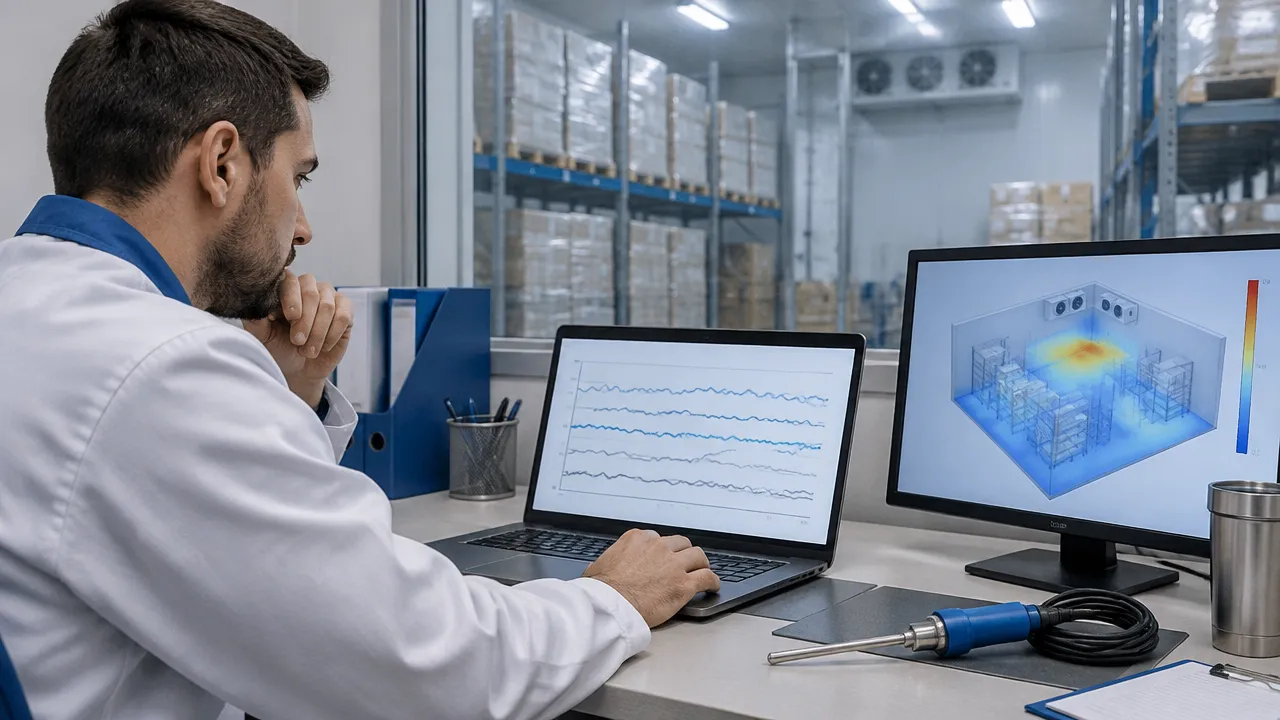
The report must show where and when the system departed from criteria, not just present an overall average. An acceptable average may hide a persistent hot spot or a brief excursion that compromises intended use.
Compare channels with each other and against recorded conditions. Investigate atypical readings before discarding them: they may indicate positioning error, sensor failure, or actual equipment behavior. Every exclusion or correction must have traceable justification.
Beyond minimum and maximum, analyze spatial distribution, stability over time, excursion frequency, and recovery after tested events. When the result approaches the limit, consider instrument uncertainty and the decision rule defined beforehand.
The report must conclude which conditions were approved, which fell outside criteria, and what actions the team took. If there are limitations, such as incomplete load or an unrepresented environmental condition, record them; the conclusion should not promise more than the study measured.
Requalify When a Change Could Alter Performance
Study repetition should respond to risk and change, not just the calendar. A defined frequency may be part of the quality system, but it is also necessary to evaluate events that alter installation, load, or thermal behavior.
Revisit qualification after relevant changes to location, controller, refrigeration system, shelf configuration, load pattern, or operation. A recurring excursion, maintenance with thermal impact, or a worsening trend may also justify early evaluation.
Between complete studies, routine monitoring helps detect deviations and verify that performance remains compatible with what was qualified. It does not replace the study: each activity has its own frequency, purpose, and evidence.
Continuous Monitoring Tracks the System After the Study
Qualification establishes evidence under defined conditions; continuous monitoring tracks behavior between studies and during routine operations. Separating these functions prevents treating an alarm as a qualification certificate or a point-in-time report as a guarantee of future performance.
At DROME, we use the STE Satellite Sensor to measure temperature and the SUL with PT100 probe in low-temperature applications, according to the selected range and configuration. The CTD Concentrator transmits data to the platform, while history and alerts help the team identify excursions and changes in equipment patterns.
This monitoring can complement management after qualification but does not replace an approved protocol, instruments appropriate for the study, or technical analysis of results. For an ultra-low freezer, for example, the team still needs to confirm that the probe, measurement arrangement, and criteria cover the specified use condition.
The most defensible plan is one that explicitly states what was measured, under which conditions, and with what limits. Start with the risk and routine of the equipment; then choose sensors and duration that answer those questions.
Read next
7 Environmental Risk Signs in Pharmaceutical Storage
Learn to recognize the 7 signs of environmental degradation in pharmaceutical storage and see how to prevent losses with predictive monitori…

Seven Environmental Parameters Overlooked in Drug Storage
Discover which critical environmental parameters are neglected in pharmaceutical storage and how this impacts product integrity.

Controlled Supplies Tracking: 2026 Regulatory Challenges
Intelligent tracking of controlled supplies for 2026: regulatory compliance and secure management in critical environments.