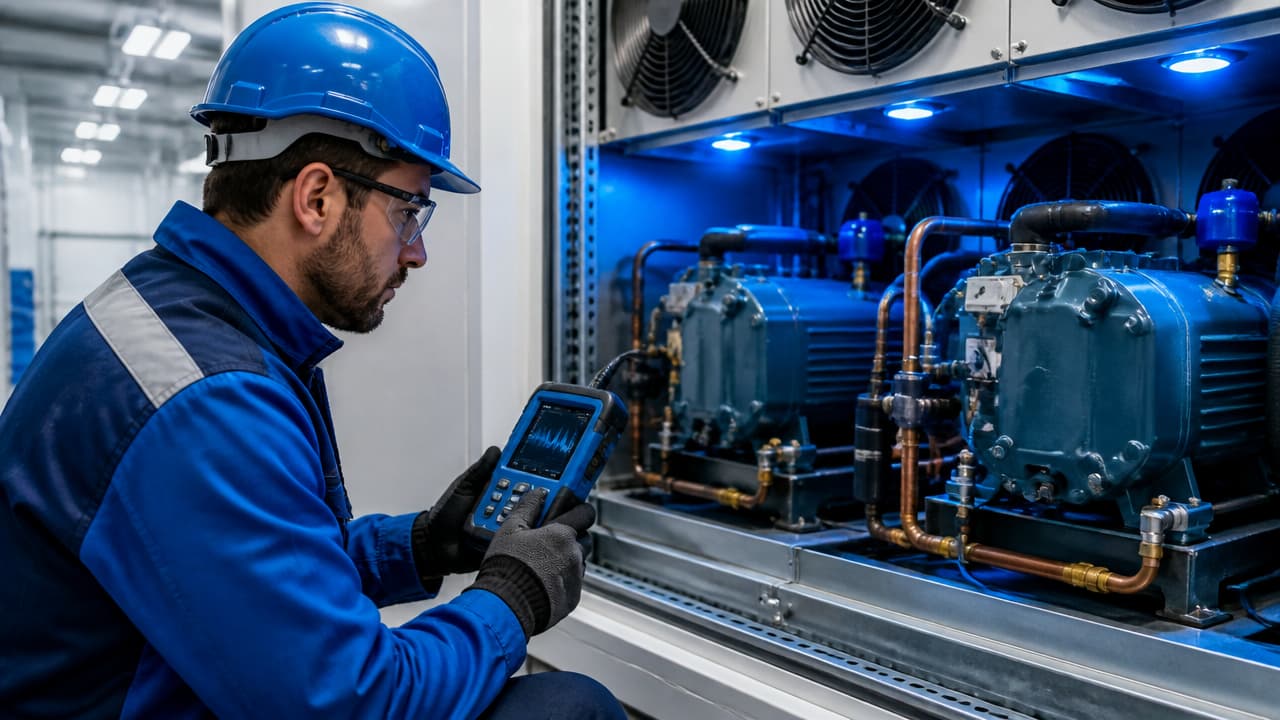
Vibration indicators function as an early warning signal of mechanical deterioration in refrigeration systems. For maintenance managers, clinical engineering, facilities, and industrial operations teams, this means gaining time to act before temperature drifts out of range, the compressor stops, or thermal load is compromised. In critical environments, the right reading serves not just to repair faster, but to prevent loss of supplies, operational downtime, and clinical risk.
In practice, vibration should not be analyzed in isolation. When combined with temperature, current, operating cycles, and asset history, maintenance shifts from reactive to probabilistic failure prediction. This is precisely where platforms like DROME create value, transforming continuous telemetry into operational prioritization.
Highlights that make the difference
- Vibration variations typically appear before critical temperature increases.
- Trend over time is more valuable than a single measurement.
- Frequency spectrum helps distinguish imbalance, misalignment, looseness, and bearing wear.
- Combining vibration with thermal variables reduces false positives and improves triage.
- AI applied to asset history increases the ability to detect subtle anomalies.
Why vibration reveals failures before refrigeration loss
Vibration anticipates failures because most mechanical defects begin long before functional collapse. A bearing starts to degrade, a shaft loses alignment, or a fan accumulates imbalance, and the equipment continues to refrigerate for some time. During this interval, the vibration pattern has already changed, even when process temperature still appears normal.
This is especially important in cold rooms, pharmaceutical refrigerators, laboratory freezers, chillers, and continuously operating condensers. The equipment may maintain the thermal range for hours or days while consuming more energy, working under strain, and accelerating internal wear. Those monitoring only temperature detect the problem late. Those monitoring vibration and trend gain a much more useful window for action.
What signals indicate imbalance, misalignment, or wear
The best indicators are those that relate intensity, frequency, and signal evolution. A global increase in vibration may point to deterioration, but diagnosis improves significantly when the team observes at what frequency the energy appears and how this changes over weeks.
| Signal observed | Probable interpretation | Operational impact |
|---|---|---|
| Gradual and continuous increase | Progressive wear | Risk of failure in medium term |
| Peak at rotation-linked frequency | Imbalance | Extra strain and efficiency loss |
| Multiple harmonics | Misalignment or looseness | Accelerated damage to couplings and bearings |
| High-frequency impulses | Early bearing failure | Sudden breakdown if not addressed |
| Unstable signal by load regime | Intermittent problem or resonance | More complex diagnosis, requires context |
In refrigeration, these signals typically appear in compressors, motors, evaporator and condenser fans. The most common mistake is treating any alarm as urgent. The correct approach is to classify the pattern, confirm the trend, and cross-reference with thermal condition, electrical current, and operating regime.
What parameters are used in vibration analysis?
The most useful parameters are velocity, acceleration, displacement, and frequency spectrum. In refrigeration systems, however, practical value comes from combining these indicators with operational context, not from an isolated absolute number.
Acceleration typically captures rapid events and incipient bearing defects better. Velocity is widely used to assess overall severity. Displacement can be relevant in low-speed machines or when structural movement is of interest. Spectrum helps link the symptom to a probable cause.
- Velocity: useful for overall vibration severity.
- Acceleration: sensitive to initial defects and impacts.
- Displacement: relevant for larger movements.
- Spectrum: separates signal by frequency to support diagnosis.
- Historical trend: shows whether the anomaly is isolated or progressive.
When DROME integrates this data with continuous telemetry, the gain is not just in the reading. It lies in the ability to recognize when an asset's pattern deviates from its own expected behavior—something essential in similar assets with different thermal loads and routines.
What technique is used to measure vibration?
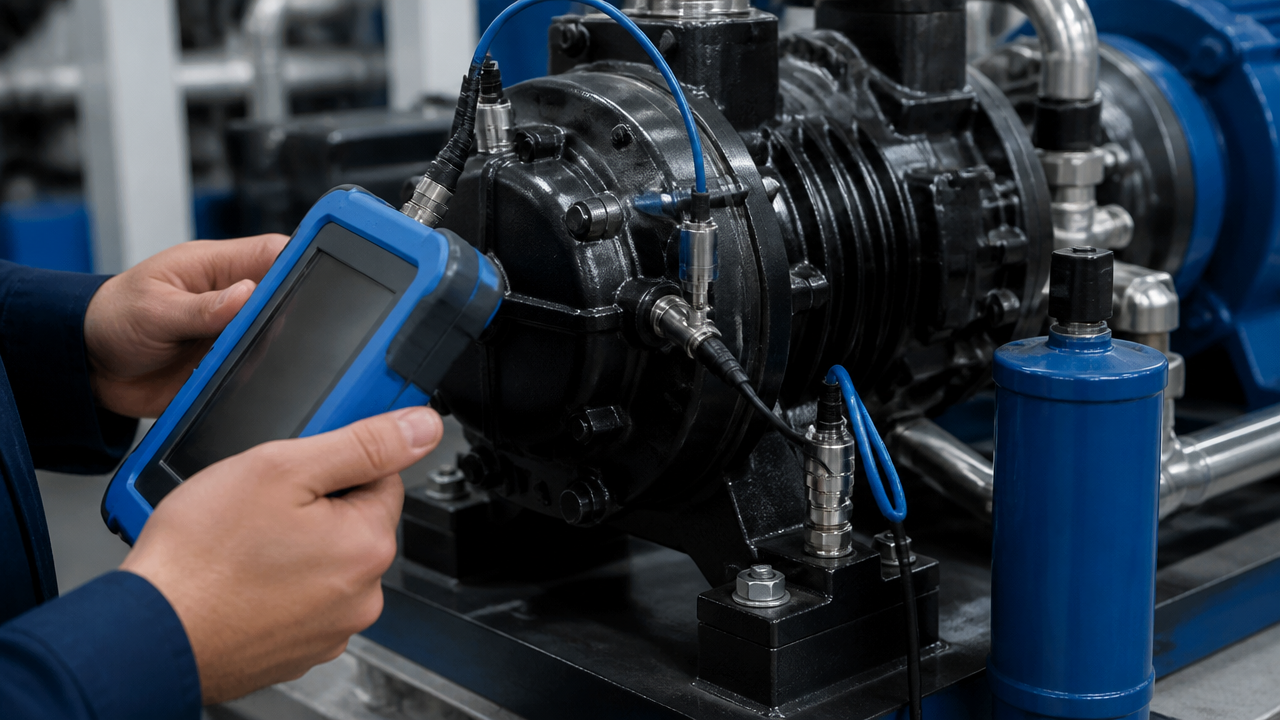
The most effective technique for prevention is to measure vibration near the mechanical source with sufficient frequency to capture evolution. In critical assets, this favors fixed, connected sensors positioned at consistent collection points, such as bearings, compressor housings, and motor structure.
Portable measurements still have value in inspection routes, but may miss intermittent events. Continuous monitoring detects small changes between cycles, including during times when the team is not present. In high-impact refrigeration, this difference is decisive.
A mature implementation typically follows this logic:
- define which assets carry the highest operational risk;
- establish baseline by equipment type;
- standardize measurement points;
- correlate vibration with temperature, current, and alarms;
- create criticality and response criteria.
What is vibration spectrum analysis?
Spectrum analysis transforms a complex signal into frequency components, making the defect more readable. Instead of knowing only that vibration increased, the team can see in what range the phenomenon occurs and which mechanism makes most sense.
This reduces unnecessary replacements and improves intervention planning. Imbalance tends to produce different behavior than bearing failure, and structural looseness generates a signature distinct from misalignment. The earlier this differentiation happens, the lower the chance of stopping a useful piece of equipment based on wrong suspicion.
For operations with many assets, AI helps scale this reading. DROME's platform can prioritize abnormal patterns that deserve human attention first, preventing maintenance teams from spending time on deviations with no real impact.

How to cross vibration, temperature, and telemetry to predict failures
The best prediction comes from correlation between signals, not from an isolated sensor. When vibration rises at the same time current increases, work cycle lengthens, or thermal instability appears, the hypothesis of mechanical degradation becomes stronger.
This cross-reference also improves prioritization. A compressor with vibration above baseline but no thermal impact can enter scheduled maintenance. An asset with vibration deviation, temperature oscillation, and recurring alarms deserves immediate action. This logic protects resources and reduces unnecessary intervention.
In critical environments, this approach is more valuable than generic alarms. DROME operates at precisely this level, using operational history to transform multiple signals into practical recommendations, focused on anticipating risk before failure affects product, process, or patient.
How to implement vibration monitoring without generating operational noise
Implementation works best when it starts with the right assets and clear response criteria. Trying to monitor everything with the same rule creates alarm overload and little learning. The most efficient path is to prioritize equipment whose failure compromises cold chain, clinical continuity, or compliance.
Some good practices reduce noise from the start:
- segment assets by criticality and usage regime;
- set initial limits by equipment family and refine them with history;
- use trend and deviation persistence, not just instantaneous triggers;
- record root cause after each intervention to train the model;
- integrate maintenance, operations, and quality in alert interpretation.
When this process matures, vibration stops being just a technical data point and becomes a decision indicator. The result is fewer surprises, lower risk of thermal loss, and maintenance more aligned with the asset's real impact.
Frequently asked questions
What is vibration monitoring?
Vibration analysis tracks amplitude, frequency, and motion pattern of compressors, fans, and motors. When these signals deviate from baseline, the team can detect wear, misalignment, looseness, or imbalance before visible breakdown.
What parameters are used in vibration analysis?
The most useful parameters are typically velocity, acceleration, and displacement, plus frequency spectrum, crest factor, and trend over time. In refrigeration, isolated value matters less than persistent change from the equipment's normal behavior.
What technique is used to measure vibration?
The most common technique uses fixed or portable accelerometers installed near bearings, housings, and motors. In continuous operation, sensors connected to telemetry are more useful because they track trend, correlation with temperature, and risk evolution without relying only on spot inspections.
What is vibration spectrum analysis?
Vibration spectrum separates the signal by frequencies and helps identify the probable source of the anomaly. Peaks in specific ranges may suggest imbalance, misalignment, mechanical looseness, bearing wear, or resonance, making diagnosis more precise than observing only a global value.
What is a temperature and vibration sensor?
A combined sensor allows relating mechanical strain and thermal condition on the same asset. In refrigeration systems, this helps differentiate motor failure, flow obstruction, lubrication problem, or overload, improving maintenance prioritization.